


Face-to-face socialising between young people in the US has declined by 30-40% since 2000, and partying seems to have been deprioritised, as it too is down 70%. Life satisfaction has dropped off a cliff while anxiety and depression have shot up.
Derek Thompson calls this the ‘anti-social century’.
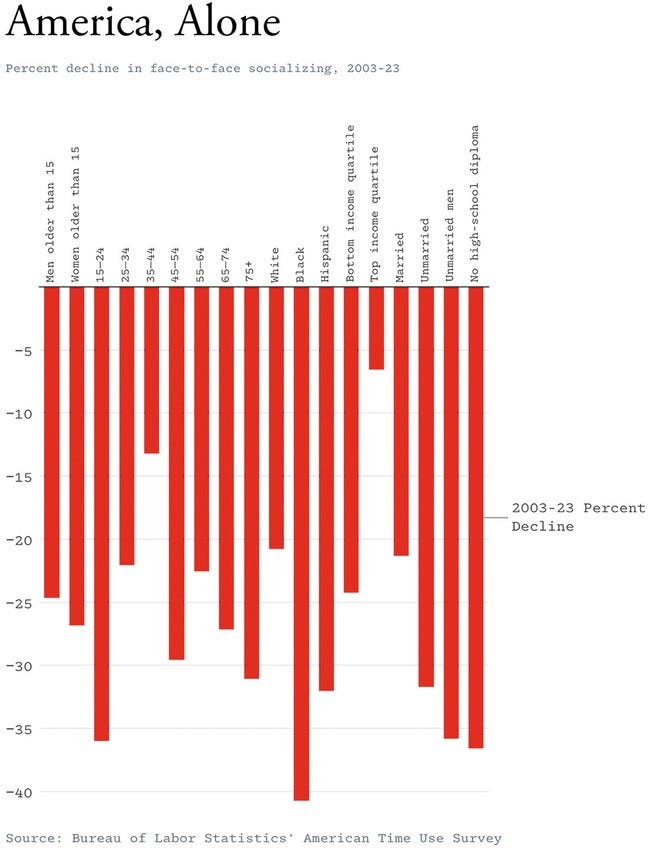
Thompson reckons Americans now spend an additional 99 minutes at home each day compared to 2003. Kids and teens are looking at screens for between 270-380 minutes a day1, and young people who once met friends almost daily, now do this 50% less often.
He goes on to explain how Character.AI has millions of users who spend an average of 93 minutes a day engaging with their AI companions. These are alarming stats and don’t forget, these only cover the US. Japan is likely worse than the US, and India seems to have similar issues. In fact, the World Health Organisation (WHO) has also declared loneliness and isolation to be a pressing, albeit underappreciated global health threat. They even issued a report which finds that strong social connection is linked to improved health and reduced risk of early death.
At this point you might think I’m about to argue that watch collecting has fallen victim to these same forces, or that Instagram has turned appreciation into a performative activity, or that online forums have replaced intimate gatherings, or that we’re all broadcasting our wrist shots to thousands but really, we are connecting with no one... but if that’s what you thought, you’re wrong.
In fact, I think the opposite is mostly true. I’m going to argue that watch collecting might be one of the few remaining antidotes we have to this “anti-social century” we find ourselves in. I think there’s something about physical objects, shared spaces, and the ritual of gathering which actually makes our hobby uniquely positioned to fight back against this isolation-epidemic.
Estimated reading time: ~17 minutes
What’s the problem?
Thompson’s thesis is based on a purported shift in how humans interact, and in particular, that broadcasting has replaced conversation. Research shows that online communication is actually materially different from face-to-face interaction and they highlight three critical differences: it skews negative (negative posts get more engagement), it amplifies in-group versus out-group dynamics (tribalism etc), and it rewards high-arousal emotions like outrage over more ‘civil’ reflections.
When you’re at a party, you can’t be consistently negative without people eventually viewing you as an insufferable pr1ck. You are forced to read body language or notice when someone’s bored, and then social norms will dictate that you adjust your behaviour accordingly. Online, you’re basically just “performing” to hundreds, thousands, or even millions of people. The focus then shifts from “the other person” to… yourself. As a result, most of this “broadcast” style communication ends up becoming pretty narcissistic2.
Thompson observes that we’ve created a virtual world where negativity and outrage clearly thrive, even though face-to-face interactions demand understanding, reciprocity, and compromise. The typical American man now spends seven hours watching TV for every hour spent hanging out with someone outside his home. The typical female pet owner spends more time actively engaged with her pet than in face-to-face contact with friends.
The consequences of this BS extend beyond individual unhappiness; and in his book “The Vanishing Neighbor” Marc Dunkelman points to the erosion of “the village” i.e. familiar (but not intimate) relationships with neighbours and community members. Remember that old saying “it takes a village to raise a child?” Well, his point is that families teach us love, tribes teach us loyalty, and the village teaches us tolerance.
When arguing online, you might write off someone who disagrees with you; but in a village setting filled with your neighbours, you will bite your tongue, try to find common ground, and learn how to accommodate opposing views with respect and more importantly, without framing everything as an attack or a defense.
“…the watch is just the excuse, and the conversation is the ‘product’.”
Thompson also talks about AI as potentially creating an “engine for the mass production of narcissism at scale” which is an interesting way to frame things. It’s true, AI does excel at validation; it has no problem telling you that your problems matter, your thoughts have value, and that your feelings aren’t stupid (even when they are). AI can deliver cognitive behavioural therapy scripts quite effectively, and these capabilities are actually therapeutic for many people - as proven by the public outrage when OpenAI decided to make GPT-5 the default model with no option to select GPT-4o.
The difference is that a great therapist isn’t (just) a professional “validator” as such; they also need to tell you when your thinking is disordered, when you’re asking the wrong questions, or quite frankly, when you’re fvcking wrong! AI has been engineered to be more sycophantic in that it is very likely to agree with you, validate you, and make you feel like you’re always right.
The good news, he explains, is that humanity has actually faced similar crises before. Though the concept of neurasthenia3 was first used in the early 1800s, in 1900-1914 there was supposedly an “anxiety epidemic.” Critics thought people were moving too fast, and the advent of bicycles, cars, and trains were overwhelming human brains at the time.
Even further back in time, in the 16th century, scholars were reported to have panicked about information overload when there were suddenly too many books to read. They invented solutions, of course; public libraries, detailed outlines, alphabetical indexes, encyclopedias and so on. Thompson concludes by saying that humans are good at finding solutions, though we often wait too long before acting.
Physical objects matter
I’m sure you’ll agree that watch collecting operates on different underlying principles than most modern hobbies. You cannot fully appreciate a watch through a screen. Yes, you can of course photograph it, take videos of it, and broadcast this ‘data’ to thousands of followers. These activities happen all around us; Instagram is full of wrist shots, YouTube overflows with reviews and commentary, and WhatsApp groups host endless debates about every aspect you can think of arguing about.
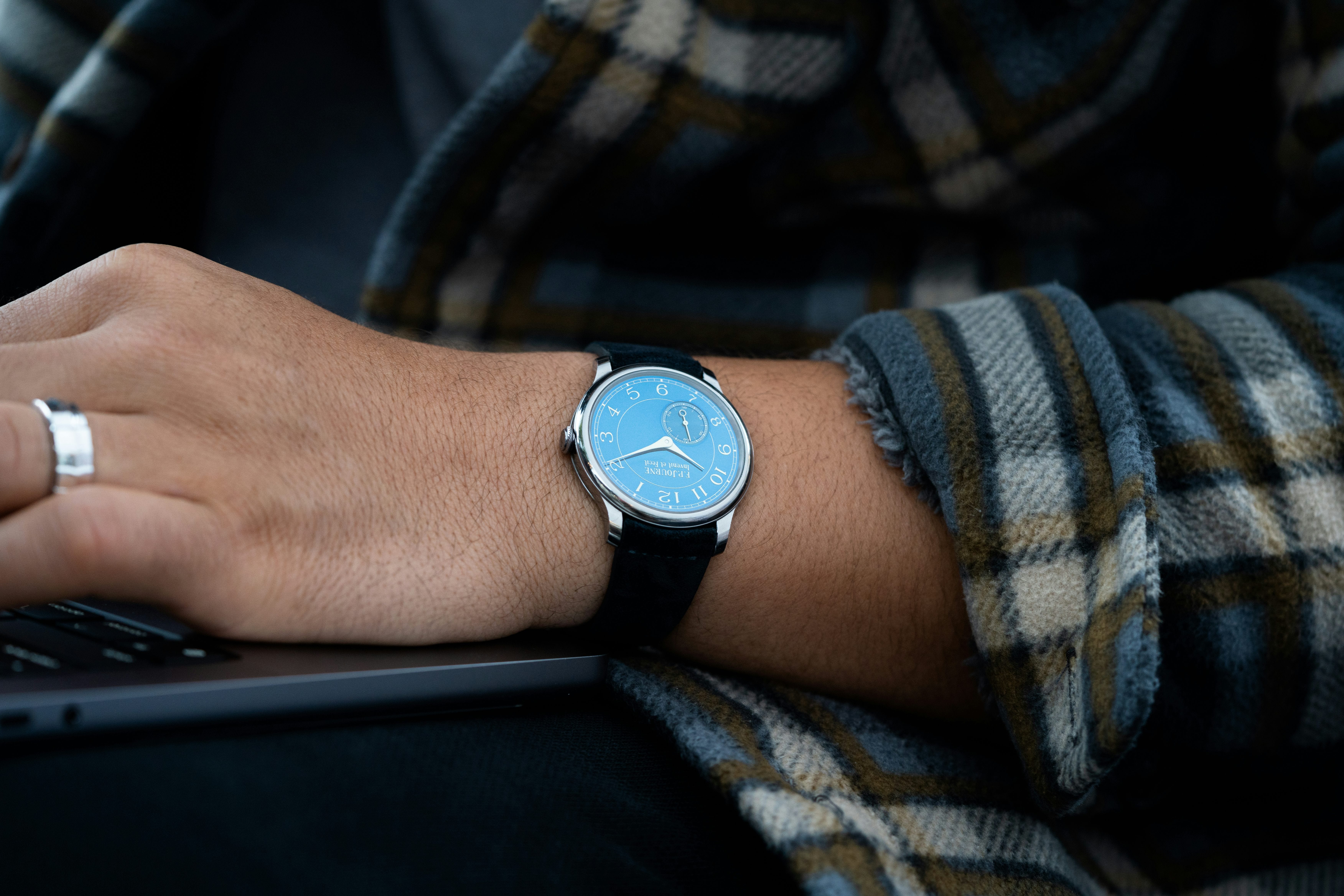
The difference is that all these digital activities really just supplement the physical experience, but they sure as fvck do not replace it. A photograph of a Chronomètre Bleu dial will never - and I mean, never - convey the way light alters its appearance in infinite ways. A YouTube video cannot replicate the sensation of winding a Romain Gauthier Logical One using a pusher. To fully appreciate any fine watch, it must exist in three dimensions, occupy physical space, and be experienced through multiple senses simultaneously.