

Royal Pop, Two Possibilities
We look into some numbers, trademark issues, aftermarket concerns, the women's market angle, and what the research says about "masstige" collabs.

If you wanted to avoid it, you’d have needed to stay offline for the last 10 days… like many in the watch world, I have been thinking about Royal Pop since the first teaser images were released. I thought about how to approach this, and decided to start with two short stories. Both start out roughly the same, but each one ends up in a different place. I’m not going to tell you which one I think will happen, because like anyone else, I really have no idea. After we’re done with the storytelling, we can do some accounting, and then we can talk about what the research says regarding ‘masstige’1 collaborations, trademark moats, and the strange psychological stuff that decides whether a $400 piece of plastic helps or hurts a $30,000+ piece of metal.
Both stories start in Le Brassus on May 16th, 2026, overseeing a globally coordinated in-store launch of eight bioceramic pocket watches. They involve a hand-wound modified SISTEM51 with a Nivachron balance spring and a 90-hour power reserve. Both involve long queues, hype, Soulja Boy, and lanyards. These stories do however, diverge, approximately 18 months later.
The first one is where AP’s strategy team gets to walk into the boardroom in 2028 and smugly tell the family they were right all along. The second one is the version where Olivier Audemars looks across the table at Ilaria Resta and asks her, with the sort of restraint that old money has perfected over generations, what the fvck she was smoking when she approved this collab.
Let’s start with the good story.
Estimated reading time: 28 minutes
Riding High in November 2027
You’re excited because it’s time to start packing for Dubai. You fly into DXB on Wednesday afternoon, and you’ve been scouting Dubai Watch Week’s website for ages now, to see what the brands have planned. AP, predictably, has the largest ‘stand’ again. I say stand, but it’s actually a fully standalone building, and the photos coming out of the construction phase are pretty remarkable. The Royal Oak logo is visible on the entrance side, but on the roof, in much smaller letters but visible from every approaching car on Al Khaleej Road, is the Royal Pop logo. Royal Pop is obviously not an ‘equal’ to the Royal Oak, but it has some relevance now because it paid for the school next door.
The school is the headline of AP’s week; in fact, six months earlier, AP officially opened the Audemars Piguet Académie de Savoir-Faire in Le Sentier, which is a free-to-attend horological apprenticeship programme funded entirely from the Royal Pop royalty pool. The opening cohort is 40 students, who will train for four years, with zero tuition fees. At the end, they will be qualified watchmakers, and any small independent in the Vallée de Joux can hire them. Some of the first cohort will probably end up at Greubel Forsey, or Voutilainen, or even AP itself; some will start working at their own benches. The point is that they exist, and the reason they exist is that AP managed to harvest something like CHF 25 to 50 million in licensing royalties from a bioceramic collab, declined to put any of it on their own balance sheet, and bought the most expensive piece of moral high ground in the watch industry.2
It worked!

The format was the first smart move; deciding to make Royal Pop a pocket watch on a lanyard and not a wristwatch turned out to be the best strategic call of the entire project, and AP basically got it right by being slightly paranoid. Pocket watches don’t compete with wristwatches the way wristwatches compete with each other. The kid wearing a Royal Pop on a Bottega lanyard at Soho House is not the same kid eyeing a steel Royal Oak Jumbo on his AD’s waitlist, even if he wants to be that kid in five years. Substitution failed because the products were not, in practice, substitutes. The 30% of consumers globally who now wear smartwatches already gave up their wrists; Royal Pop weaseled its way back into their lives in a way that didn’t need to ask for the wrist back.
Another masterstroke was the supply discipline. Swatch and AP agreed early on to cap total production at ~600,000 units across an 18-month window, ending in late 2027.3 By March 2027, secondary market prices had stabilised at a modest 15-20% premium to retail, which was high enough to keep the object desirable and low enough that nobody on Instagram was openly mocking AP for releasing a ‘flipper’s watch’. The painful MoonSwatch lesson, which Omega learned was taken into account this time.
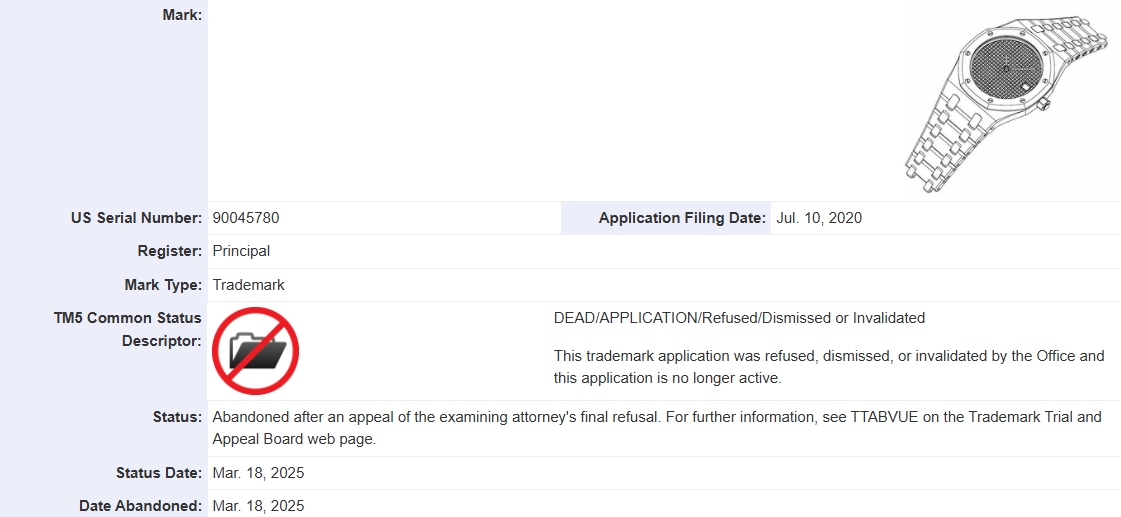
One massive consideration was the whole trademark debacle. AP lost its bid to register the Royal Oak’s shape as a trademark in Japan in March 2024, and the US Patent and Trademark Office issued its final refusal in March 2025. Both jurisdictions held that an octagonal bezel, eight hexagonal screws, and a tapisserie dial were ‘highly common in the watch industry’ and not inherently distinctive enough to be owned by one party. This was, in a legal sense, terrible news for AP. In a market sense, one could assume it meant that Asian factories were about to flood the world with octagonal homages, and there wouldn’t be much AP could do about it through the courts.4
So, AP did the next best thing; they flooded the world themselves, with a sanctioned, branded, Swatch-distributed version. By the time the Royal Pop production run closed in late 2027, there were more officially branded Royal Oak silhouettes on the planet than at any point in the previous 54 years. Knock-offs still existed, of course, but the ‘cultural reference’ was owned by AP themselves. When someone showed up wearing an octagonal-bezelled bioceramic homage from Alibaba, the question changed from ‘is that a Royal Oak?’ to ‘is that a Royal Pop?’ That question, in the hands of an enthusiast, is devastating to any homage maker, because it implies the original they’re copying is the $400 Swatch version and most importantly, not the $30,000 original from Le Brassus.5
One more thing that worked out well was how audience received this product; specifically the female audience. You can easily conceive how a 16-year-old girl who bought a Rainbow Royal Pop in May 2026 just because her favourite TikToker had one, didn’t actually grow up to want a $30,000 Royal Oak by 2030. But regardless, she did grow up to know the brand exists, which is, when you actually look at it, what every luxury house wants.
By the time this kid turns 21, she’s already fluent in AP design codes; this fluency was the thing AP couldn’t ever buy at any price through traditional advertising, and Royal Pop bought it for them at scale. By Q3 2027, Resta’s target of moving women from <20% to 45% of AP’s buyer base by 2030 had in fact jumped forward by roughly 18 months.
AP has had an audience-cultivation problem for years - the brand has under a hundred mono-brand stores globally, with an average transaction price of around CHF 51k, and produces fewer than 53,000 watches a year. So it’s fair to say they are not in the business of making customers - and especially not female customers. They are in the business of receiving customers - ones who have already been made (into watch-buying customers) by somebody else. Royal Pop, in this scenario, became the ‘somebody else’. It taught the untapped female market, a generation of Gen Z, and Gen Alpha kids, what an octagonal bezel was, why eight hexagonal screws were a design thing, what Petite Tapisserie meant, that the Vallée de Joux was a thing, and that the people who made the ‘real’ versions of this watch thought it was important enough to fund a school or whatever.
Anyway, by November 2027, AP’s secondary market is doing fine. The Royal Oak Jumbo is still trading at ~30% above retail, and the waitlists are, by most accounts, slightly longer than they were in 2025 - that’s partly because the Royal Pop hype seeded a new generation of would-be buyers without giving them a substitute.
AP’s revenue has now comfortably crossed CHF 3 billion. The 150th Heritage Universal Calendar pocket watch, released in 2026 with 30 complications and a price in seven figures, is being read by the press as the elite bookend to the Royal Pop’s mass-market entry point. The brand is, somehow, both more accessible and more aristocratic than it was 18 months earlier.
In this version of the future, Ilaria Resta instantly gets a five-year contract extension, Olivier Audemars gets invited on the The Joe Rogan Experience where he goes on about generational courage or some sh1t, and the brand goes on to report a record year. Everyone gets drunk at Black Coffee’s set at the AP party in Dubai… Mark Ronson plays Suzanne and nobody gives a fvck.
AP can dream, right?
“…because the revenue is being given away, the only thing AP is putting at risk is brand equity, and the only thing they get back is also brand equity (of a different kind). The trade is brand equity for brand equity. AP is selling a small amount of exclusivity equity for what they hope is a larger amount of cultural equity…”
Cry Me a River in November 2027
Now we’re in an alternative universe - but in the exact same week as the previous story.