


A 35-year-old movement engineer from Brittany recently released his hand-built escapement that is, according to SJX, “functionally identical” to Rolex’s Dynapulse. It’s made from steel and ruby entirely - that is to say, it doesn’t contain any silicon.
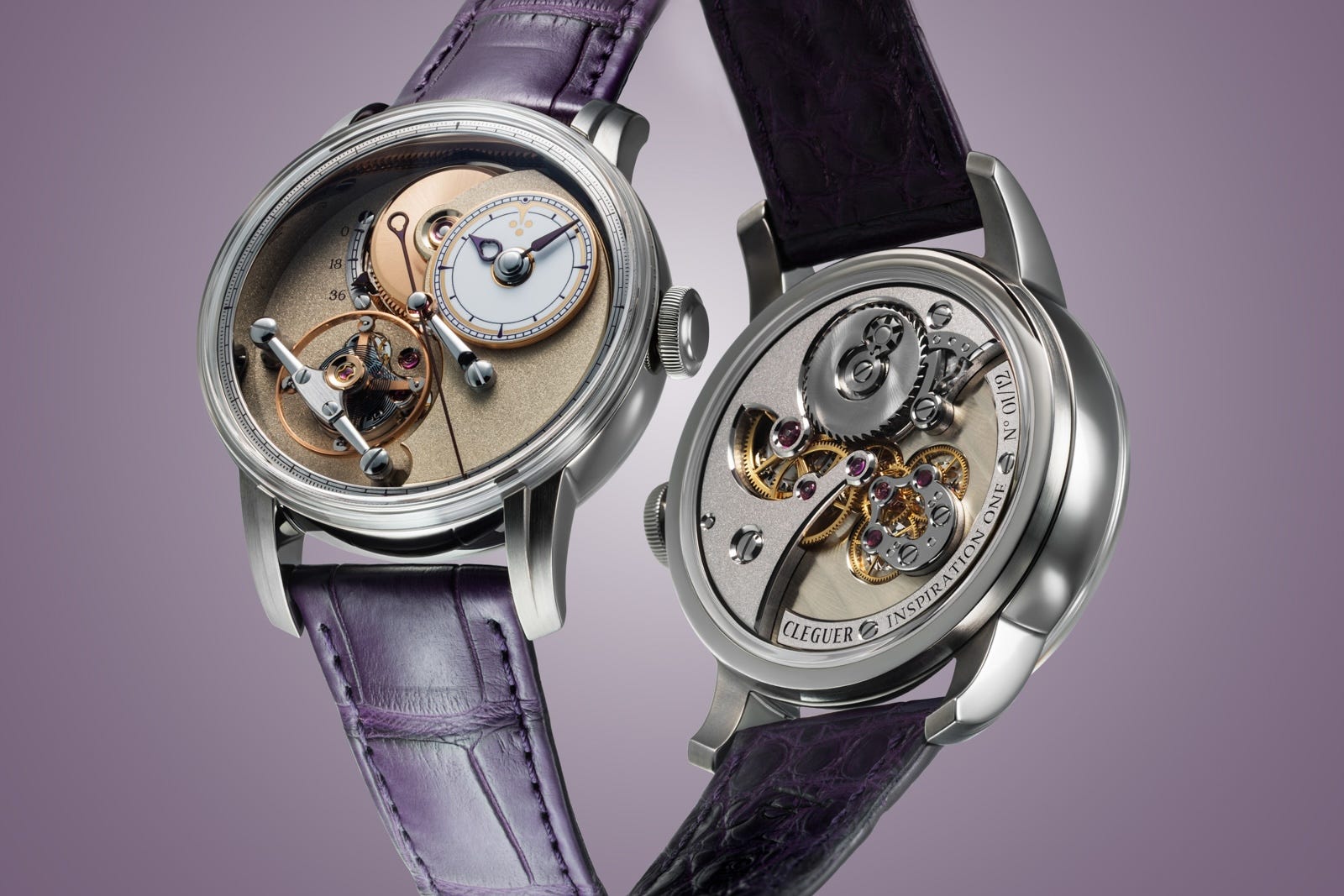
His name is Mathieu Cleguer, and his new watch is called the Inspiration One.
If you’ve been following SDC’s coverage of escapements over recent months, you will recall that we covered Breguet’s natural escapement and Daniels’ double-wheel concept in SDC Weekly 119, then Frodsham’s and Lederer’s wristwatch solutions in SDC Weekly 121.
In some ways, this is the next chapter in that accidental series and it’s a bit of a weird one, because this time we’re talking about a brand-new independent watchmaker who seems to have arrived at the exact same ‘mechanical theory’ as the world’s largest watch company.
The 12-piece titanium souscription series (CHF 56,000) is already sold out, and future production in precious metals will be around double the price of the titanium pieces. Also, total lifetime production of this watch will be capped at 80 pieces, so you could say his production output is comparable with someone like Rexhep, or close enough.
Anyway, today we will talk about what this watch is about, and why anyone should care.
Estimated reading time: ~20 minutes
Quick refresher on escapements
If you’re new to all this, a mechanical watch basically stores energy in a spring that wants to release itself all at once. The mainspring, which is a coiled metal ribbon, stores all this energy when you wind it, and if nothing stopped it, the whole thing would unwind in a couple of seconds with the hands spinning out rapidly.
The escapement is the mechanism that prevents this from happening. It acts like a turnstile, which lets energy through, one tiny bit at a time, in a steady rhythm. Each ‘tick’ is the escapement releasing one tooth of the escape wheel, which nudges the balance wheel to keep it swinging, which keeps the watch running at a consistent rate.
For about 250 years, the Swiss lever escapement dominated the industry, and most agree that it works well, it’s reliable, and it can ’start’ itself. The problem is that the escape wheel’s teeth physically slide across the ruby pallets under pressure. This wastes energy as friction and, more importantly, requires oil for lubrication. This same oil eventually dries out, thickens, or migrates, and it causes a watch to lose accuracy and eventually stop.
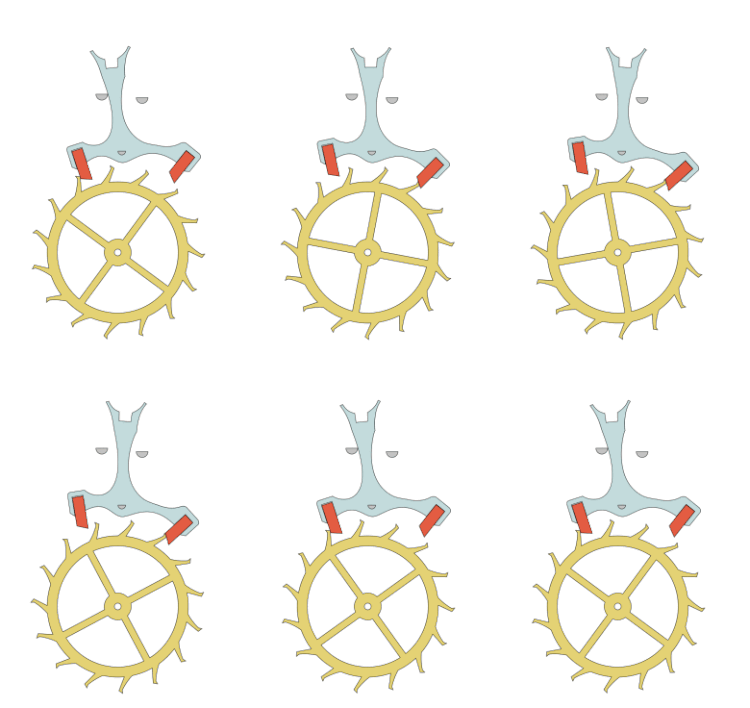
The general dream among watchmakers has always been to build an escapement where the contact is tangential (a rolling push, like nudging a merry-go-round as it passes) instead of a sliding action. This idea of ‘tangential contact’ is of course much more efficient and barely needs oil, if any.
Breguet tried to solve this in the early 1800s with his natural escapement, and then Daniels tried to solve it in the 1970s with the co-axial and the independent double-wheel. Omega mass-produced Daniels’ co-axial from 1999, and Frodsham and Lederer proved the double-wheel could work in a wristwatch. Rolex then launched the Dynapulse in 2025, and now Cleguer has added his own design to the mix.
All of these ideas are simply a different approach to the same underlying issue.
Who is Mathieu Cleguer?
Cleguer is 35, from Brittany in France, and studied micromechanics at HE-ARC in Neuchâtel between 2011 and 2014. After graduating, he spent the next decade as a movement construction guy, which I guess means he would usually design calibres from scratch for other brands. His CV includes Akrivia, Breva, and Emile Chouriet, which I suppose gives you some idea of the level he was operating at. According to Revolution Watch, Cleguer has the ability to design movements that balance both aesthetics and technically clever bits - which I would imagine is much harder than it sounds, because most movements you see tend to lean heavily one way or the other (and the few exceptions we know of, come from truly exceptional people!).

The Inspiration One is his first watch under his own name, and it’s the first of a planned ‘Inspiration’ series which he will dedicate entirely to alternative escapement systems. The Inspiration Two is currently scheduled for 2030 and Matheiu tells me “it will be nice.” 🤣
I don’t know about you, but I like this guy already! As an aside - his next watch will not be part of the Inspiration collection - we know it will a complication, but he was tight-lipped about any further details.
Problem solving
SDC readers may recall the two big historical flaws we discussed back in SDC Weekly 119.
First was in Breguet’s natural escapement, which used two escape wheels spinning in opposite directions, with each one delivering a direct push to the balance. It was an elegant concept, but had two problems. The first was that the wheels were geared together, so they moved simultaneously (creating excessive inertia - like trying to push two heavy doors at once instead of one at a time), and the tiny gaps between meshed gear teeth caused ‘backlash’ that made the impulse uneven. The second problem was that the whole thing was unreliable at self-starting. Breguet built about 20 of these, got frustrated, and then gave up.
Then there was Charles Fasoldt, a German-American watchmaker working in Albany, New York in the 1860s. Fasoldt came up with another clever idea, where, instead of having the escape wheels push the balance directly (Breguet’s approach), he used a lever as an intermediary step. The escape wheel would push the lever tangentially (so rolling contact with barely any friction) and the lever would then transfer that energy to the balance - also called an ‘indirect tangential impulse’. The problem was that Fasoldt’s system only delivered impulse in one direction, so during the return swing of the balance, it got nothing. Watchmakers call this a ‘lost beat’, and it made the whole mechanism too weak for a wristwatch1.
So you had two escapements from the past, each one was innovative in one respect and but badly flawed in another; Breguet’s gave impulse in both directions (good) but used direct contact and couldn’t self-start (bad). Fasoldt’s used tangential contact through a lever (good) but only pushed one way (bad).
And this brings us to Cleguer… who spent many years trying to combine the best bits from both.
Innate Escapement
The Innate Escapement is Cleguer’s name for the proprietary system he created; technically we could classify it as a “double-wheel, indirect-tangential impulse escapement” - and I know that sounds like a word salad, but each part of that description has a purpose which we can deconstruct quite easily.
Double-wheel means it uses two escape wheels, arranged in a mirrored layout and turning in opposite directions, with each one taking turns to deliver energy. This is the part he took from Breguet.
Indirect means the escape wheels don’t touch the balance wheel directly. Instead, they push a lever, and the lever transfers the impulse to the balance through a conventional fork-and-roller connection. This is the part he took from Fasoldt.
Tangential impulse means the contact between the escape wheel teeth and the lever’s ruby pallets is a rolling push and not a sliding drag. This means it has minimal friction, and therefore, barely any oil is needed on the impulse surfaces2.
What took Cleguer five years and more than twenty failed prototypes to figure out was that he needed to abandon Breguet’s defining feature (direct impulse from wheel to balance) and route everything through Fasoldt’s lever instead. He told Revolution:
“The problem is that a traditional natural escapement is not self-starting. Most modern solutions rely on silicon, but I wanted a mechanical solution.”
He first tried to make Breguet’s direct-impulse system work with traditional materials, but that failed - just as it had for everyone else who tried without silicon. “It wasn’t the right solution. I had to rethink everything,” he said.
His breakthrough came when he moved the impulse mechanism to the lever; instead of the balance wheel having impulse pallets on its roller (as in Breguet’s design), Cleguer put dedicated impulse and locking pallets on the central lever itself - one pair for each escape wheel. The lever then handles all the complex, high-speed work of locking the wheels and receiving tangential impulse, and then simply passes a clean push to the balance through the fork.
This solves both of the original problems; you get impulse in both directions (because the two wheels alternate, like Breguet intended), the contact is tangential not sliding (because the wheel teeth roll against the convex face of the lever’s ruby pallets, like Fasoldt intended), and the geometry is arranged so that a tooth always comes to rest in front of a pallet when the movement stops - this means it self-starts the moment you wind the crown.
The whole thing is built from hardened steel escape wheels with traditional chronometer-style tooth profiles and synthetic ruby impulse and locking stones. If you showed the components to a 19th-century watchmaker, they’d recognise every single material - only the geometry is new.
Dynapulse comparison
When Rolex unveiled the Dynapulse escapement in the Land-Dweller’s Calibre 7135, it was rightly hailed as one of the most significant technical developments in Swiss watchmaking in decades.
The more interesting thing for us nerds is to recognise the Dynapulse is also a double-wheel, indirect-tangential impulse escapement. It seems to be the same underlying mechanical design, and it hails from the same family tree - Breguet and Fasoldt, through Daniels, with everyone arriving at this indirect tangential system with twin wheels taking turns.
The difference is how they get there.
Rolex builds the Dynapulse from silicon using Deep Reactive Ion Etching (DRIE), which is basically the same photolithographic process used to make semiconductor chips. The silicon components are impossibly light, inherently non-magnetic, self-lubricating, and can be shaped into complex organic geometries that would be physically impossible to machine from metal, at least for now. Rolex’s escape wheels have just six teeth each (compared to dozens in a Swiss lever), the whole thing runs at 5 Hz (36,000 vibrations per hour), and it delivers roughly 30% more energy to the balance than the standard Chronergy escapement. It is, without a doubt, an industrial marvel, and it’s backed by 7 patents on the escapement alone and 16 total for the calibre.
Cleguer’s Innate still arrives at the same result (tangential impulse, twin wheels, self-starting, dual impulse) but instead uses hardened steel and ruby on a watchmaker’s bench. It beats at half the rate (2.5 Hz, 18,000 vph), uses a massive 12.9 mm free-sprung balance, and has traditional chronometer-style teeth on the escape wheels. Where Rolex uses lightness and speed to overcome inertia, Cleguer uses careful geometric balancing of heavier components at slower speeds.
It’s a bit like two architects solving the same design problem; one uses carbon fibre and computer-modelled stress analysis, and the other might use stone and centuries-old masonry principles. Both may have used different tools, but physics doesn’t change, and so both buildings stand up just fine.
I think the philosophical tension here is pretty fascinating, and this is something we’ve been writing about here for a while. Silicon offers lighter weight, complex profiles, and is suitable for mass production - but it’s brittle, can’t be repaired with traditional tools, and its long-term durability measured in centuries remains unproven (because it hasn’t existed for centuries). Steel and ruby are heavier, require some lubrication, and demand precision from the watchmaker - but at least they’ve been proven serviceable across centuries by anyone with a decent set of tools.
Why only 36 hours of power reserve?
The Inspiration One’s mainspring actually stores enough total energy for about 55 hours, but Cleguer discards roughly a third of it on purpose. He does this using a Maltese cross stop-work (also known as a Geneva stop-work) which is integrated onto the barrel ratchet.
Historically speaking, this is a significant mechanism and it physically prevents the mainspring from being wound to its absolute maximum tension or running down to its weakest. The pin on the driving wheel rotates into a series of slots on a cross-shaped wheel; when it hits a closed slot, the winding stops. Going the other direction, when the watch unwinds to a certain point, the pin hits the closed slot from the other side and the movement is force-stopped with some tension still remaining in the spring.
I spoke with Mathieu via email about this, and he said:
“I chose 36 hours in a provocative way; I’m annoyed by the idea that “we are selling mechanical watches like electric cars.” We only talk about power reserve without talking about the drawbacks of increasing the power reserve. That behavior of the industry is only possible due to the absence of chronometer concourse nowadays
And by purposefully having a small power reserve, it guides people to ask me why. And in a time only watch, a daily wind is not a supplice3, and I developed the all winding system to be pleasing with a loud click, 90° gear for smoothness...”