You Can Now Bet on Whether Rolex Will Release a Coke GMT
Kalshi and Bezel just launched Watch Futures - prediction market contracts on releases and price indices.

Yesterday, news that a company called Kalshi and a watch marketplace called Bezel have developed something called Watch Futures1, went viral via X.com. What this means is you can now trade ‘contracts’ on the future, in the world of watches.
Here’s what that looks like:
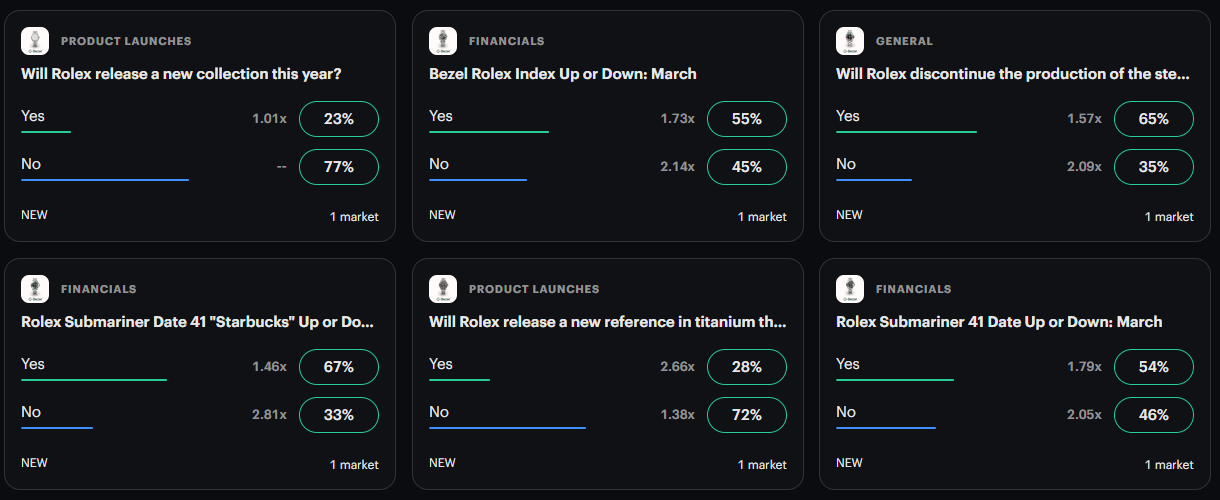
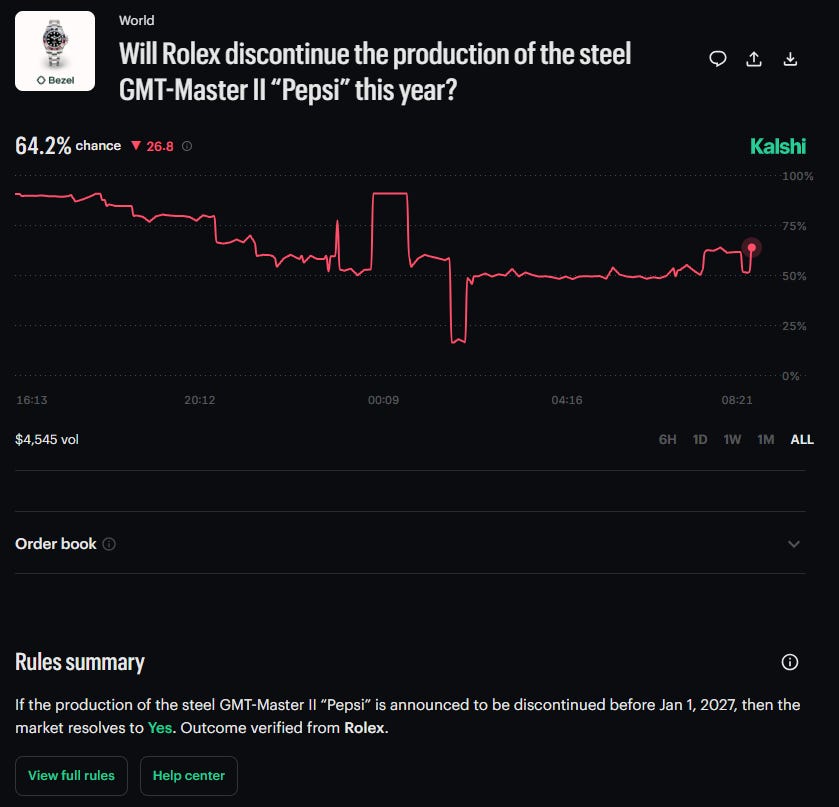
You can essentially bet on whether the Bezel Rolex Index will close above a certain price at the end of the month, or on whether Rolex will discontinue the Pepsi… you can even put money on whether Rolex will release a steel GMT-Master II with a black and red Bezel this year. You can view an example of the full rules here.
You might be wondering whether this is pure genius, or a disaster waiting to unfold… but I suspect it’s both. I’d like to explore what’s going on, because the coverage so far has been either breathlessly celebratory (“democratising access to luxury assets”) or reflexively horrified (“Wall Street ruins watches”), and neither of those takes is especially useful if you’re trying to figure out what this means for our hobby.
Estimated reading time: ~ 12 mins
What is Kalshi?
Kalshi is a prediction market, which, to the layman, means it’s a platform where you trade contracts tied to the outcome of future events as opposed to shares in companies. The price of a contract at any moment reflects the crowd’s view on how likely that event is to happen. If a contract trades at $0.70, the market thinks there’s roughly a 70% chance the thing happens. If it resolves yes, you get $1.00. If it resolves no, the contract expires worthless.
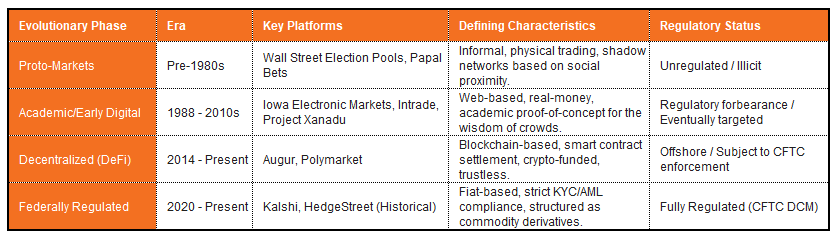
Prediction markets have in fact existed in various forms for a long time. There were organised betting pools on US presidential elections as far back as the late 1800s, and the Iowa Electronic Markets (an academic project at the University of Iowa) started in 1988 and consistently outperformed traditional polling on political forecasting. More recently, Polymarket handled billions of dollars in volume during the 2024 election cycle.
What makes Kalshi different from those is that it’s fully regulated by the Commodity Futures Trading Commission (CFTC) as a Designated Contract Market - this is the same regulatory category as the Chicago Mercantile Exchange. Kalshi spent years fighting for that status, including a protracted lawsuit against the CFTC itself when the agency tried to block it from listing political contracts. Kalshi won, the D.C. Circuit Court of Appeals agreed with them, and the agency eventually backed down.
So unlike Polymarket, which operates offshore in a regulatory grey area, Kalshi is, technically, a proper exchange. This matters because it changes what the platform can offer, who can trade on it, and of course, what rules apply when someone does something shady.
Beztimate(s)
The watch-specific wrinkle in all of this is how the price contracts actually resolve. You can’t just scrape listing prices from Chrono24 and call that a market index, because those listings are kinda aspirational, (as opposed to a ‘real’ stock price). A watch listed at £12,000 can easily sit there for six months before someone talks the seller down to £9,500. Using listing data would produce an index that’s systematically inflated and easily gamed.
Bezel’s solution is what they call the Beztimate algorithm, which they built originally as an internal pricing tool. Rather than public listings, it aggregates live bids, actual offers, and most importantly, verified settled sales. Before any transaction feeds into the algorithm, the watch has to pass through Bezel’s authentication centre in Santa Monica. Their team checks originality, period-correctness of components, functional performance, and runs serial numbers against stolen watch registries. They reportedly reject somewhere between 29% and 34% of watches submitted (which tells you something both about the quality of Beztimate’s data and about the state of the secondary market generally.)
The result, they claim, is an index based on what watches actually clear for, and not what sellers wish they’d clear for. For the purposes of a regulated derivative, that is, I suppose, better than anything the industry had before.
Is it perfect? Of course not, and I’ll get to why in a second.
Regulatory mess
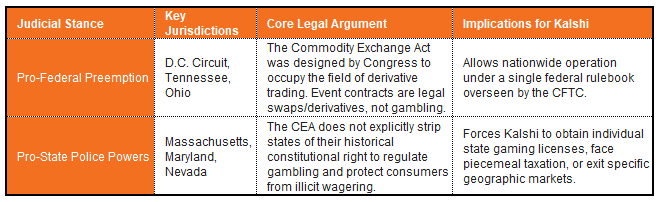
Even with CFTC approval, Kalshi is currently fighting legal battles across multiple US states concurrently, and the outcome of those battles will determine whether these watch contracts truly work at scale or collapse into a mess of geographic restrictions.
The main argument from states like Massachusetts, Nevada, and Maryland is that prediction market contracts on sports, cultural events, and now watches are just proposition bets, and the states have historically regulated gambling. Their gambling regulators want Kalshi to get state gaming licences, pay state taxes, and submit to state consumer protection rules2.
Kalshi’s counter-argument is that the Commodity Exchange Act grants the CFTC exclusive jurisdiction over exchange-traded derivatives, and state gaming law doesn’t apply - and perhaps unsurprisingly, multiple courts have sided with Kalshi on this. In February 2026, a Tennessee federal court granted an injunction blocking the state from interfering with Kalshi’s sports contracts, and as far as I can tell, similar protection was granted in Ohio and New York.
It’s not all rosy, though; other courts have also gone the other way. A Massachusetts court ruled that federal commodities law and state gambling law can coexist, and blocked Kalshi from operating sports contracts in the state. A Nevada court dissolved an earlier injunction, saying Kalshi’s contracts were essentially an attempt to dodge decades of state-level gaming regulation.