
Oystersteel, Cerachrom, Everose… why Grand Feu?
Rolex invents their own name for everything. So why, for the most discussed dial of the decade, did they choose not to?

You may have noticed something about Rolex… like Apple, they name everything.
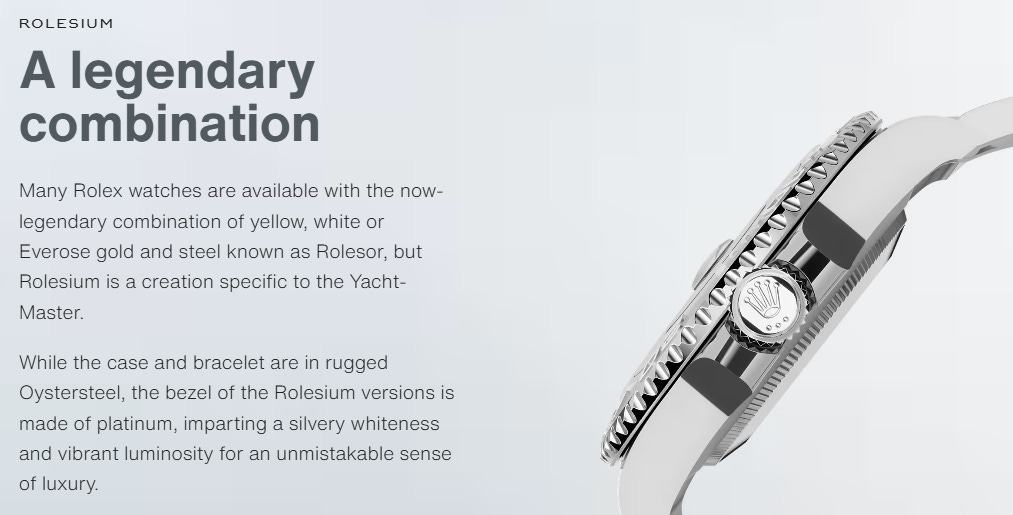
Their steel is not called “steel,” it’s called Oystersteel. Their rose gold is not called “rose gold,” it’s called Everose, and it contains a little bit of platinum to keep the pink from washing out - which is the sort of problem you only discover you have once you have sold a lot of rose gold watches to a lot of people who live in sunny places. Their steel-and-gold bimetal watches are called Rolesor. Their steel-and-platinum mix is Rolesium, a word Rolex has owned since 1932, when they originally used it to describe a proprietary steel that looked like platinum, and then retired the name and reused it 70 years later when they had platinum that looked like platinum.
Their ceramic bezel is of course, Cerachrom. Their lume is Chromalight. Their hairspring is Parachrom; their shock absorber is Paraflex; their crowns are Twinlock and Triplock and, for the Deepsea, Ringlock. The people they pay to wear their watches are not called “ambassadors,” because “ambassador” is a word other brands can use - so Rolex ambassadors are called Testimonees, which is a word so specific to Rolex that fvcking autocorrect doesn’t even recognise it.
So tell me, does it not make you wonder why, when unwrapping their most-discussed release of Watches & Wonders 2026, Rolex decided, for once, not to invent a word for this?
As we now know, they have called it Grand Feu enamel:
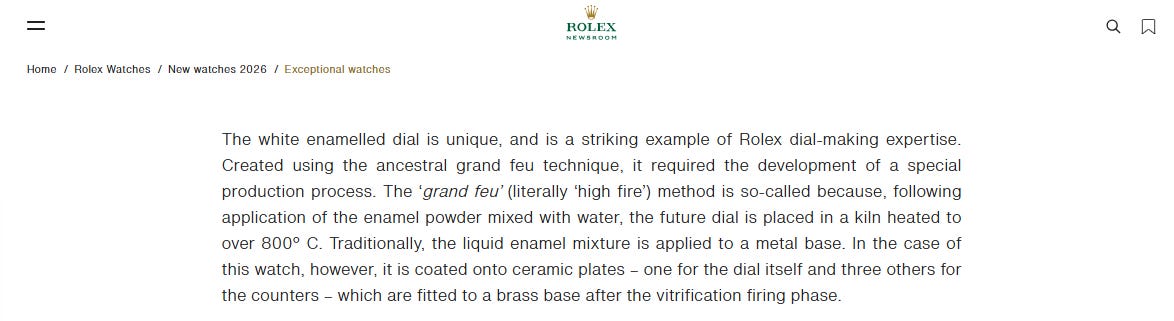
This is interesting because everything else was standard-issue Rolex - they named the metal, they named the ceramic, they named the lume, and then they got to the dial and they reached across the fence into general watchmaking vocabulary, and they stole “Grand Feu.”
This term has meant one specific thing in watchmaking (see update below) for hundreds of years1, and Rolex used it to name a process that does not meet the centuries-old definition. That’s not nothing, but before I can explain why it’s not nothing, I have to walk through what “enamel” and “Grand Feu” mean in the first place.
So let’s cover some definitions, then we can look at Rolex’s method, and finally we will get into the weeds with naming, which is where this gets good.
Update 17 April 2026 following the comment from Flavio: In watchmaking, Grand Feu has meant one specific thing - but the term itself is in fact older; born in the French faience tradition of the 17th century, where it described high-temperature firing onto tin-glazed earthenware. When it crossed into horology, it narrowed to mean glass-on-metal specifically, and that is the definition every major horological glossary still uses today.
Estimated reading time: ~13 minutes
What is “enamel” anyway?
At a chemistry-level, enamel is just glass, I guess.2 You take silica, aka sand, and you mix it with fluxing agents (like sodium carbonate and boron oxide, whose job is to lower the melting point of the sand so that you can work with it in a kiln instead of needing a blast furnace) and metal oxides (for colour), and you fuse the whole mixture into a lump.
That lump is called frit. You then grind the frit into a powder, apply the powder to a surface, and fire it in a kiln hot enough to melt the powder back into glass. When it cools, the glass bonds to whatever surface you put it on. That bonded layer is the coating we call enamel.
The catch here is that the name of the coating apparently depends on what you bonded it to; so this is where things get lawyerly.
ASM International is the professional society for materials scientists, and they maintain the reference handbooks which engineers use when they need to know what something is called - according to their definitions, this whole thing is unambiguous on this point:
”When the substrate is a ceramic, the coating is called a glaze. When the substrate is a metal, the coating is called a porcelain enamel. When the substrate is a glass, the coating is called a glass enamel.”3
If that weren’t enough, you will be pleased to hear that the same distinction is also codified by ASTM International in standard C286. Note how the title, “Standard Terminology Relating to Porcelain Enamel and Ceramic-Metal Systems”, already tells you everything you need to know about what “porcelain enamel” refers to. Let’s say you are a structural engineer specifying a coating for a storage tank, or a lawyer writing a product liability contract, and you write “porcelain enamel” - you have clearly specified glass on metal. If you write “glaze,” you have specified glass on ceramic.
Now, to be fair to Rolex and to ‘the other side of the argument’, outside of strict materials-science standards, “enamel” seems to be a rather forgiving word. Wikipedia’s definition of vitreous enamel allows any substrate (i.e. not only metal). Museum glossaries also seem to allow any substrate. If a ceramic expert says they are “enamelling” a piece of pottery, nobody calls the grammar police. So yes, there is a loose, colloquial, material-level sense of “enamel” that just means “fused-glass coating,” and Rolex has a fair claim in that sense.
The issue with Rolex is not what “enamel” means in a museum, though. For me, the problem is what Grand Feu means in the watch world.
Fine, so what is “Grand Feu”?
“Grand Feu” literally translates to “great fire,” and it refers, in the French-language watchmaking tradition from which it comes, to one specific process. That process is, specifically, fusing powdered glass to a metal base at a temperature high enough (800°C and up) to vitrify the glass.
The metal part is not optional - and I want to make sure this is clear, because this is the crux of the whole discussion. Some definitions from a few references I could find:
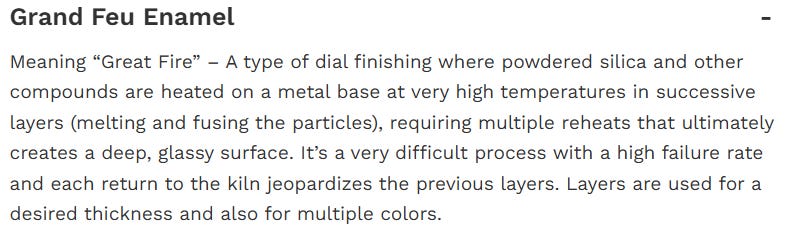
Monochrome Watches has one of the better glossaries on the watch internet, and it defines Grand Feu as powder “heated on a metal base at very high temperatures:”
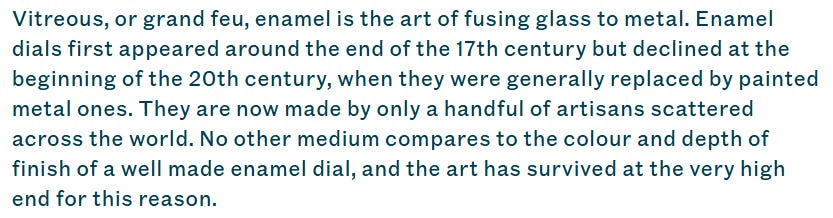
anOrdain are primarily known for their enamel dials, and they concur:
Heritage Crafts is a UK body that maintains a register of traditional crafts, and they have watch dial enamelling on its “at risk” list - they also think a metal base is part of the definition:
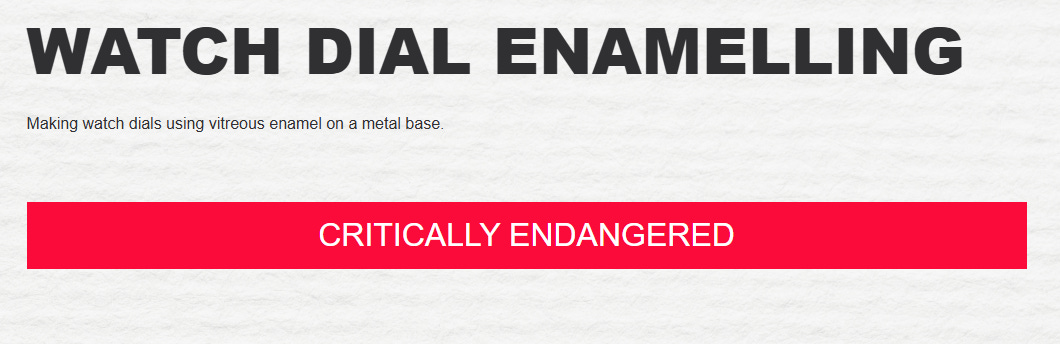
All of this is to say, there is no real disagreement in the watch industry on the definition of “Grand Feu” - it means glass on metal. The reason it should mean glass on metal is that the entire mystique of the process is down to the fact that that metal is a really, really difficult thing to fuse glass onto.4 This is the reason collectors value it, why dials take so long to make, why the rejection rate is somewhere in the 40-50% range, and the reason the Heritage Crafts register classifies it as being “critically endangered.”
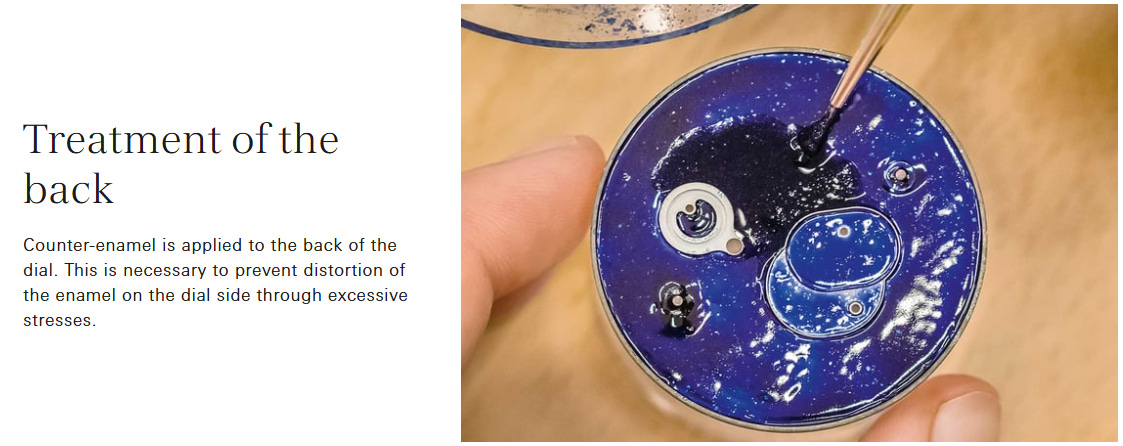
Glass and metal expand and contract at different rates when heated, and this is just a physics-based-fact. This means that every time you fire an enamel dial, the metal underneath wants to do one thing and the glass on top wants to do another, and if you don’t manage the fight between them, the dial explodes or warps or cracks.
You manage the fight by applying a second layer of enamel to the back of the metal blank - this is called the contre-émail, literally the “counter-enamel” - so that the front and back contract at the same rate and hold the metal flat between them. Every single one of the multiple firings has to be managed this way. And by the way, every single firing is a coin flip… if you get to firing number seven and blow it, you need to start over; hence the high rejection rate.
So hopefully it makes more sense now, and that’s basically what you are paying for when you pay for a Grand Feu dial. You are paying for the need to have way too many coin flips. Actually, to be more specific, you are paying for the ones that didn’t survive, because somebody had to grind the frit for those too.
So what did Rolex do?
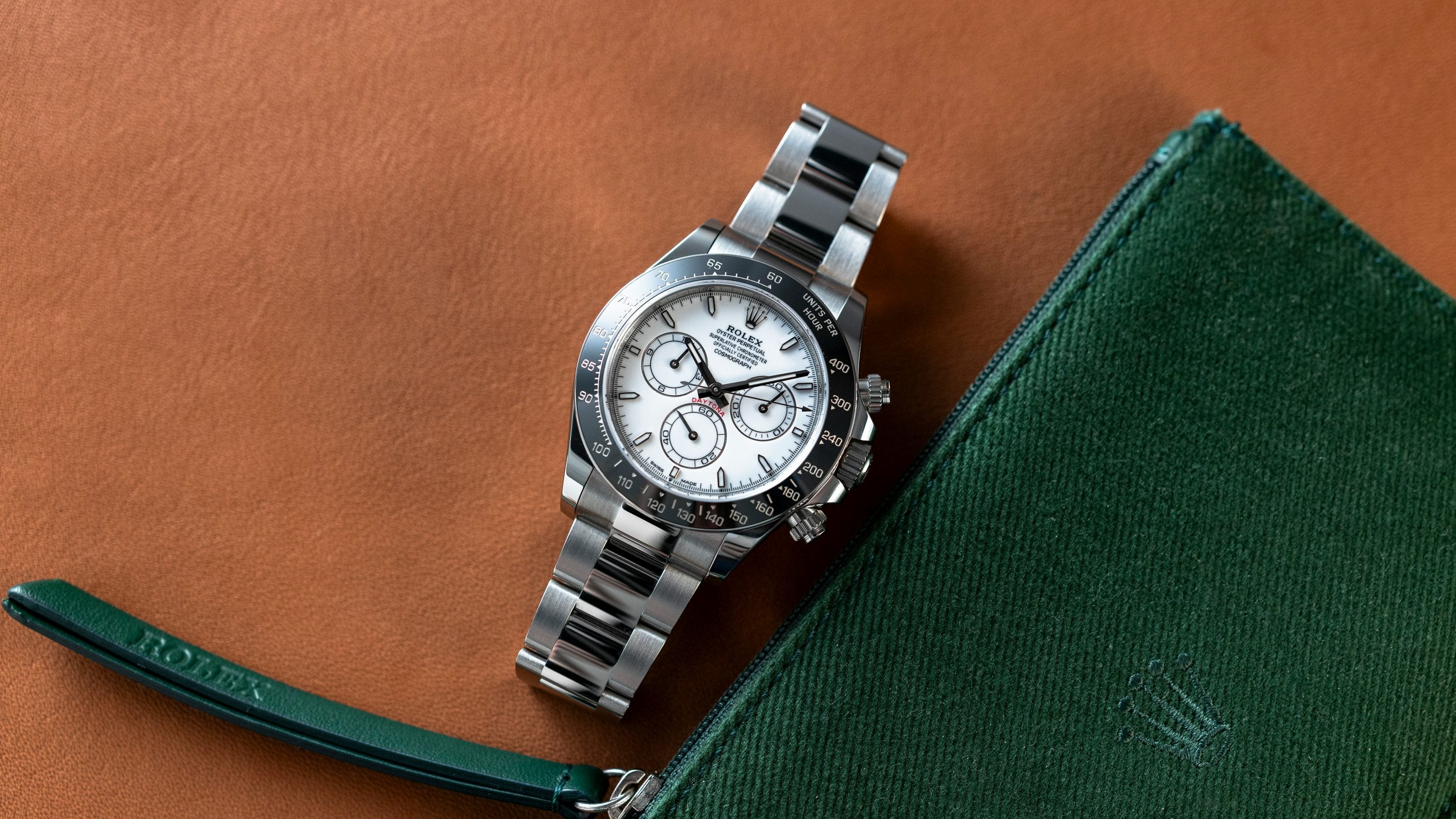
Rolex, to their considerable credit I might add, have engineered the romance out of the problem. The 126502 dial is not made on a metal base. In their new process, you take a ceramic plate and you fire vitreous enamel onto it. Now, because ceramic is very hard and does not expand or contract much when heated, you do not need any counter-enamel.
Roughly speaking, the ceramic just sits there, doesn’t warp the way metal would, and the glass does whatever glass does. This solves the coin-flip problem I mentioned earlier. You can do this four times; once for the main dial and once for each of the three sub-dials, and Bob’s your uncle. Then, because the ceramic plates cannot be soldered the way enamelled metal sub-dials were in the past, you mount all four finished pieces onto a brass backing plate using modern adhesives or physical fasteners.
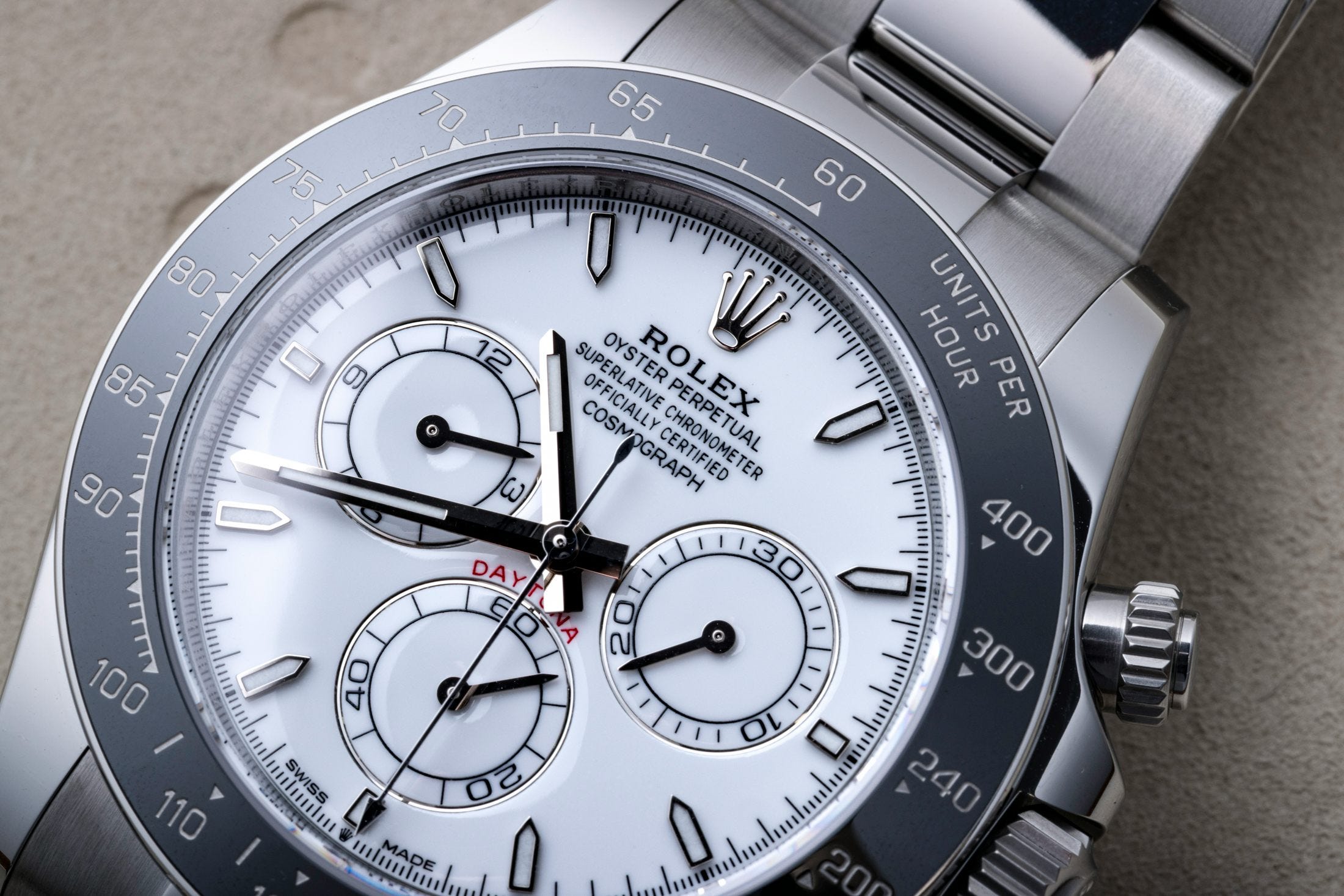
The result is rather beautiful as far as I can tell from photos. The surface is indeed vitreous enamel, fired at the right temperature, with the milky luminous quality that everyone loves to gush over.
The four-piece construction mimics the stepped, layered architecture of the great English pocket-watch dials of the late 19th century… like the Willis dial, shown on this J. Player & Son Supercomplication:
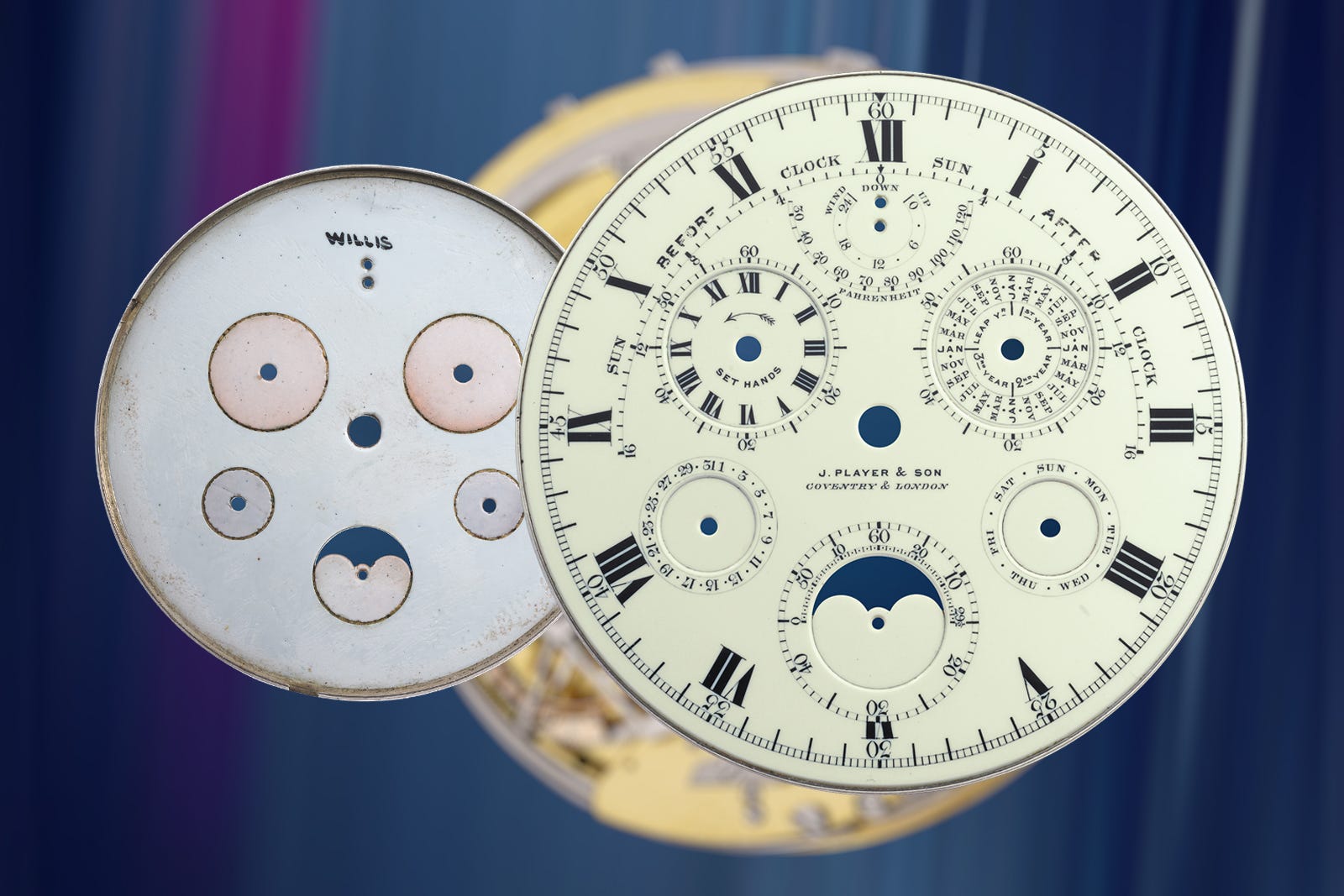
Andrew Cavanaugh (via SJX) writes about this J. Player & Son Supercomplication:
London dial manufacturer T.J. Willis made the enormous vitreous enamel dial for this and most other English complications of the day. Each of the five sunken sub-dials are separate parts, soldered into the main dial. While proportionally small, in absolute terms each sub-dial is quite large and easy to read.
So really, for Rolex to make this as tribute to Hans Wilsdorf’s London origins (they didn’t), it might even feel inspired. But let’s be serious… it is also, by the strictest technical definitions, not a Grand Feu dial.
It is actually just fused glass on a ceramic substrate - and this, per industry definitions, is a glaze.
Three ways to look at this
Purists may even agree that Rolex has done something innovative but they will also say Rolex should not be allowed to call it Grand Feu enamel. This is correct on the definition (glass-on-ceramic is not the canonical Grand Feu process), and it is also correct on the reduced difficulty (no counter-enamel, no thermal soldering, no Rose’s-metal-low-melting-alloy-drama5). Some, such as Brandon Thomas in this IG post, have suggested what Rolex has done is “pottery” - but this is false. Pottery is specifically clay-based (kaolinite, earthenware, porcelain) and Rolex’s zirconium oxide is an industrial ceramic, not pottery.
The correct materials-science-based word is perhaps glaze or more accurately, glazed ceramic. “Pottery” is of course a much funnier word, but it’s not technically the right one. If you wanted to get pedantic, a closer fit would be “glazed zirconia,” which perhaps sounds like a dessert.
Pragmatists will likely say it’s enamel because it’s made of enamel, and it’s Grand Feu because the firing process is the actual Grand Feu firing process (”Grand Feu” translates, remember, to “great fire” which actually refers to the kiln, not the substrate upon which the glass is melted). Plus, the construction style is plausibly Willis-esque anyway, right? I think pragmatists would be right to argue Rolex did not just slap lacquer on a ceramic disc, which is what they could have done and what nobody would have called enamel. They did bother to fire vitreous glass at ~800°C or whatever, and this is a legit process which requires some legit skill, I’d imagine. I guess these folks would conclude that Rolex just took a difficult process and industrialised it, and perhaps they are just being loose about what that thing is called, but it’s fine.
Material scientists do not care about feelings, so I suppose they will throw the book at this and declare that when you fuse glass to ceramic, the word is “glaze.” Not much more to say, is there?
Anyway, these positions are only in conflict if you insist on one answer. They are not in any sort of conflict if you admit that “enamel” here, is doing two jobs; one is about materials, and the other is about traditions. Rolex is using the material definition and any purist would be using the traditional definition.
This is actually a classic arbitrage if you think about it… the same word means two different things to two different audiences, and you can do quite well for yourself by using the word to the audience that hears the “flattering” definition while also relying, legally and technically, on the “unflattering” one.
Which brings us back to the naming issue we started with.
Why didn’t Rolex invent a new word this time?
Rolex, as we’ve already established, names everything. Rolex’s approach to language in general, seems to be “if you can trademark it, trademark it; if you can’t trademark it, invent a word you CAN trademark.”
So if you are Rolex, and you have, factually and objectively speaking, invented a new dial construction, one would think that the Rolex move practically writes itself here. You can call it Cerafeu, or Emaillium, or Grandoyster, or whatever the hell you want - people will roll their eyes and still lap it up. Rolex names are often slightly worse than the real thing, and that’s fine, because the point of the name is not that it’s good but that it’s yours. Rolex would own the word. The press would have to explain the word every time they wrote about it. The word would, over the next few decades, accrue the same kind of premium that “Cerachrom” and “Everose” have accrued, where eventually the word itself is some kind of luxury “signifier”, even if it sounds divorced from what it originally described.
I am sure you could imagine this happening, because at every other point in Rolex’s history, this is indeed what has happened. And yet, for the most consequential dial-material announcement of, I don’t know, their entire existence (?) … they chose a term that they do not own, which predates them by centuries, and whose accepted meaning their own process does not quite satisfy.
Why is that?
I think their made-up names work because the underlying things are in fact theirs. Oystersteel is just 904L, sure, but Rolex did pioneer using 904L in watchmaking at scale. Cerachrom is zirconium oxide ceramic, sure, but Rolex did develop the proprietary process that makes those bezels colourfast and (almost) uniform. Everose is a gold alloy with a platinum additive, and Rolex did formulate it. Rolex’s made-up names cover technologies where Rolex can credibly claim authorship. The name is a flag planted in territory they created, and subsequently owned.
“Grand Feu,” on the other hand, is territory they do not own. The term holds the prestige of hundreds of years of enamelling tradition - a tradition Rolex is not part of and has never tried to be part of. Many other brands are part of that tradition, and they all still use metal blanks, and apply counter-enamel, and accept the failure rate that comes with Grand Feu.
If Rolex had invented “Cerafeu,” they’d have a cool proprietary process with zero “inherited” prestige. Nobody would know what it was, and Ben Clymer would have to spend even more words explaining it. Collectors would have to decide from scratch whether this new-fangled Cerafeu thing was as good as actual Grand Feu, and some would say yes, and some would say no, and the discourse would play out the way discourse plays out, and eventually, in ten years, “Cerafeu” might stand on its own.
But calling it “Grand Feu enamel” skips all of that noise. It instantly imports the prestige of an old tradition without Rolex having to do the traditional process at all. It is, to be direct about it, a free ride on vocabulary and hard work, built by others.
And frankly, that’s the move they made here. They invented a new process, purposely did not invent a new word for it, and instead borrowed the oldest prestige-word in the dial-making business, knowing perfectly well that the word carries a set of expectations the process does not meet.
This is a genius bit of brand work, I have to say. It is also - and to be clear I have enormous respect for what Rolex accomplished here - not entirely fair to the independents who are still doing it the “hard way”, and who do not have a marketing and legal department the size of a small country to defend the nomenclature on their behalf.
The specific problem for me is that if Rolex calls glass-on-ceramic “Grand Feu,” and Rolex is the largest and most visible watch brand on earth, then within a generation “Grand Feu” will mean whatever Rolex’s version of it means. Which means the people who still do counter-enamel and soldering on copper will have to find a new word, or add an adjective (”traditional Grand Feu,” “old-school Grand Feu,” “metal-substrate Grand Feu” etc), which is exactly what “organic” food producers had to do when the regulators watered down what “organic” meant, and exactly the issue we have with the term “handmade” in watchmaking itself.
Linguistic drift is a real thing, and in this case it is a “cost” which will be borne by specialists because the largest player in their category has stretched the language to cover something new (and easier).
Again, this is not a Rolex-specific problem either; this is how words work, and especially how luxury words work - Swiss Made, Manufacture, In-House, Haute Horlogerie, Hand-Finished… all of these have been stretched to near-meaninglessness by one brand or another, and each time it happens, the brand that stretched the word pocketed some kind of “value” from the brands which followed the older definition more accurately. Rolex is just particularly good at it, and their whole naming strategy exists so they can control their own vocabulary and nobody can rip off their efforts.
The fact that they chose, this one time, to use somebody else’s vocabulary tells you exactly how much they wanted the prestige of Grand Feu, and exactly how aware they were that their process would not earn that prestige on its own, no matter what name they made up.
Final thoughts
Is the Daytona 126502 dial beautiful? Yes, and I suspect it’s even nicer in person.
Is it a new engineering achievement? Probably yes. As far as I can tell, firing vitreous enamel onto zirconium oxide at Rolex’s production quality is a new thing, and it is hard, and I’m sure that independent dial-makers would agree.
Is it enamel? In the loose material sense, yes. Vitreous enamel is the coating material, and Rolex is using real vitreous enamel. In the technical sense, the coating on the dial is a glaze, because the substrate is ceramic. But really, both things are true, and the word “enamel” will continue to do both jobs depending on who is talking.
Is it a Grand Feu dial? Nope - not by the watch industry’s own settled definition. “Grand Feu” has meant glass-on-metal with counter-enamel and multiple firings for the longest time; objectively speaking, Rolex has not done that. What Rolex has done is looks the same but is technically different, and those are two different things. As a pragmatist, if you make the argument that “great fire” just refers to the kiln temperature… this might be etymologically right, but historical precedent disagrees… it has never meant “just” that, in any context where the term is used seriously in watchmaking.
Is it a Willis dial? Of course not. The Willis lineage is about soldered, multi-piece, metal-based enamelling; the 126502 is effectively four glazed ceramic plates glued to brass.
Was Rolex entitled to call it Grand Feu anyway? Well, this is not a technical question at all. It’s more about whether you think a dominant brand should be allowed to “import” the prestige of a niche and specialised tradition without doing the special thing that said tradition requires.
Where I land is that if you name your own steel, and you name your own gold, and you name your own ceramic, and you name your own lume, and you name your own paid ambassadors… and you essentially make a new word for every single proprietary material your R&D department produces; and then on the one occasion where you invent something that truly breaks new ground, you choose not to name it and instead annex somebody else’s word, I don’t think that’s an accident. And I also think the decision tells you that Rolex believes the marginal dollar of prestige contributed by Grand Feu (versus a word of their own making) made it worthwhile to use. It is a disservice to watchmaking tradition, and they should never have used the term.
Either way, appreciate the watch, appreciate the dial… I know I do. You can also appreciate that Rolex has made something new, and something that, entirely on its own technical merits, is a perfectly reasonable thing for them to be doing - after all, industrialising slow and tedious processes is how humanity progresses.
But appreciate, also, that “Grand Feu” is doing far too much work in describing their new dial - work that Rolex did not pay for, and work which will inevitably devalue the (more difficult) work done by smaller artisans in the watch world.
P.S. In other news… my friend Manuel pointed this out to me:
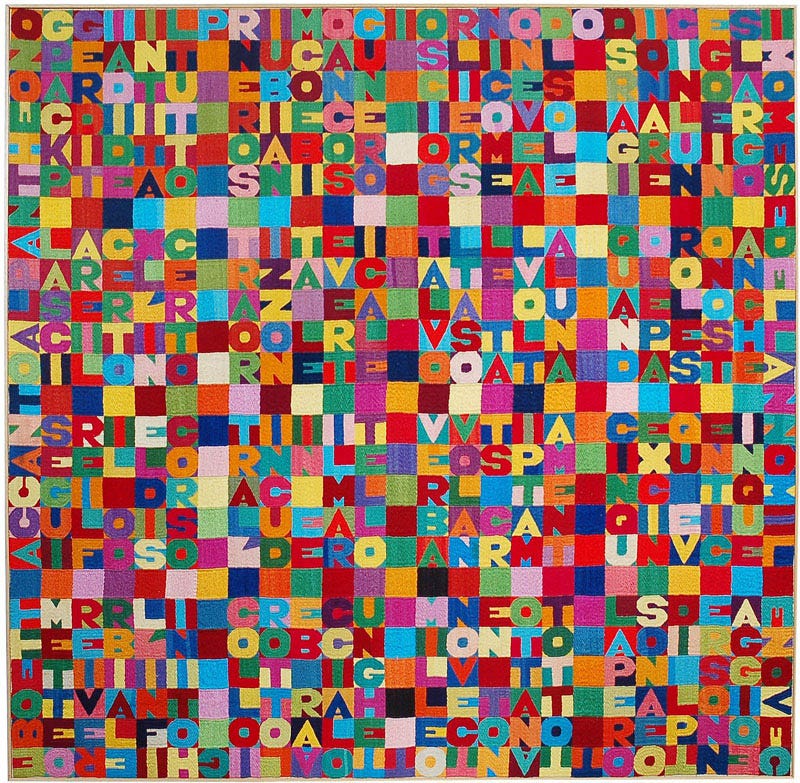
Now look at this:
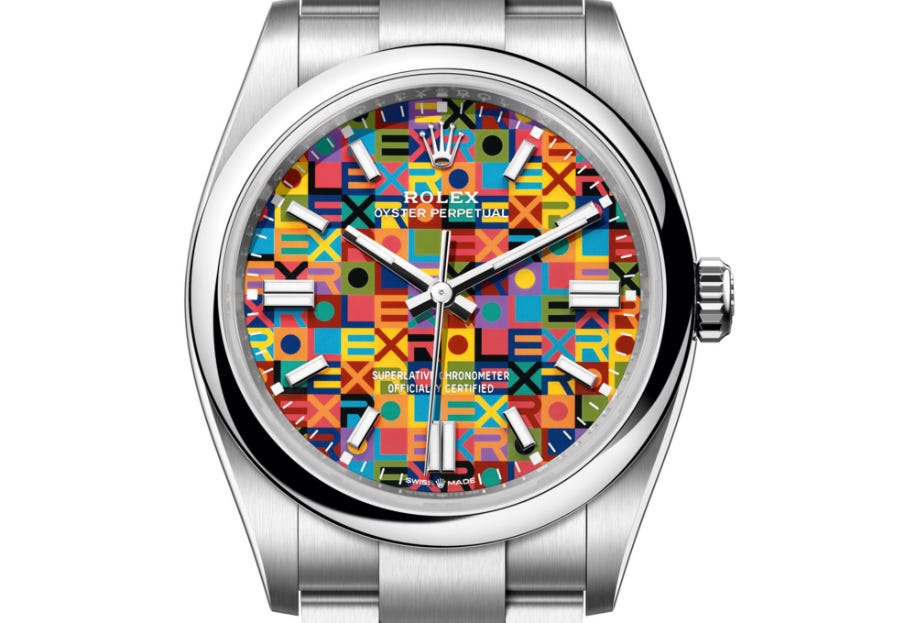
I guess Rolex really has run out of fvcks to give… 😂
Footnotes
Over 300 years it seems… didn’t want to get into a historical rabbit hole.
Update 17 Apr: It seems I should have!
The word “enamel” has at least four meanings in ordinary English, which is part of why this argument is a thing.
First is tooth enamel (a calcium phosphate mineral coating, no relation). Next is nail enamel (a cosmetic lacquer, no relation). Then we have “enamel paint” (a hard glossy oil paint, historically no relation but named for its glossy appearance). And finally, vitreous enamel, which is the one we care about - i.e. fused glass. When the watch world says “enamel,” we always mean this one.
This is from ASM International Handbook, Volume 5, Surface Engineering, “Glazes and Enamel Coatings for Ceramics and Glasses.” The quote from the preview without subscription can be found here.
Rose’s metal is a bismuth-lead-tin alloy with a melting point of about 94°C, which is to say: it melts in a cup of hot coffee. Historically, multi-piece enamel dials were assembled by applying a drop of Rose’s metal to the back of a finished sub-dial and then gently re-heating until the alloy melted and bonded the sub-dial to the main plate.
The reason it had to melt at such a low temperature is that any serious heat would re-melt the enamel on the front of the dial, which would destroy weeks of work. The fact that traditional enamellers were soldering components together in a temperature range where one wrong move would undo everything (and were doing it that way because there was no better option) is why people who do this for a living tend to get a little p1ssed off when someone else, who has bypassed the whole problem, uses “their word” for it.
Thanks for all these detailed explanations. Concerning "Cerafeu", "Emaillium" and "Grandoyster", I am afraid that they are already trademarked pokemon names :D
I just posted a response to that text on my Instagram @relogiosmecanicos , as follows: @kingflum, @perezcope and @watchoosy — people I deeply respect for voicing opinions that challenge the status quo — have written posts, and in kingflum's case a careful long-form text, arguing that Rolex inappropriately appropriated the term "grand feu" to describe the dial of the new Daytona. I beg to differ, on the basis of sources that everyone seems to have overlooked.
The critics' argument rests on the ASM International definition, according to which glass fused onto metal is "porcelain enamel" and glass fused onto ceramic is "glaze." Correct — but that is twentieth-century industrial nomenclature. The historical record tells a different story: the V&A Museum and LACMA document that "grand feu" was born in the French faience tradition of the seventeenth and eighteenth centuries precisely to describe high-temperature firing onto a ceramic substrate. The term later migrated into watchmaking's metal-based enamelling and acquired there a restrictive meaning that was never part of its origin.
There is a second problem with the premises. The narrative of grand feu as a difficult and industrially irreproducible craft does not survive historical scrutiny. Elgin and Waltham produced millions of grand feu enamel dials in fully industrial fashion, for cents on the dollar, with no one ever questioning the term. Today, anOrdain, Venezianico and Seiko deliver technically correct enamel dials on watches costing around two thousand euros. Temperature-controlled kilns have made the process far less unpredictable than it was in Breguet's era.
And here lies the greatest irony: the need to match thermal expansion coefficients between vitreous enamel and tungsten carbide-enriched zirconia — an inert substrate chemically hostile to adhesion — makes Rolex's process very likely more complex and more costly than any conventional grand feu on a metal base. Rolex solved in a sophisticated way a problem that traditional counter-enamel solves far more simply.
For me, it is grand feu. But this debate deserves stronger premises than those that have been circulating.