

Self deception and Survival Instincts
How we lie to ourselves about watches, and why it's perfectly normal

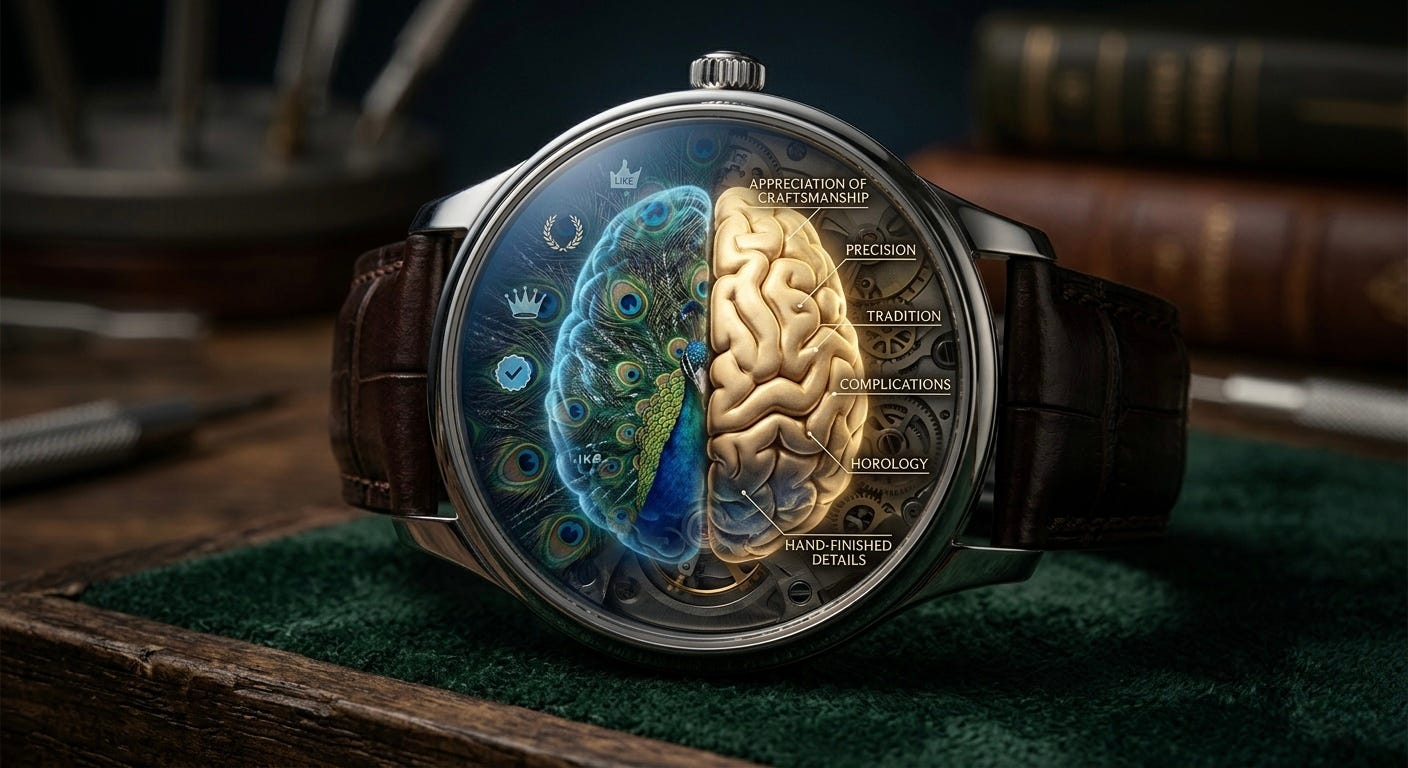
Robert Trivers died on March 12th, 2026, at the age of 83. Trivers was an evolutionary biologist, not a watch collector. He spent his career thinking about altruism, parental investment, and sex ratios in the animal kingdom - none of which has, on the face of it, much to do with watch collecting.
And yet, in 1976, in the foreword to Richard Dawkins’ The Selfish Gene, Trivers wrote a single paragraph that pretty much explains watch collecting better than most watch collectors ever have. The idea, in one sentence, is that we deceive ourselves on purpose because evolution built us this way, and we do this mainly so we can do a better job of deceiving other people.
Which means your million-dollar FFC is not, in a strict Triversian sense, a million-dollar FFC. It’s an elaborate piece of psychological equipment that helps you feel completely normal about spending a million bucks on a watch, while at the same time helping you convince everyone around you that this was a perfectly rational thing to do.
For context on Trivers - he was a Crafoord Prize winner, ranked among Time Magazine’s greatest thinkers of the 20th century, and probably the single most influential figure in modern evolutionary psychology. Between 1971 and 1974, he published four papers that changed how we understand human social behaviour. So with four papers in four years, each one was a kind of grenade tossed into a different corner of the social sciences. Then, in 1976, he added a fifth idea called self-deception, and this is the one we’re applying to watch collecting today.
Steven Pinker described one of Trivers’ passages as follows:
“If … deceit is fundamental to animal communication, then there must be strong selection to spot deception and this ought, in turn, to select for a degree of self-deception, rendering some facts and motives unconscious so as not to betray—by the subtle signs of self-knowledge—the deception being practiced.”
This sentence, from Robert Trivers’ foreword to ‘The Selfish Gene’, might have the highest ratio of profundity to words in the history of the social sciences.
Frankly, “the highest ratio of profundity to words in the history of the social sciences” is the most high brow academic praise I have ever read in my life. This idea1 is also probably one of the most disturbing in all of psychology, which is why I want to spend the next 4,000 words on it.
Estimated reading time: ~17-23 minutes
Think back to the last hype watch you bought; maybe it was a piece you justified because of its “superior craftsmanship”, “in-house movement” or perhaps even the,“investment potential.” You’re probably wondering why I am using quotation marks here; after all, it is quite likely that you actually, truly, believed these were the reasons you bought the watch… right?
Well, sure, you’re convinced you bought the watch for the reasons stated. Your brain has constructed a perfectly logical narrative that feels completely true. You believe it, 100%.
What Trivers proposed (and what decades of research has since supported) is that your brain is running a much more sophisticated programme than you realise. This programme has evolved specifically to hide your own true motivations from you - and get this… it’s a feature, not a bug.
Of course, you’ll probably read all of this, nod along, recognise all the patterns described… and then go and buy another watch anyway. Which, as it turns out, is exactly what the research predicts.
Evolution made you a really good liar
Trivers’ original argument from 1976 starts from a premise that Richard Dawkins articulated neatly in The Selfish Gene: “all animal communication contains an element of deception right from the start, because all animal interactions involve at least some conflict of interest.”
If that’s true (and the evidence suggests it is) then there should be strong evolutionary pressure to spot deception. And that pressure should, in turn, select for self-deception; because if you truly believe your own bullsh1t, you won’t give off the subtle cues that betray a person who knowingly tells lies.
Trivers’ 2011 paper with William von Hippel came out with a counterintuitive finding - that self-deception evolved to help you win social battles, rather than to protect a fragile ego. In the sporting sense, this is offense and not defense.2
von Hippel and Trivers identified three specific advantages of this system. Self-deception removes the mental stress of maintaining a consistent web of lies, it removes the nervousness and stress cues that come from knowing you’re being dishonest, and it eliminates the secondary ‘tells’ you might produce when trying to mask your nervousness. So you’re not acting calm, you are calm - because you believe your own story.
Applying this to watch collecting, when you truly believe your new Patek is a reflection of your ‘appreciation for horological heritage’ instead of something you bought in pursuit of social status, you eliminate many “tells” from your personal behaviour. If you think about this purely from the perspective of evolution, it’s genius, really.
Everyone has little quirks; nervous glances, vocal tone shifts, and other tiny behavioural cues exist in all human behaviour, and these tend to betray your conscious lies a lot of the time. “True” information is preferentially kept out of your consciousness, and false beliefs take its place.3
Even your brain is in on it; when researchers study ‘directed forgetting’, they can see the prefrontal cortex actively suppressing the hippocampus.4 In short, one part of your brain is literally telling another part what it’s allowed to remember about your own motivations. Effectively, evolution has burdened you with an internal filing clerk whose job is to lose the receipts 😂.