

Where did the time go?
Why 90%+ of your year vanishes from memory, what the research says about it, and what this means for how you spend your time as a collector.

At the end of last year I went down a bit of a rabbit hole with the German philosopher Martin Heidegger as my companion. The gist of that old post was that we don’t exist in time; we are time. Every breath you take is a moment passing, every thought requires time to form, and you are, quite literally, the seconds ticking away.
The whole section in that old SDC edition was about how we, as enthusiasts, wear our watches ‘of the present’ on our wrists, and then use them to project ourselves into fantasy futures. “When I get the grail, then I’ll be satisfied” or other such ‘projections’ come to mind here; it’s as though the watch on your wrist isn’t telling you, sixty times per minute, that now is all there is.
Anyway, that post was mostly about not ignoring the present, and today’s post, sticking to the same theme, is more about forgetting the past. I say ‘same theme’ because both angles speak to the same idea, which is to lose your life without dying.
Estimated reading time: ~15 minutes
Main question
At some point, which, for me, hit around mid-to-late-thirties, you will catch yourself asking a strange question: where did the time go?1
You might look at your kids and take in the fact that they’re suddenly not babies anymore. Or perhaps you will look at photos from 10 years ago and even though they feel like they were taken last year, apparently a whole decade has passed… while you were busy commuting, refreshing your email, going about your daily life and talking to strangers about watches on the internet.
By the way, this is not me ‘projecting’ my own experience on to everyone; this feeling is supposedly so ‘universal’ that psychologists have been studying it for well over a century. What they’ve found maps quite well onto how we experience (and waste) time as watch collectors… which was great to discover (in a cringe sort of way).
First we will go through some research, and then I want to try something with you; a little experiment we shall call a ‘Memory Audit’.
Why time disappears
There are three competing (but complementary) explanations for why time seems to speed up as you age. Each one builds on the other, and each one tells us something a bit different about the issue at hand.2
Proportional theory
The oldest explanation comes from French philosopher Paul Janet, who proposed in 1877 that we perceive time as a proportion of our total life lived3. When you’re only five years old, a single year is 20% of your entire existence, but when you’re 50, it’s just 2%. This causes the same 365 days to be experienced at what feels like a completely different speed for people at different ages.
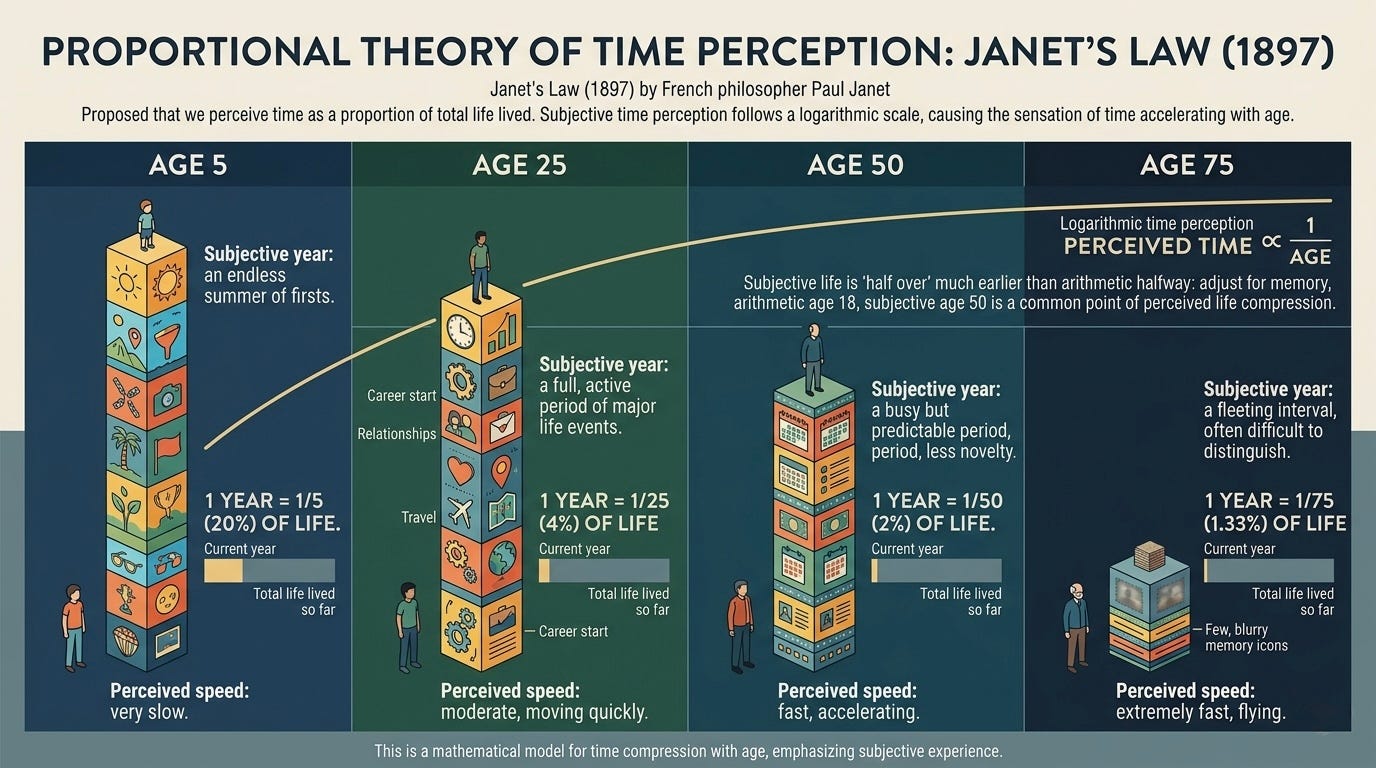
This is sometimes called ‘log time’, and it’s probably the explanation most people have either heard before, or have intuitively worked out for themselves. The main issue I have with this theory is although it may well be intuitive to many, it is also more or less useless, because we can’t change basic maths. So just because we know this or realise it, doesn’t mean much since you can’t make yourself younger. So let’s move on to other stuff you can do something about.
Memory density hypothesis
In 1890, the American psychologist William James wrote in his book Principles of Psychology that time seems to speed up because adulthood brings fewer and fewer memorable events4. When you think about it, the passage of time for an average human tends to be measured by ‘firsts’ from the time they’re born… first smile, first step, first day at school, first date, first kiss, first car, first job, first wife (lol), first child, first watch... I mean, the list is endless. Anyway, as you age, the firsts tend to dry up, and the days and weeks, as James rather bleakly put it, “smooth themselves out… and the years grow hollow and collapse.”
Bizarrely, this general idea seems to have sat around for about a century before anyone tested it. In 2005, psychologists Marc Wittmann and Sandra Lehnhoff at Ludwig-Maximilian University Munich ran the first major study on subjective time across the entire adult lifespan5. They surveyed 499 people aged 14 to 94 and measured how fast they felt time was moving.
What they found was that for short intervals (hours, weeks, months) there was barely any difference between the perceptions of young people versus old people. Everyone apparently thought time was moving quickly. The ‘effect’ only really showed up when people were asked to reflect on how fast the previous decade had passed. In this case, the older you were, the more the last ten years felt like they had vanished; the effect seemed to peak at approximately age 506.
The mechanism goes something like this: your brain encodes ‘novel’ experiences into memory, but it skips over all the ‘routine’ ones. It’s easier to think of your brain like an editor with limited storage; it only keeps the scenes that are interesting enough to justify the hard drive space.
A first date is something your brain will save, but your 37th commute to work will likely get binned. The result of this is that when you look back on a period packed with novel events, it feels long because there’s plenty of mental footage to wade through. When you look back on a period filled with routine, there’s almost nothing there, which is why the decade just seems like a blur that whizzed by.
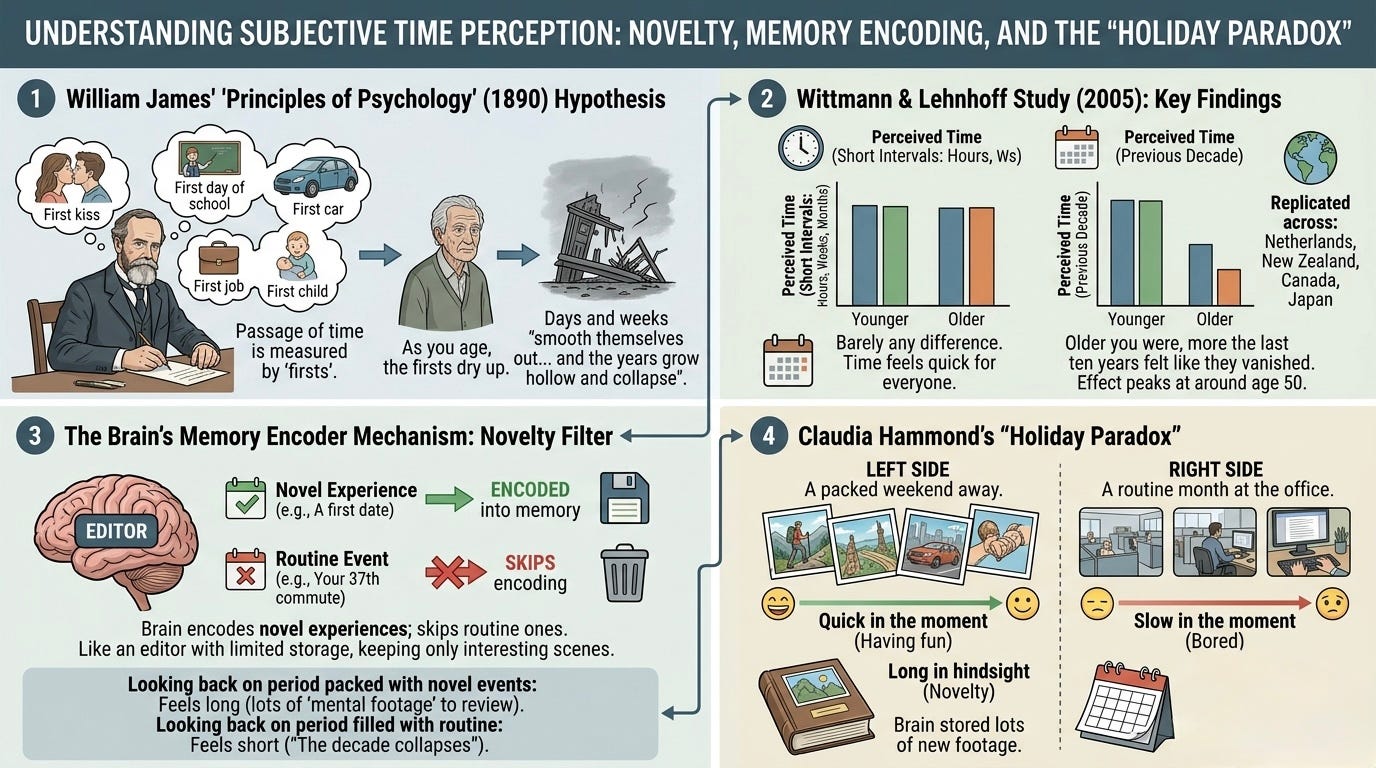
Claudia Hammond, a psychologist and BBC broadcaster, has called this the ‘holiday paradox’. I found this obscure reference and decided to include it because it is so relatable. A packed weekend away might feel quick while you’re living it (because you’re having tons of fun), but it also feels long in hindsight (because your brain stored lots of ‘new footage’). Now compare this to a routine month at the office and it can feel slow in the moments you’re living through it (because you’re kinda bored), but it then disappears completely from your memory… you can barely tell one Tuesday from another.
Neural processing theory
In 2019, Adrian Bejan, a professor of mechanical engineering at Duke University, offered a totally new angle grounded in physics instead of psychology7. As we get older, the neural pathways in our brains grow in size and complexity, but then they start to degrade - this means signals travel slower. The result is that the older brain literally processes fewer ‘mental images’ per unit of clock time.
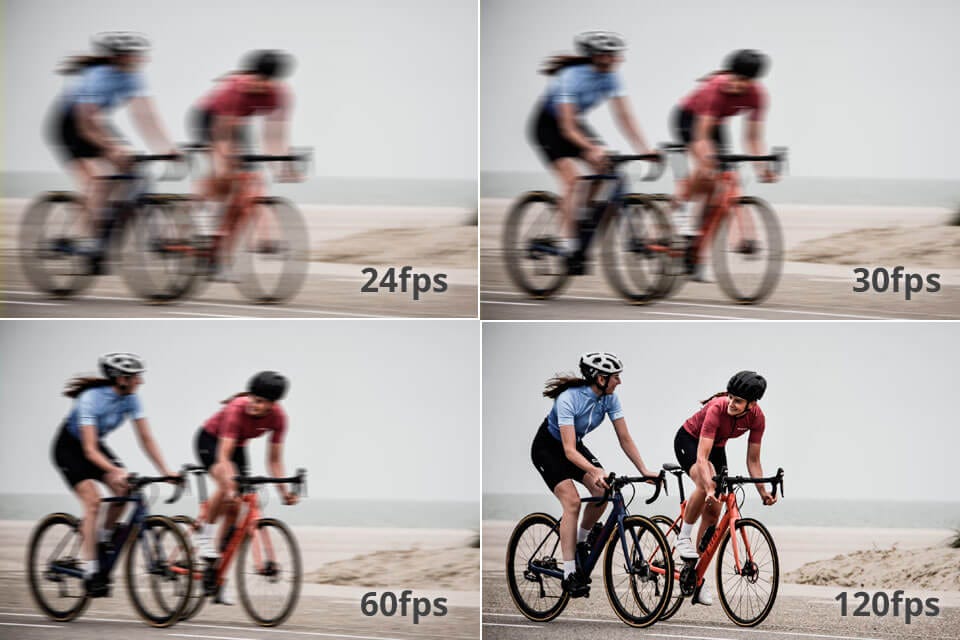
A good analogy for this, is a video’s frame rate; when you’re young, your brain is running closer to ~120 frames per second, meaning every moment is rich and detailed. As you age, the frame rate drops off. Having fewer frames in the same amount of clock time will make the day feel shorter.
As Bejan put it, the young mind receives more images during one day than the same mind in old age, and this is supported by the observation that infants’ eyes move far more frequently than adults’ eyes i.e. they’re processing more visual information per second.
Plot twist
Very recently, Marc Wittmann (the same researcher from the 2005 study, now 20 years older himself) teamed up with researchers and tested 120 adults aged 20 to 91 across three countries8. The goal was to directly test whether time really does speed up because we store fewer memories as we age. This had always been the assumption, but nobody had actually checked.