

Good for whom? What Makes a Watch Worth the Money.
Specifications are about watches and criteria are about you. Most watch arguments confuse these two things, and Barrelhand's Monolith is a great example of this problem in action.

Some words in the English language don’t work well when they are used on their own. “Taller” needs a than. “Nearby” needs a to. There is no such thing as something taller; that thing needs to be taller than something else, and if you don’t say what, then it’s fair to say you haven’t actually said anything at all (other than you made a noise which kinda sounded like a sentence).
Today I want to talk about some other words which work this way. “Good” is one of those words, and “worth it” is a pair of words that works the same as well. With these special words and pairs, I like to imagine that they all have a hidden slot built into them; to fill that slot you need to assign the word to a something (or someone) specific.
A ‘good’ knife for filleting tuna is definitely going to be a ‘bad’ knife for chopping onions - and I think you will have no trouble agreeing with me that this isn’t because of the varying steel quality in the knives those two cutting tasks would require. Yes, you may argue that the steel in these knives does have a hardness rating, and that edge-geometry does vary, and that the spine thickness in these knives does change... but to understand whether a knife is good depends on who’s holding it and what they plan to do with it.
Now, many watch people say things like “is this a good watch?” the way sensible people like you might ask “is this watch 40mm?” Only one of those questions has a universally-valid answer; this answer would be based on evaluating the watch itself.
No need to accuse me of relativism just yet… because yes, there are plenty of straightforward facts about a watch. Can the watch survive in a pool? Does it run to ±5 seconds a day? Is the bezel ceramic or aluminium1? These sorts of questions are checkable and falsifiable, and therefore, not usually up for debate.
My point with all this is to call out something basic… there are two layers in these sorts of conversations which get mixed up all the time:
Specifications. 40mm is the diameter. 55g is the weight. 60 hours is the power reserve. Anyone can check this stuff and if the brand lied, the brand lied. It is what it is.
Criteria. This is about which of those specifications you ‘weight’ at all; and of the ones you weight, how heavily is each criterion weighted? This layer is unique to every individual, and it isn’t ‘contained’ in any specific watch on earth.
Almost every argument in watch collecting is about layer two, but too often, the argument ends up using the ‘grammar’ of layer one.
Which brings us to today’s topic:
The term “overpriced” is not really a fact about a watch at all; it’s just data about the person saying it.
Estimated reading time: ~20 minutes (about 10 minutes free)
Three things
Ferrari’s F40 cost about 400k back in 1987, and from then until 1992, Ferrari made 1,311 of these machines. Now, by many measures, the F40 is in fact a disastrous machine. It has no power steering, no ABS brakes, and only 125mm of ground clearance which makes it feel like you’re gambling every time you drive it anywhere. If you took it off-road you would puncture the sump in under 5 minutes, guaranteed. As a daily driver it’s essentially a hostile weapon, and as a family car, well... no kids allowed:
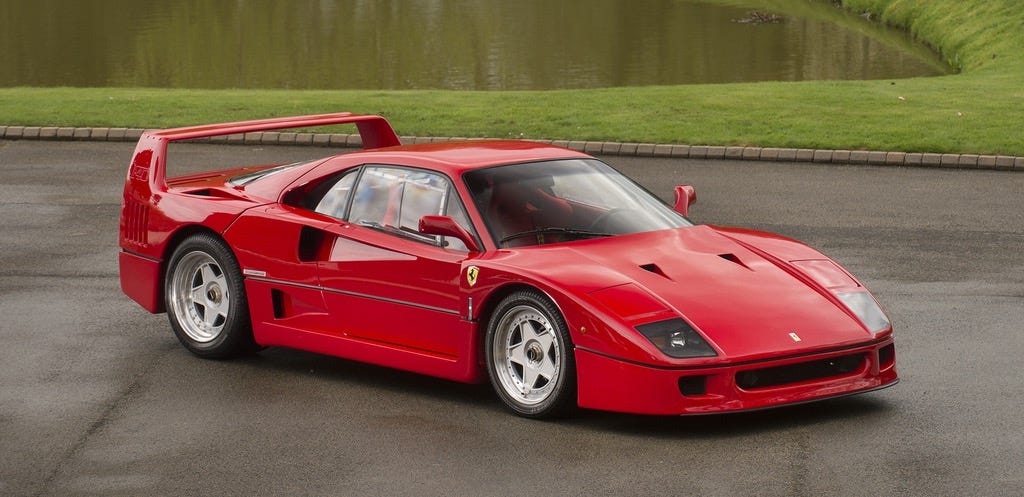
So, is it a bad car? Well if you wander around and ask a hundred people, you’ll likely get near-unanimous yeses on “great car” and, I’d guess, near-unanimous yeses on “terrible daily”, from the same hundred people. Obviously they aren’t confused…they’re just filling the second slot differently depending on which question they think you asked.
How about a two-piece suit from Huntsman on Savile Row? These start at around £7,500 and they take up to 28 measurements, require three fittings, and involve 80-plus hours of handwork… not to mention you’ll wait about 14 to 16 weeks before you can actually use the thing. But let’s say you decide to take it on a trip to the Amazon. I’m not sure how well the worsted wool will fare at 90% humidity, but I’d bet you’ll have mildew through the canvas inside a fortnight, and every one of those 80 hours will be rotting off your back before you return home. So, is it a bad suit? Well, obviously not! It’s an extraordinary suit that you chose to use as tarpaulin.
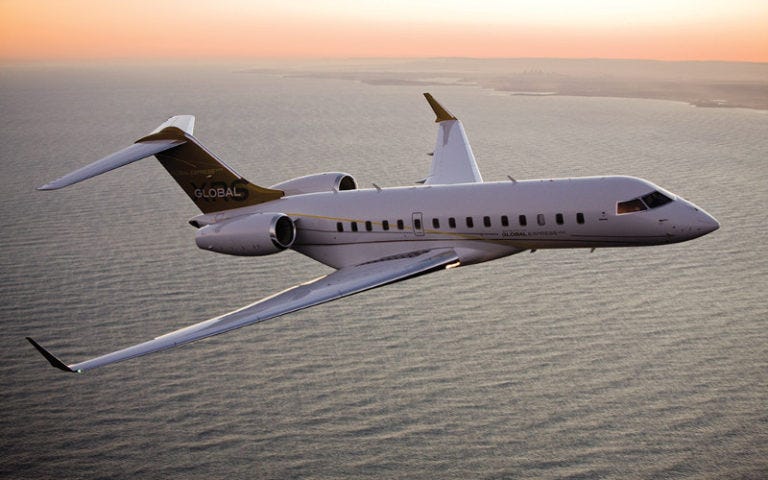
Have you heard of the Bombardier Global 7500? It has a list price of about $75 million. I’ve never heard anyone argue about whether it’s well made; in fact I have zero doubt it is a superb aircraft. But is it good value? Well, a British Airways First return, London to New York, has been going out around £2,800 on a good day, call it $4,000 or so. Just divide $75m by $4,000 and you get roughly 18,000 return trips at most. And maybe I am being overly optimistic with the fares, but even if you insist on spiked fares at, say, $15,000 a seat, you’re still at 5,000 trips. Point being, you literally could fly first class thousands of times for the price of this aircraft.
Not to mention, that’s just buying the thing. You also need to run it, which will cost you another $5m, which works out at roughly $10,000 an hour.2 So here’s something to think about: one hour in the air on a Global 7500 costs about the same as a Barrelhand Monolith. I’ll explain why this is relevant in a few minutes.
Before we get to watches, let me ask you: how does anyone justify buying this aircraft? Easy. Instead of comparing the aircraft to the usual commercial fare, people buying this aircraft usually compare it to their own time. Say the jet buys back 200 hours a year of dead time you’d otherwise spend in queues, connections, and other people’s schedules. $5m divided by 200 is about $25,000 an hour, and over a 2,000-hour working year, that person is in fact generating something in the region of $50m a year. (Yes I know, you would net off the first-class fares you’d have paid anyway, fine. Let’s just go with it!)
So let me ask again, is the Global 7500 good value? I would say that for the number of people on earth who can hang their hat on $50m a year of personal output, yes, it’s obviously good value. For everybody else, it’s pretty stupid. What this example demonstrates is that with the same aircraft, and the same $75m purchase price, the answer changed only because the person changed.
That’s the main point here; value is the output of a function with two inputs, and one of the inputs is you.
Guy at my office
Private jets are nice and all, but I’m mentioning this story to show how the equation doesn’t change if the numbers get smaller. We were talking about insurance over lunch one day, and a colleague told me that the most valuable things he owns, setting aside his house and car, are his TAG Heuer watch and his wedding ring. He wasn’t being self-deprecating or anything like that, he was just reporting a fact about his life.
Say the TAG was £2,000 or so, which is roughly the middle of the range, and say he has £40,000 of everything else. That watch is 5% of his net worth. Now imagine someone worth £40 million buying a Barrelhand Monolith (at $9,750 which is about £7,300) - that’s ~ 0.02% of their net worth.
Which means, if you own a Global 7500 jet, a Monolith will cost you less than an hour of cruising at 42,000ft would cost. To the guy at my office, the same watch is ~17% of everything he owns (apart from his house and car). So given that we’re talking about the same watch, at the same $9,750 price, these two guys are definitely not having the same conversation. Heck, they are barely speaking the same language!
So you see… we can be talking about the same category of object, and we will have two sentences that have almost nothing in common. If you were to ask “is a £2,000 watch worth it” without saying which of those two men you are talking to, you have once again simply made a noise which sounds like a sentence to you.
In fact, I’d take this one step further and posit that my colleague’s TAG is adding more ‘value’ in his life than most grail watches do in the collections of ‘huge collectors’. For him, it seems to carry some sense of ‘having arrived’ somewhere in his life, and it does this for him 365 days a year. As far as I can tell, there is at least one definition of “good value” where this guy at my office is the best-performing watch owner I will ever know.
Space watch
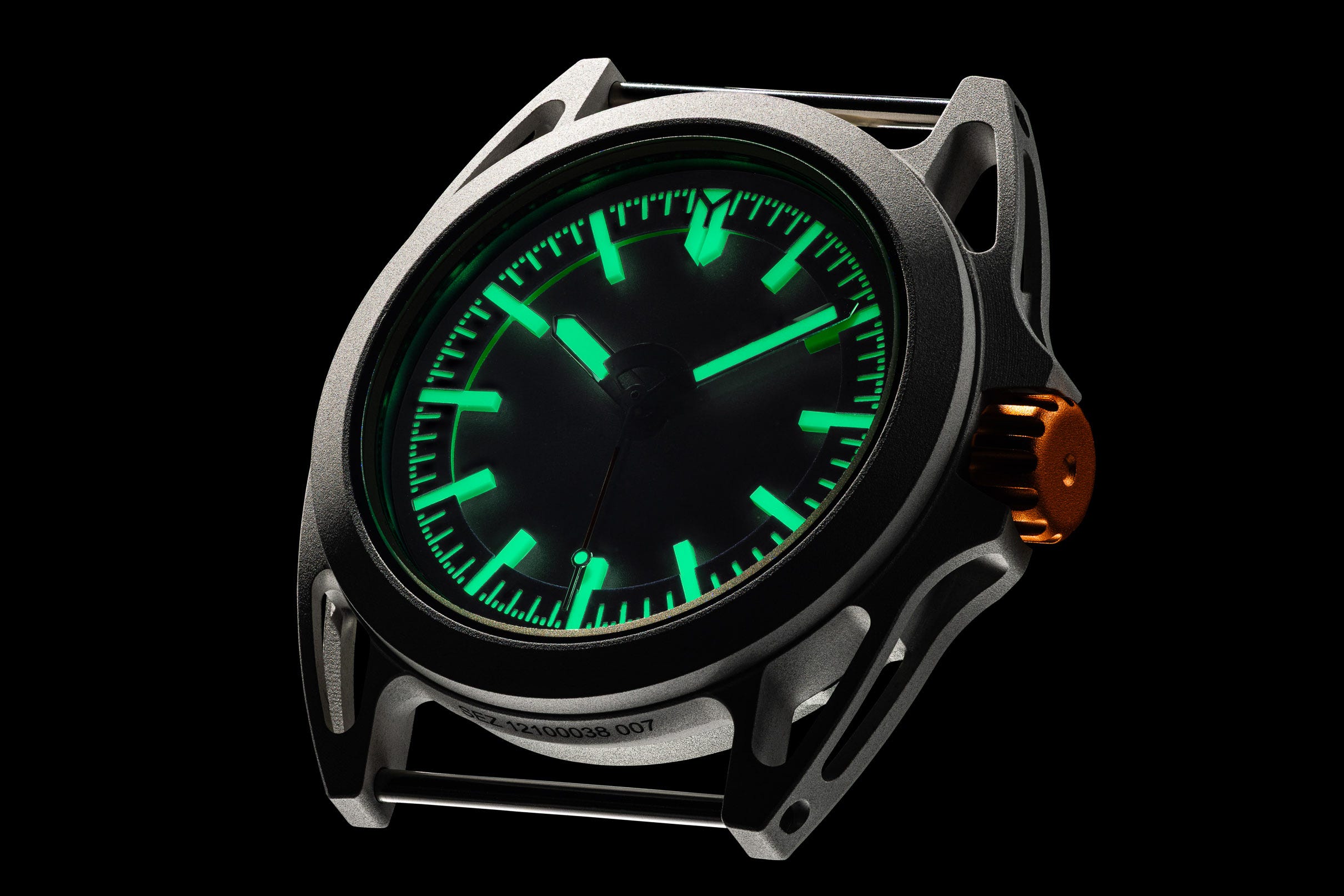
In May, Barrelhand launched their Monolith publicly at $9,750, but I understand that a first batch had already gone out to early adopters before that. It’s a 3D-printed watch with a Scalmalloy case (Scalmalloy being an aluminium-magnesium-scandium alloy developed for aerospace printing… essentially very strong and very light; about 40% lighter than titanium, and considerably stronger than the commercially pure stuff).
It has a bunch of features that mean nothing to a muggle like me… air-core insulation, water resistant to 200m without a screw down crown, an operating range from -120°C to +120°C, and it was built using ISO aerospace standards, NASA material guidance, and EVA/IVA3 test protocols. I mean, fvck, it means nothing to me but it sounds pretty intense. But that’s not all… on the back there’s a 19mm nickel memory disc produced by NanoFiche, and this thing involves a physical micro-engraving process which fits about a thousand pages of human culture onto a disc the size of a coin.
And then… inside the watch, you will find a modified Sellita SW300-1b.
Below the line: who Barrelhand is really selling to and why that changes the calculus, an argument that all of this is just a nicer-sounding version of all brands’ favourite excuse, how to use the words “for me” and how far they get you, and some thoughts on what Jack Forster found when he looked into all this.