


If you saw the header image and wondered what the hell that was all about, you’ll have to read a little bit more to find out!
Estimated reading time ~ 15 mins
Most people tend to remember ‘headline stats’ from the annual Morgan Stanley survey; Rolex is always at the top, but this year’s big news was Cartier moving up to second, and Omega dropping down to fifth. One thing that I recall vividly was Christopher Ward (CW) breaking in to the top 50, and ending up right below MB&F.
That was interesting to me because these are very different companies, and yet, they still generate roughly the same revenue. Of course, that’s where the similarities end. One of them has the freedom to move up and down the price ladder as freely as they want to, and the other appears to be stuck where they are.
CW sells watches for around CHF 1,300 (avg. selling price), which means they sell around 39k watches with estimated revenue of CHF 51m. MB&F makes around 400 high-end watches plus a few thousand M.A.D.Editions, so call it 3,400 watches in total. That’s 11.5x more watches from CW for roughly the same revenue… and that’s why they’re side by side on the rankings table.
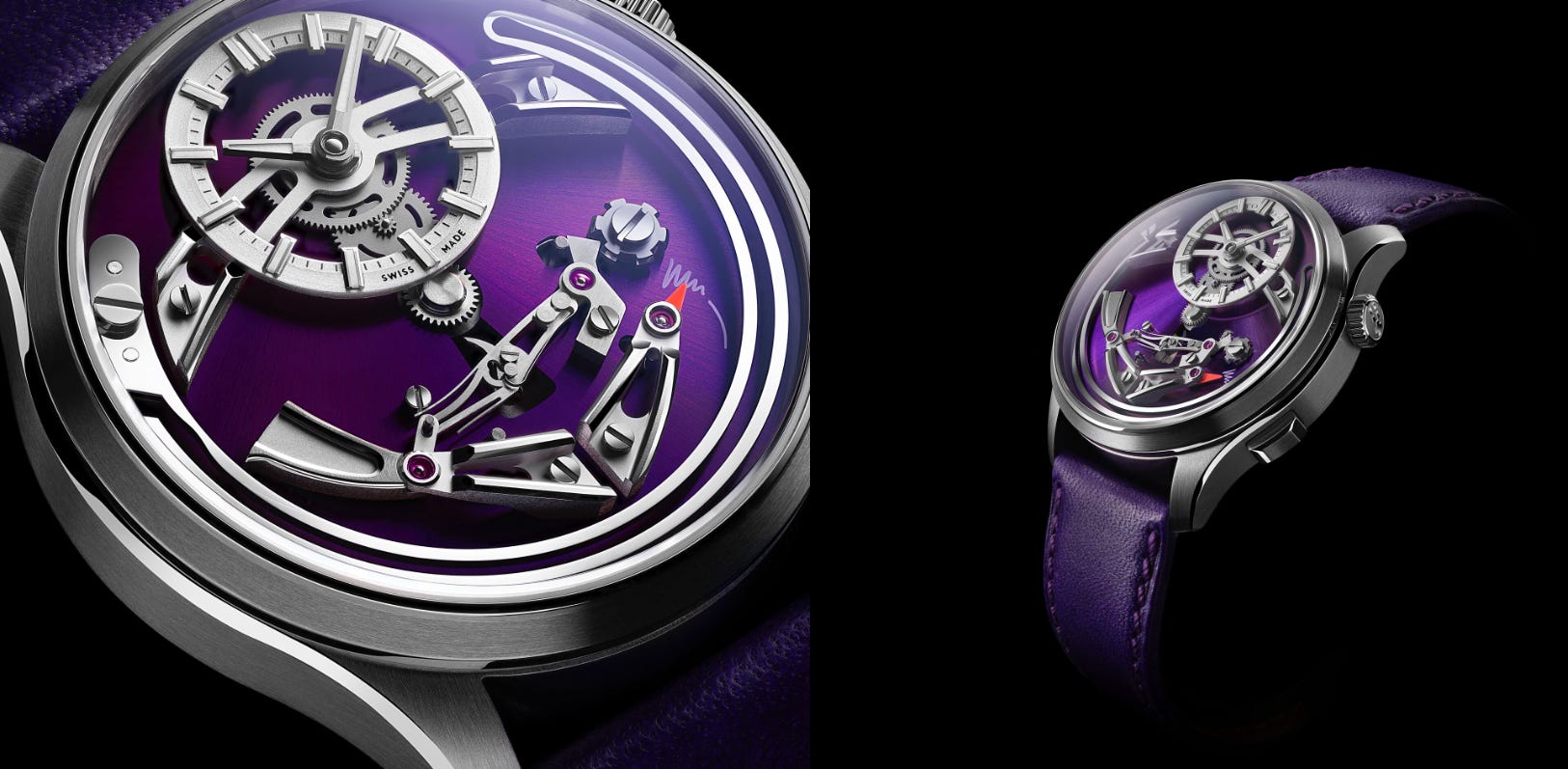
And then there’s the ‘star’ of either brand, so to speak. CW put themselves on enthusiasts’ map because of the C1 Bel Canto; this is a chiming watch that launched in 2022 for under $4k and they sold out their first 300 pieces in a few hours. MB&F’s cheapest watch is the M.A.D.1, which sells for around CHF 3,000.
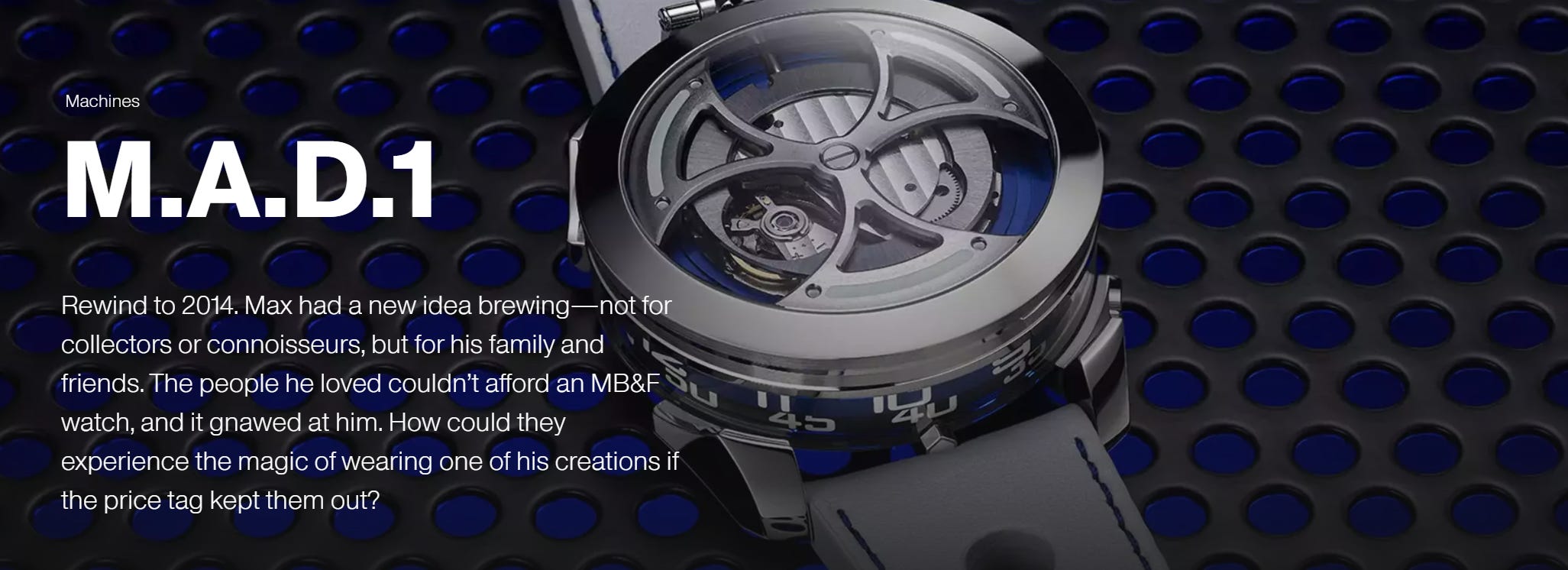
These two are basically on the same rung of the proverbial price ladder… but from each brand’s perspective, one had no problem climbing down to get there, and the other climbed up.
Down first
When you build a business that inherently relies on scarcity you end up accumulating a strange asset in the form of people you don’t sell to. You might not see this as an asset, but I call it that because these people love you… they have filled out your forms, joined your waiting lists, and part of your strategy is to say no to them, or ask them to wait. That queue is an asset in my opinion.
What happens with the queue varies across brands, but you can see it as the cost of doing business, and in some cases, it might even be free marketing. The folks in the queue run off to tell their friends how difficult it is to buy your watches, and how they managed to get a promise, and all this does is make your watches more desirable. This ends up making the queue longer, and so the cycle continues. I already wrote about that loop and it’s very much the prevalent engine for many brands in this industry.
Now here’s a fun thought… How did museums solve this? You aren’t allowed to take a Vermeer home after all. But what you can do is buy their Vermeer tote bag. That tote bag is a booming business, right?
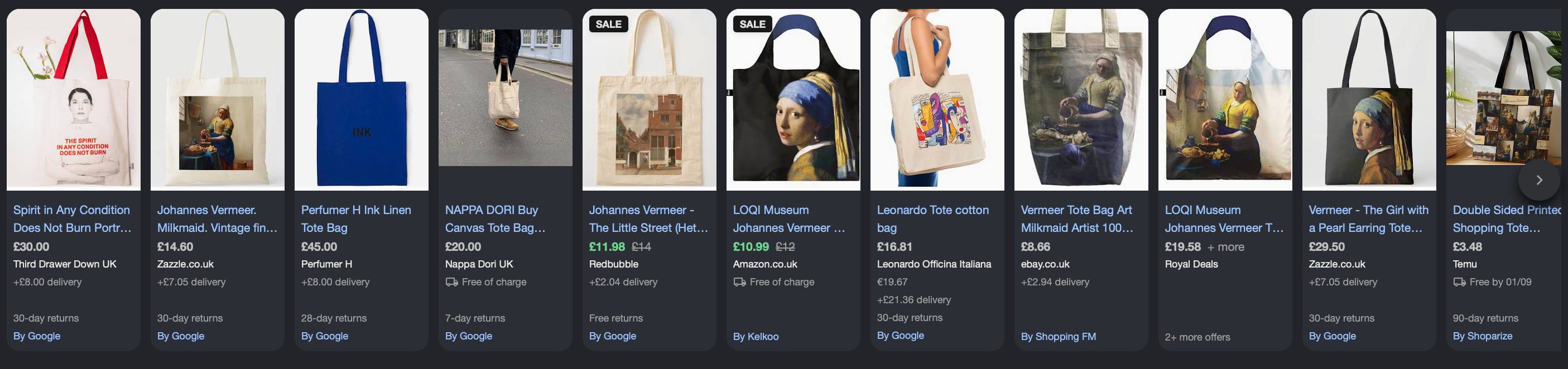
So if you think about it, this whole ‘tote bag’ model has been spreading across the watch industry quite a bit over the last 7ish years. Hajime Asaoka is known for his 6-figure watches but off the back of his name alone, they launched Kurono Tokyo in 2019; they used cheap movements, told everyone it was Asaoka’s design language, and charged people $1,500 to $3,500 for the service. Max Büsser did the same with M.A.D.Editions in 2021. Andreas Strehler launched STREHLER in 2023. Bart and Tim Grönefeld saw the light in 2024 and launched Grøne Oldenzaal at €2,150 a pop. Théo Auffret worked on the SpaceOne. Stepan Sarpaneva might just be the ultimate ‘OG’ in this racket because he’s been running S.U.F. Helsinki since 2004 - so yeah, 15 years early and, as usual I suppose, mostly uncredited for the ingenuity.
Now you might look at this and think it’s all about the cash… I think that it’s partially about cash - they are running businesses after all - but there’s more to this. We know from previous essays that M.A.D.Editions makes about a third of MB&F’s revenue… so that’s around CHF 17m so between 5-6k watches; a third of the revenue for nearly 15x more watches, prepaid directly to the brand, with no retailer margin and no stock being held in safes around the world. Per Max Büsser in this interview: “There are no retailers, there is no stock, and no one can try one on before registering for the raffle.”
I wrote about this at the time, but the Green version of the M.A.D.1 had around 22,000 raffle entries for a total of 1,500 watches, which means at least 20,500 people got nothing. You’d think that most of those raffle-losers were never really considering a 200k MB&F anyway, so they don’t really count as part of the MB&F ‘queue’ at all.
But the thing is, there are in fact two doors to think about here. Not getting an MB&F allocation will leave a few hundred people in the queue; these are people with money but no invitation to the tribe. Not being able to afford an MB&F is a price/affordability issue, and this shuts out a few thousand people. But in the end, this is the same feeling for both parties… there’s a brand you love, and they make objects you can’t have. So the price is really just a different version of ‘scarcity’ in this picture.
That must mean that the so-called ‘queue’ isn’t just the waiting list because it must include everybody waiting outside - regardless of how they came to be there.
Why does it work to go down the ladder?
What is a brand, anyway? Turns out I wrote a long story about this which you can read another time. From that essay, I will quote: “a brand is the sum of all emotions that a customer feels when thinking about a particular product.” It’s basically a promise about some kind of value, and whatever price they charge is just an outcome of the sum total of the promises the buyer has understood from the brand. Does MB&F make expensive watches or do they make whimsical watches? I’d argue it’s more the latter, and my point is that a brand is not a price at all - or at least, it shouldn’t be.
And so, a brand can travel as far as they want along their own axis, in any direction, because their customer already believes in that specific axis. What they can’t do, is switch axes; because doing that would be asking the customer to believe something new about the brand. For me, that’s a tall order, and it’s way more difficult than asking that people believe something similar at a different price.
Can you guess what MB&F’s axis is? I’m sure you will guess this easily or get very close, but I think theirs is imagination. We’re talking frogs, spaceships, cars, and robots… basically an iron clad conviction that a watch can be a toy for grown adults with too much money. And indeed, all the M.A.D. watches still fulfil the same promise at a fraction of the price of an HM or an LM… nothing has to change in the buyer’s head, and that’s true regardless of price.
So I have a theory… if you’ve got more money than you know what to do with, and you’ve never bought a whimsical watch, spending 200k on a spaceship or 380k on a robot is wild bet on some sort of ‘taste’ you don’t really know you have. On the other hand, spending a few grand is not even a bet to you… it’s more like a dabble. Even if you can afford an MB&F, buying the M.A.D. watch is a cheap way to test your taste for whimsy… and then, some fraction of rich folks will maybe discover that yes, actually, they love it. After that, they just need to work out how deep they want to go... more subtle with an LM, or downright loopy with an HM… anything is possible.
So get this… the whole ‘gift shop’ business may be bringing in a handful of new top-tier clients every year, and if that’s true, it would be outperforming every community event in the industry - and the funny part is that those events cost money but this gift shop makes money. Where else in luxury have you heard of a marketing channel which brings in clients at negative cost?