

Louis Vuitton’s New Watch and A Story You Have Never Heard
How an anarchist smuggler, an Italian business man and a dose of “sprezzatura” may be responsible for LV's new Monterey

A few months ago, Ryan Goddu dropped an image into a WhatsApp group I’m in. It was a beat-up watch from some Italian auction house; rough condition, and branded with a name I didn’t recognise. But something about it caught my eye… The lugless case, the oversized crown at 12 o’clock, that pebble-shaped silhouette. It looked familiar; very much like the Monterey I wrote about when it was recently launched.
I messaged Ryan to find out more, but he didn’t have much to share at the time - just a curious listing he’d stumbled across. So I did what any reasonable person would do… I asked him to dig deeper, chase the thread, and write the whole thing up. I promised that if the story was interesting enough, I’d share it here.
Lucky for us, I think he delivered!
What follows is entirely Ryan’s work - the research, the picture sourcing, the sleuthing, all of it. He’s traced an obscure 1960s Italian watch through Swiss smugglers, anarchist newspaper editors, and eventually into the orbit of Gianni Agnelli himself. Whether it proves anything definitive about the origins of the Monterey is for you to decide… But frankly, this is exactly the kind of horological detective story I love reading, and I hope you do too.
You can find Ryan on Instagram at @WatchToDoToday and listen to him speak on the Waiting List Podcast as well. Without further ado, here’s Ryan’s story - and before we go any further, a huge thanks to Ryan for taking the time to prepare this fun story 🙏.
Estimated reading time: ~13 minutes
What we know so far
In early October 2025, Louis Vuitton (re)released The Monterey. A passion project for LV’s Director of Watches and new industry darling, Jean Arnault. The watch is time-only and powered by an automatic, in-house movement. Cased in 18k gold, it features a Grand Feu enamel dial, all created by La Fabrique du Temps, Louis Vuitton’s artisanal watchmaking division. It’s beautifully made, there is no doubt about that, but it comes with an eye-watering price tag of 56,000 EUR.
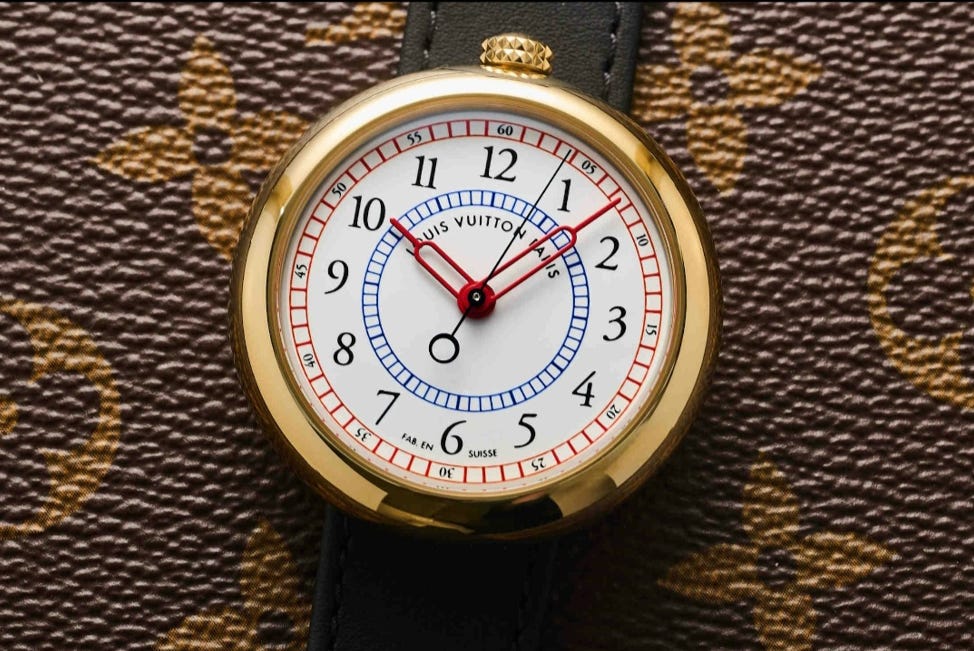
Around 2000 years ago Latin writer Publius Syrus said “everything is worth what its purchaser will pay”, but what about this watch makes it desirable to a purchaser at 56k? If I were to describe the watch in the most basic sense, it’s a round watch, with a crown at 12 O’clock. On paper, its not groundbreaking, when you consider thousands of pocket watches that came before it are of a similar configuration. And this new piece is not displaying any high complications or complexities that justify the price, but focusing on these things would be missing the point. This watch is not about stats or specs. It’s a design watch and the details are what matter most.
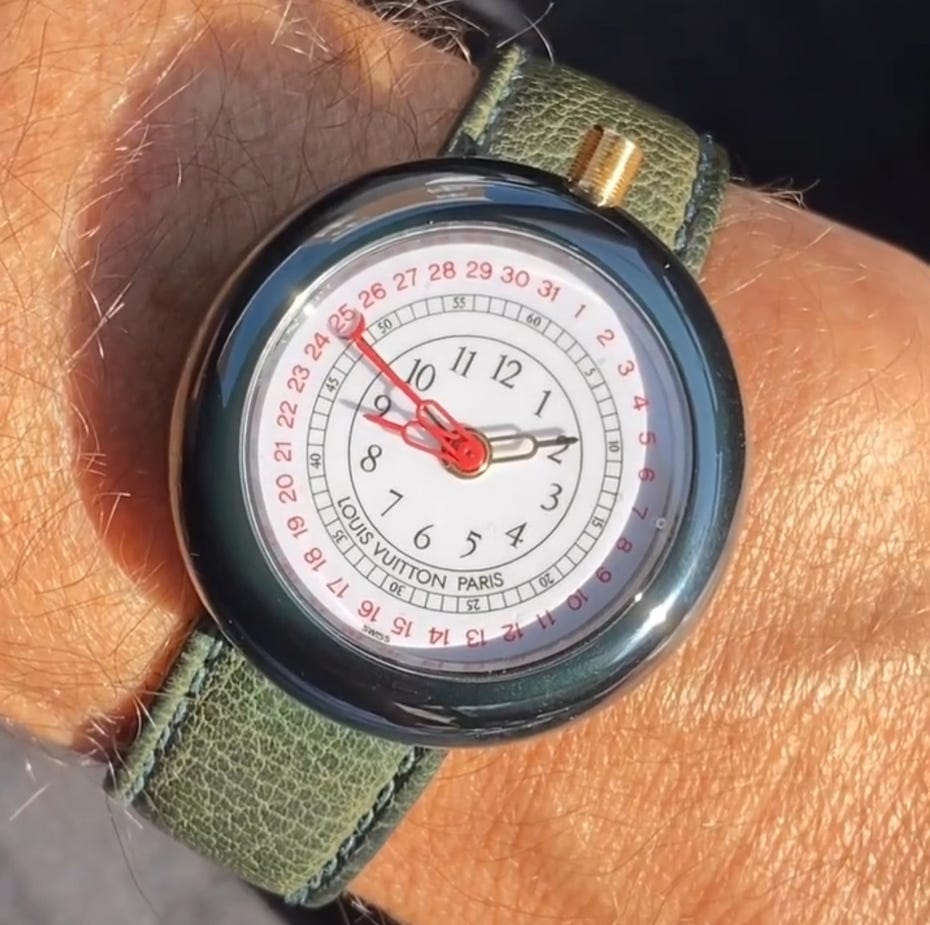
Released originally in 1988, the inspiration for the above watch was the LV I and LV II, designed by renowned Italian Architect and designer Gae Aulenti who had just completed her most notable project transforming the Gare d’Orsay in Paris from a train station into the Musee d’Orsay in 1986. The LV I and LV II were Louis Vuitton‘s first foray into watchmaking, produced by IWC for the maison. It was organically dubbed the “Monterey” apparently because American LV customers had difficulty pronouncing the French word “montre” (watch) which was being used while they shopped it to their VIPs. The nickname stuck and was adopted officially in the 2025 re-release.

What made the “Monterey” stand apart from the crowd was the design details. It was not just a round case, but the edges softened into what’s best described as a pebble shape. The lugs were completely removed, making the watch seemingly float on the wearers wrist. The crown placed at 12:00 was not for function, but a prominent design feature, standing tall and extending from the case much further than it would on a more conventional wristwatch. The combination of these elements together give the watch its sense of identity. Even for someone with Aulenti’s resume, to design a wristwatch on your first attempt, and have it leave a lasting impression on an industry filled with people who obsess over details, is a remarkable accomplishment. Was it purely a stroke of genius, or could there have been something she drew inspiration from?

Despite standing apart from other watches design-wise, the LV I and LV II were not immediate successes from a commercial standpoint and were produced in limited numbers overall. Hidden in obscurity for most of the following few decades, the combination of design, rarity, provenance, and a recent revival of LV’s watchmaking division all contributed to these models gaining interest over time. Fashion insiders like Tyler the Creator were seen wearing these pieces and watch TikTok star Mike Nouveau along with artist and taste-maker Phil Toledano helped thrust the Monterey into the spotlight in 2023 by sharing the stories above on social media, subsequently sending prices soaring and providing some justification for the price tag we saw LV assign to the re-release. Personally, I like the design and while the proverbial ship has already sailed, I still secretly hope to find an original discarded somewhere for a bargain.
The mystery watch and the story you haven’t heard
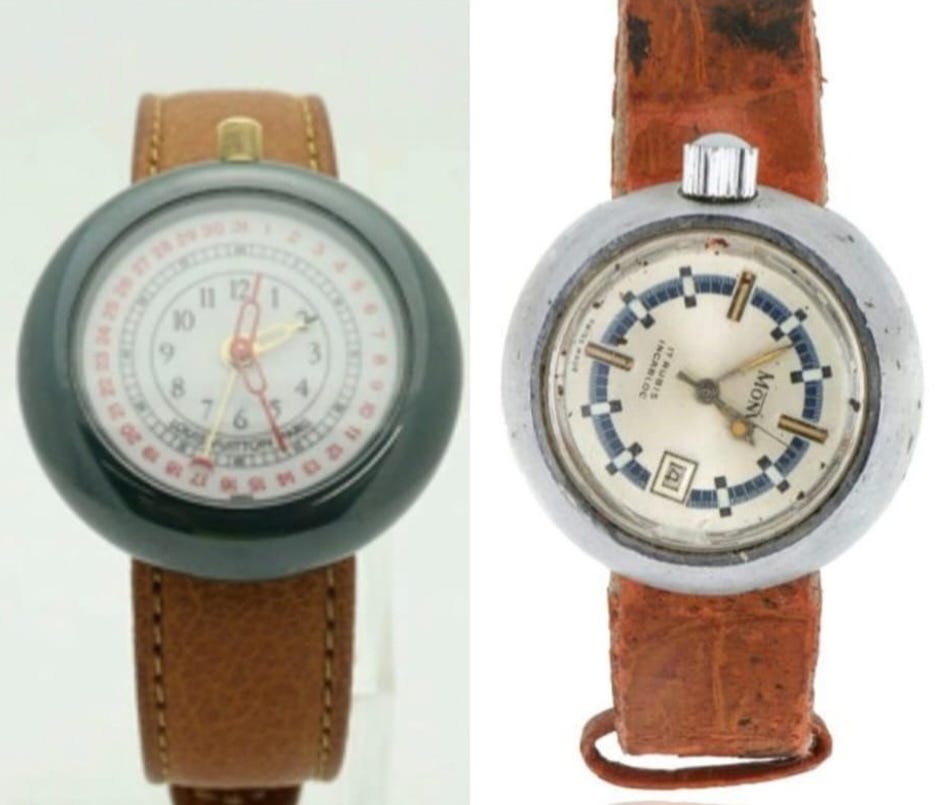
A few months after the Monterey re-release, I was on my nightly watch scroll sifting through the deepest, darkest corners of the internet, hoping to find a hidden gem. I was not searching for a Monterey in particular, but anything that piqued my broad interests. I came across an unusual listing at an Italian auction house. The watch was in poor condition with the dial seemingly detached and rotating within a severely worn case, the strap deteriorating and the brand name on the dial one that I admittedly did not recognize: “MonVis”.
There was no feature, no detailed catalog notes, or big estimate to draw attention to it but somehow the watch still stood out to me. A lugless case, smooth rounded bezel and an oversized crown featured proudly at 12:00. It was a design I recognized from the Monterey. There are plenty of watches that look the similar to one another, “perhaps this brand had copied Louis Vuitton?”, I thought. But the watch looked vintage, with what I would describe as a rally style dial that was reminiscent of watches made in the 60s and 70s, well in advance of the 1988 debut of the LV I design. My interest had officially been piqued and I decided I had to learn more about this mystery watch.
Before we dive in further, I want to state that my intention here is not to tear down Gae Aulenti or the Monterey. Rather, I hope to explore if there is an undocumented influence or untold origin story to her creation. There is no doubt in my mind that she improved and elevated the design, but in the spirit of horological scholarship, I think it would only be fair to highlight a forgotten piece that could have indirectly led to the high-end La Fabrique du Temps version of the watch decades later. In order to determine if this watch really could have been influential in Aulenti’s design, I would need to learn a few things. Who was responsible for making it? When and where was it made? And finally, was it plausible or likely that Gae Aulenti could have been exposed to it before designing the Monterey for Louis Vuitton? And so my search began there…
The Italian business man and an anarchist smuggler
The first set of questions I attempted to answer were the more factual, who, when and where was it made. I knew that the watch was branded with the name “MonVis” so a quick search was able to locate a web-page for the modern day version of the company. Proudly posted at the top of the page it states “Swisse Made Watches since 1962” but as I continued to dig, I found the identity of this brand was more of an Italian story. In 1962, Franko and Palmiro Monti, brothers and Italian business men, set out to create a watch brand (Although it is Palmiro who seems to have been the driving force among the duo). It’s name created by combining the start of their surname “Mon” with the Latin word “Vis” which means Strength or Power.
MonVis seems to have been sold primarily, if not exclusively, in the Italian Market, but the watches were Swiss made and MonVis was registered in Switzerland as a trademark under the Dux S.A/ N. Praz / IPO S.A. manufacturing company in Biel which held many different brand names and trademarks in Switzerland.
This manufacture company was owned by Narcisse Praz, an interesting character in his own right. Born in Switzerland in 1929 into a poor family, he was sent to the seminary for education but was eventually expelled. In 1951 he became an employee of Beltex Watch SA and eventually Nicolet Watch SA where he married Charles Nicolet’s daughter. Following this he wrote books, plays and even a film before eventually creating his own watch brand and manufacturing company which he used to produce watches and smuggle them across the Swiss boarder into markets facing certain Swiss import restrictions, like Italy.
He was arrested in 1965 for his smuggling activities and in 1966 he sold his watch companies to Charles Albert Brandt of Le Locle (and the same Brandt family known for its ties to Omega). Following this he moved to Paris, was divorced, suffered a heart attack, and would have to straddle the worlds of cinema and watch smuggling to make a living for the next few years.
In 1970 he founded a satirical news paper which displayed Praz’s leanings toward anarchy. He was sued by the Shah or Persia for slander, leaving the paper in financial trouble and leading to it’s close in 1975. Praz would eventually return to watchmaking and get back on his feet over the next ten years. Certainly an interesting life, but it is his factories that play a role in this watch story.
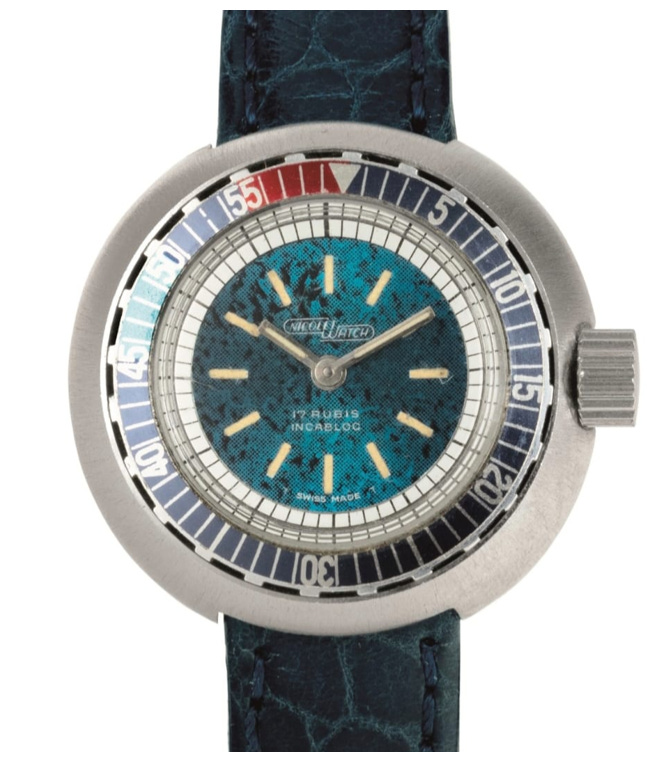
In all of my searches, I couldn’t find any other examples or info about this top winder/disco volante style watch from MonVis, but I did find a photo of the Nicolet Watch below which appears to have very similar shape and large crown, albeit positioned at 3:00, as a more traditional watch would have.
As mentioned, Narcisse Praz, was married into the Nicolet family, so one theory could be that his factories, which produced watches for many brands, could have produced similar designs for Nicolet first (or even if made in separate factories, Praz would have at least been around similar designs as they were being produced) and later tried experimenting by moving the crown around - possibly to appeal to the more design-focused Italian market that MonVis targeted.
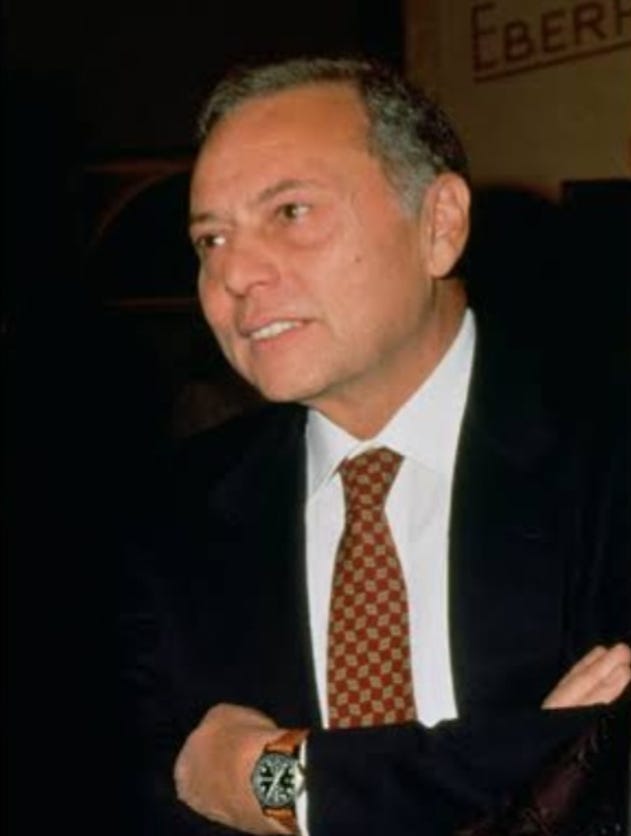
The MonVis brand closed for business in 1977, apparently succumbing to pressures from the quartz crisis. But it appears the majority of the MonVis pieces I found online were produced in the 60s; probably because Palmiro Monti purchased the Eberhard watch brand from Charles Albert Brandt (the same man that bought Narcisse Praz’s factories) in 1969 and shifted focus toward the more storied and successful company where he managed the brand for 35 years until he passed away and was succeeded by his daughter. Monti is credited with bringing multiple collections and watches to market with Eberhard including the “8 days” and the “Chrono 4”, to name a few. This timeframe with the MonVis company means the mystery watch I was researching was definitely made before the LV Monterey, which came out over a decade after MonVis closed its doors.
Now that I knew who made this watch, where it was produced and when, I needed to determine if Gae Aulenti could have plausibly seen this watch before drawing her designs. Gae started her career in the 1950s and was deeply embedded in Milan’s vibrant post-war design and cultural scene. Her social circles were said to revolve mostly around professional networks but I was unable to find any direct connections with Monti or Praz despite them all being of similar age and sharing overlapping timeframes in their careers and locations.
I think the more likely scenario is that one of Gae’s high society or design-minded acquaintances could have worn this watch around her at some point.
The style icon and a touch of sprezzatura
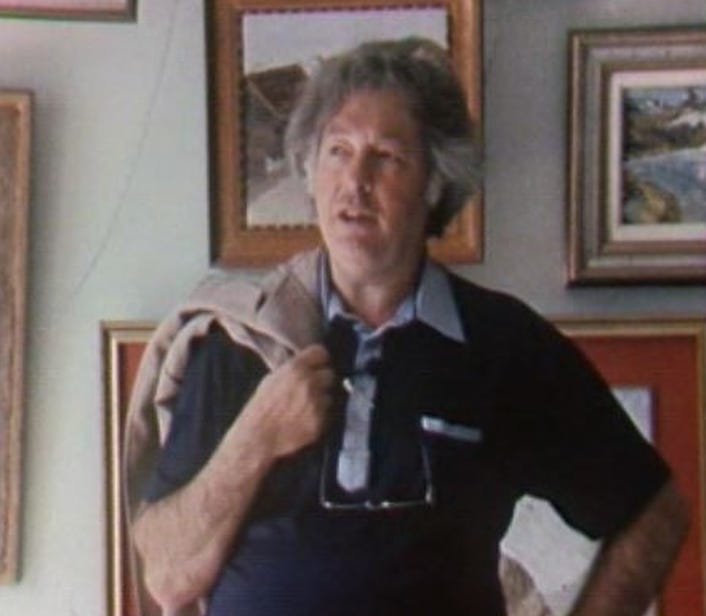
So who was Gae Aulenti keeping company with during the 1960s and 70s? For that I turned to our sponsors, over at Perplexity AI… (I’m kidding, I could not send this article to kingflum without at least one bad joke… of course I used Grok 😉). I was able to identify three of Gae’s close acquaintances with ties to the watch world. The first being Gae’s longtime friend and companion Carlo Ripa di Meana.
Despite never marrying, the two were long term partners and lived together for over 30 years. Ripa di Meana went on to co-edit the 2012 bilingual biography Gerald Genta: The Master and His Art along with Osvaldo Patrizzi. Despite playing a prominent role in this project, I believe Patrizzi (a renowned auctioneer and watch expert) likely provided the bulk of the horological content and Ripa Di Meana complemented him from a cultural and artistic standpoint. The book was also published much later and while Carlo Ripa di Meana was an important figure in Aulenti’s life and may have had an interest in watches, I don’t think he is our culprit.
The next suspect was Aldo Rossi, Gae’s close friend, fellow architect, and designer. Aldo designed the “Momento” watch for the Alessi design company. The Momento watch is a convertible piece that could be worn as a pendant watch (interestingly with its crown at 12:00), and then can be fitted into a hollow case that allows it to be worn as a conventional wristwatch. Although this has some similarities, it was designed in 1987, meaning it would have been created at nearly the same time as the Monterey. Besides Rossi’s work on the Momento, I was unable to find any other evidence of him being deeply embedded to the watch scene and believe it would have been unlikely that he owned or wore our mystery watch decades earlier.
The final connection was through her best friend Marella Agnelli, who was said to have a profound friendship with Gae, starting in the late 1950s and lasting more than half a century until Aulenti’s death in 2012. Marella was married to Fiat heir Gianni Agnelli. A charismatic automotive giant who was a central figure in Italian public life during the era. Gianni had impeccable style and was known as the “Rake of the Riviera”, a nickname that was said to have been the inspiration for the Rake magazine‘s name (Wei Koh can kindly confirm in the comments, please).1
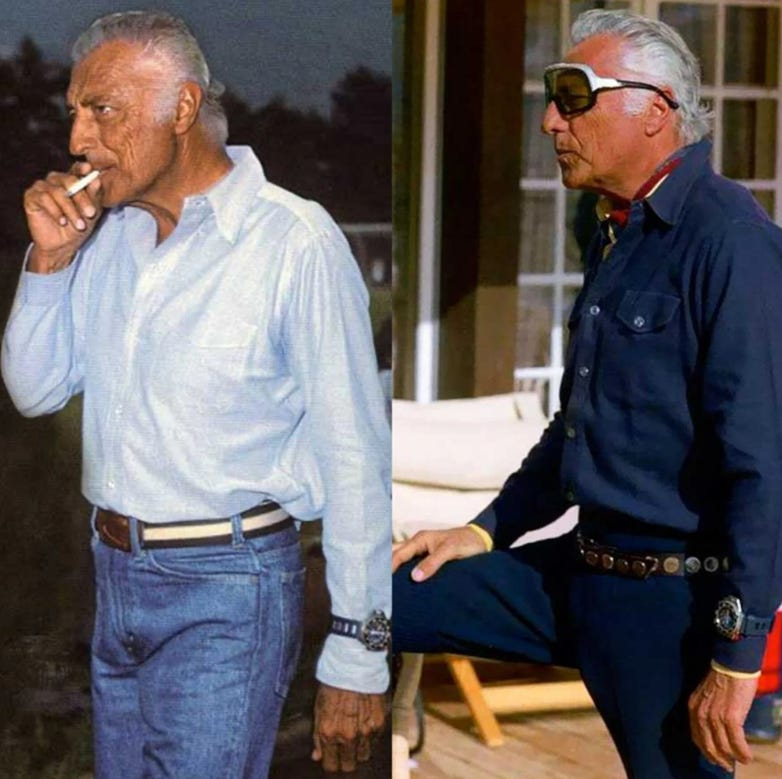
Agnelli was known for mastering the Italian ideal of sprezzatura, or the art of making difficult things look effortless. He would deliberately introduce small imperfections or rule breaking touches like wearing boots with fine tailoring or slightly askew ties.
In addition to being a style icon, Agnelli was a legendary watch collector, often seen wearing his watches “over the cuff”. His collection included eclectic, design-forward pieces and also sporty watches like the Omega Ploprof and a Porsche Design chronograph. During my search I noticed that at least two of the watches he was photographed wearing (a Cartier and an Audemars Piguet, pictured below) were converted pocket watches with their crowns positioned at 12.
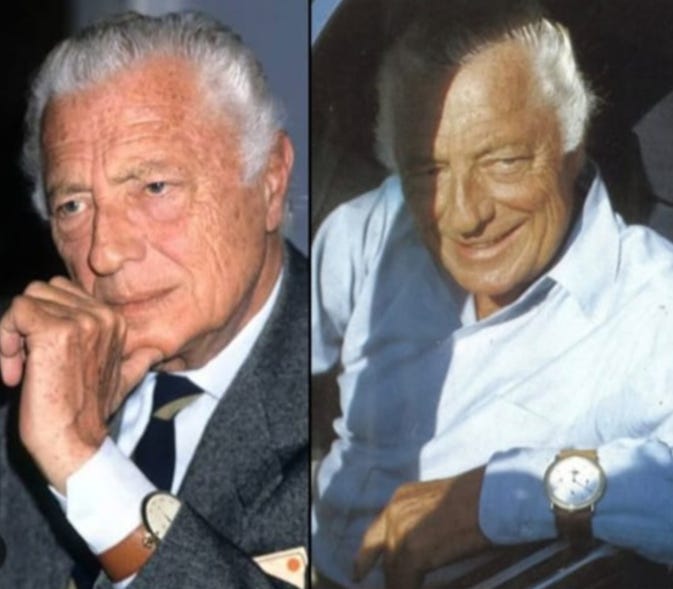
I think it is fair to say Agnelli had an affinity for this style of watch, something thoroughly Italian, sporty, perhaps automotive inspired with a rally dial and a crown at 12, just askew from where the rest of the crowd would have it.
Does this prove that an obscure MonVis watch released in the 1960s was the origin of the LV’s new release? Not exactly, but I would say it is certainly plausible that as part of Agnelli’s large collection of watches, he may have worn this design in the company of Gae Aulenti. Maybe she didn’t even intentionally emulate it but it had just left an impression on her. Either way, I am glad she did, or else it, along with the stories of Monti, Praz and the MonVis mystery watch could have been lost in time.
As I looked over my research, with cans of empty Red Bull piling up on my desk and a web of red strings strewn across my office walls connecting photos of obscure watches with Italian high-society... I thought to myself “Am I crazy? Could this story all just be a figment of my imagination?”, I cried out “Give me a sign!” and just then, as if the watch-gods were smiling down on me, a video appeared on my computer screen of Louis Vuitton’s 2025 Fall/Winter fashion show.
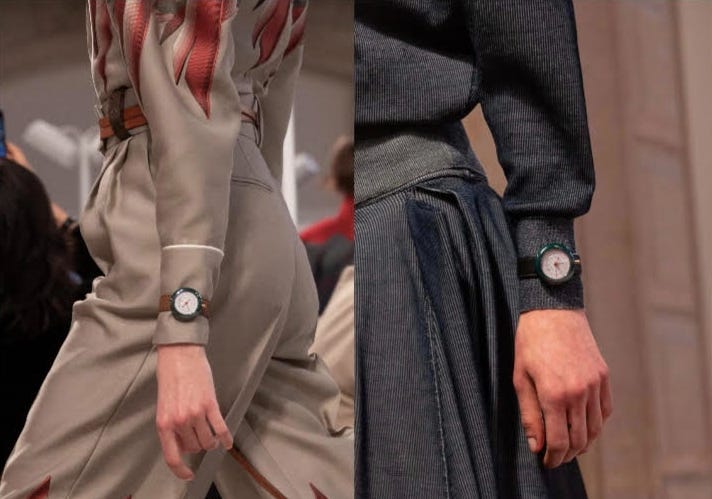
Models, one by one, walking down the runway wearing the 1988 Monterey. The event was perfectly curated down to the last detail. And how did they choose to display the watch? Of course, it was over-the-cuff, just as Gianni Agnelli would have worn it. Was this merely a coincidence? I’ll let you be the judge.
I would love to know what you think in the comments.
Special thanks to kingflum for letting me use his platform and encouraging me to tell a watch story, in long form, and to do it in my own words. I had a blast researching it and if you have interest in learning more, I have included some links below that I found extremely helpful in piecing this tale together.
Links:
Mikrolisk - Horological trademark index
Editor’s note: Wei Koh blocked me a while ago, so he probably won’t be commenting here!
So interesting 🤩
Not much is new or truly original . The converted pocket watches Agnelli is seen in all looked similar to the LV Monterey. And the MontVis would’ve been a clear inspiration in the Italian designer elite. A bonus; the MontVis company was no longer a threat to complain about the Monterey when it was released. But LV wants no association with any dead brand, let alone a lower status one than they perceive themselves to be. So even with definitive proof I think there’d be a flat denial that the LV design is anything other than a singularly unique divine inspiration - justifying its divine price.