
Loot Boxes, Long Degeneracy, and the Watch World's Gambling Problem
Luxury Bazaar just partnered with Courtyard.io to sell mystery watch packs. The maths are terrible for the buyer, and the theory of why all this exists is pretty interesting.

Two bizarre stories broke in the space of 48 hours; the first was Watch Futures; the Kalshi-Bezel prediction market I wrote about here, and the second is this collaboration between Luxury Bazaar and Courtyard.io:
Both of these announcements are best described as ‘infrastructure for thinking about watches as financial assets’
Estimated reading time: ~12 minutes
The concept, as explained on the website, is as follows:
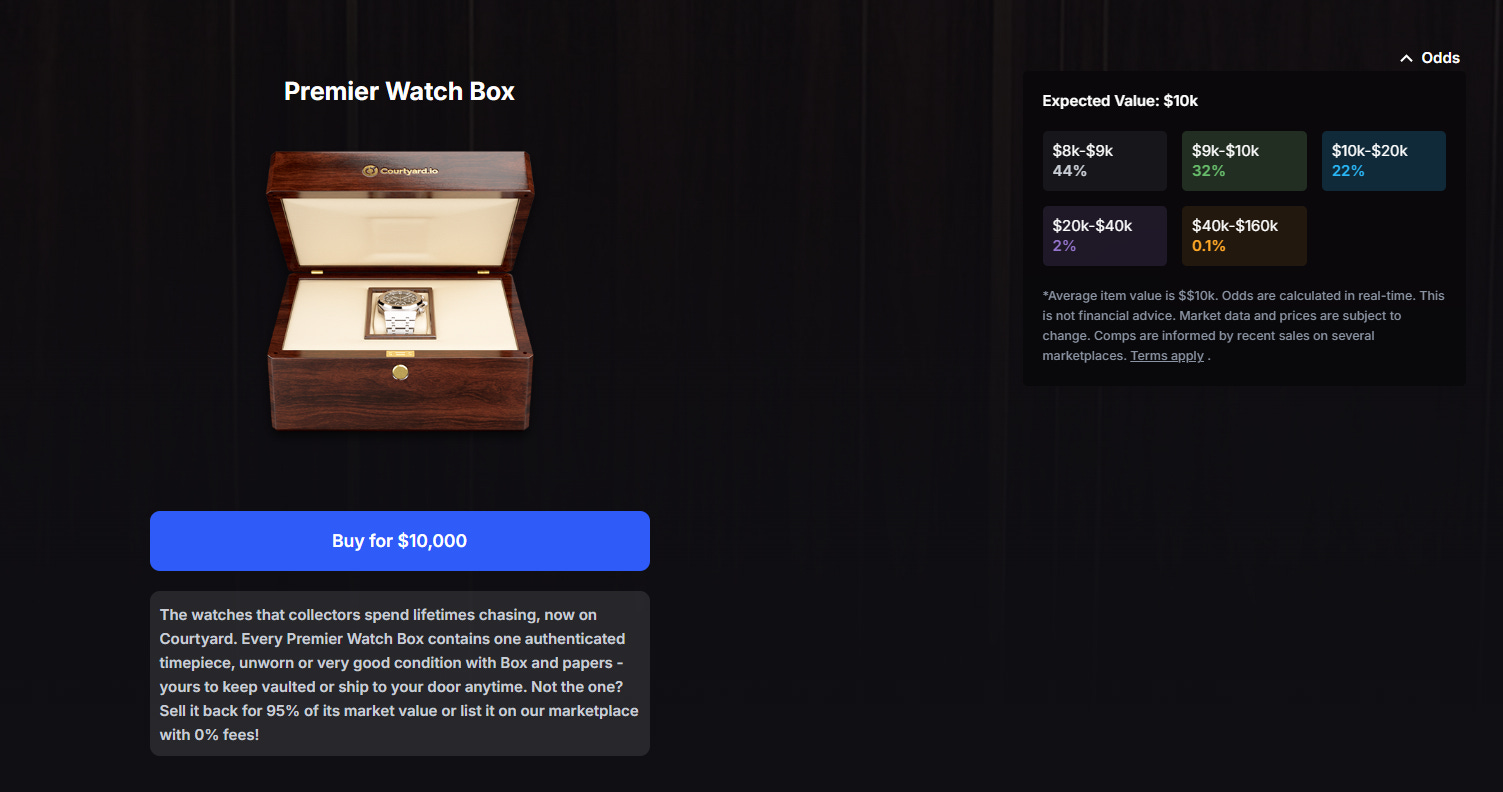
“The watches that collectors spend lifetimes chasing, now on Courtyard. Every Premier Watch Box contains one authenticated timepiece, unworn or very good condition with Box and papers - yours to keep vaulted or ship to your door anytime. Not the one? Sell it back for 95% of its market value or list it on our marketplace with 0% fees!”
We really should call a spade a spade… this is a loot box, or close enough anyway1. The mechanics (variable reward, surprise reveal, gamified unboxing) are the same ones which Belgium’s Gaming Commission classified as gambling in April 2018, and that the Dutch Gaming Authority also flagged2 in the same year. The underlying asset being an authenticated watch rather than a digital sword or whatever, doesn’t change what happens neurologically - and I’ll come back to whether that comparison is entirely fair in a bit.
A friend who read a draft of this essay pushed back on that framing by the way; a watch, he argued, is something in a way that an NFT or digital collectible simply is not. He mentioned how watch collecting has survived the quartz crisis and the smartwatch, and I reminded him how The Bored Ape Yacht Club did not survive 20233. He is right that there’s a worthwhile distinction to be made; physical objects tend to accumulate more ‘legitimacy’ over time and purely digital speculation struggles with this. But my point is meant to be narrower; the whole ‘gamified acquisition’ mechanics are the same, even if the thing you’re acquiring is real and enduring. The dopamine hit from opening the box doesn’t know the difference between a digital Bored Ape and a physical Rolex - it’s all about the neurological reaction.
Anyway, let’s take a quick look at the numbers.
The Premier Watch Box is priced at $10,000 and Courtyard publishes the probability breakdown for what you might receive. Using the midpoint of each payout range and multiplying by its probability gives you an expected value of ~$10,780 which, on the surface, sounds mildly positive.
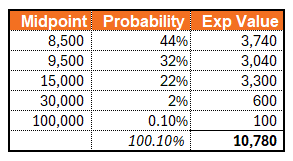
The thing is, that number ($10,780) deserves a lot of scepticism, and I’ll get to why in a moment. First, let’s just look at the mechanics. The top tier ($40,000–$160,000) carries a probability of 0.1%, so one in a thousand. If you’re thinking “well, 1,000 attempts and I should hit it once”, that’s not how probability works. If you play exactly 1,000 times, you have roughly a 63% chance of hitting it at least once.
Using the probability formula P = 1 - (1 - p)^n4 here’s how many tries you’d need to hit the top tier at least once:
50% Chance (A coin flip): ~693 attempts
If you try 693 times, you are equally likely to have hit the top tier as you are to have missed it.
75% Chance: ~1,386 attempts
At this point, it is statistically more likely than not that you’ve hit it.
90% Chance: ~2,302 attempts
Highly likely.
95% Chance: ~2,995 attempts
Very highly likely.
99% Chance (Near certainty): ~4,603 attempts
Even with a 99% probability, there is still a tiny 1% chance you could try 4,603 times and STILL never hit the top tier.
If these numbers mean nothing to you, here’s a straightforward takeaway: to get to 95% confidence, you need to make nearly 3,000 attempts - at $10,000 per box, that’s $30,000,000 (thirty million dollars) spent to be ‘very highly likely’ to win a watch worth somewhere between $40,000 and $160,000.
In other words, the house is most definitely not losing sleep over this arrangement.
For the 76% of outcomes sitting in the two lowest tiers ($8,000–$10,000 ranges), you’re essentially paying $10,000 to win somewhere between $8,000 and $10,000. You started with $10,000 in real cash… i.e. actual money that can buy actual things… and you end up with a watch, whose liquidation value comes back to you at 95 cents on the dollar if you sell it back.
So even at the best-case outcome in the lowest tier, you’ve paid $10,000, received something worth (at best) $10,000, and absorbed both the authentication and storage overhead that Courtyard built into the pack margin before you ever played.
This is fine as a business model - perfectly legal, logical even. But the 95% buyback guarantee is really just a question of framing; it caps your downside at 95% of the pack price, which itself already carries a premium over the cost of the underlying assets. The guarantee doesn’t protect you from the spread; it is the spread.5
There is also an inherent valuation problem, because the expected value calculation above only holds if the stated ‘market values’ are real (they are not).