
Morgan Stanley's Q2 2026 Swiss Watch Market Report
A recovery in the price of discounts; Patek retakes the VR crown because Rolex killed the Pepsi.

I think it’s fair to say a market recovery will be considered ‘real’ once it stops needing an explanation. As soon as I received this report and read through it, I started to think back to how we got here. When prices turned positive last year, we credited the 39% tariff and the panic buying that came with it. Then when Q4 kept climbing, we pointed at retail price increases, gold, and a weakening dollar (and strengthening Franc); so more like a rise measured with a shrinking ruler… point being, every recent quarter of growth has had some sort of asterisk or fine print which implied exceptional circumstances.
So how about this time? Maybe the asterisks are running out? Let’s see.
Disclosure: WatchCharts provides all the data in the report. They don’t pay SDC for advertising, and SDC does not pay WatchCharts for this report.
Estimated reading time: ~13 mins
Key Findings
There are a couple of key takeaways from the quarter (charts shared in the sections below)… The WatchCharts Overall Market Index rose +1.5% quarter-on-quarter - the fourth consecutive quarter above +1%. The pace has however slowed from +2.5% in each of the last two quarters, but the breadth has improved with 27 of 35 brands positive quarter-on-quarter (QoQ), and 29 of 35 positive year-on-year (YoY).1
All four Swiss groups are now positive year-on-year for the first time since early 2022. Rolex SA +6.9%, Swatch Group +5.4%, Richemont +4.2%, LVMH +4.1%. That’s perhaps noteworthy… that the listed groups (the ones we’ve been describing as donors of market share) are now growing on the secondary market.
Watches & Wonders is supposedly now ‘a market event’ as opposed to just being a trade fair. April was the single best calendar month since March 2022 (+2.5%), driven by record anticipation for the show; May and June then gave back a full percentage point as the surge of new listings outran demand. Shocker.
Patek reclaimed the value retention crown at +15.4%, and Rolex slipped to +9.8%; this is due to Rolex discontinuing the Pepsi, since that was the watch propping its number up. More on this below… it’s funnier than it seems.
Rolex CPO posted record sales of $186 million, up +67% YoY. Here’s a batsh1t statistic for you… half-year sales already equal two-thirds of all of 2025, and the growth now comes from existing retailers selling more, with barely any new doors joining.
Secondary Prices
There is a fair bit of nuance here because the headline (+1.5%) hides a very lopsided shape across the quarter. Essentially all of the growth happened in April. The tracker rose +2.5% in that single month, then fell -1.0% across May and June combined.
In April, Watches & Wonders happened, and this year it seemed to have had a huge impact. Search interest for the fair set a five-year record (the report includes the Google Trends chart (shown below), which looks like a heart monitor detecting a major cardiac event). They reckon this was fuelled by two stories the collector internet could not stop chewing on… the anticipated discontinuation of the GMT-Master II “Pepsi”, and Patek’s 50th Anniversary Nautilus releases.
Now, back to the funny story about the Pepsi. You’d assume the Pepsi discontinuation (which did indeed happen) sent Pepsi prices to the moon, right? Well, no... Pepsi prices fell -2.3% in the quarter. Buyers had spent so long front-running the rumour that by the time Rolex made it official, everyone who wanted one at silly money already had one. And all the clowns who bought the rumour had nobody left to sell the news to. Not gonna lie, my schadenfreude was off the charts (lol!) with this revelation. Regardless, Rolex’s gains came from the dressier end of the catalogue… Air-King +2.1%, Datejust +1.7%, Sky-Dweller +1.6%. The hype cycle and the market spent the quarter pointing in opposite directions, and I guess the market won.
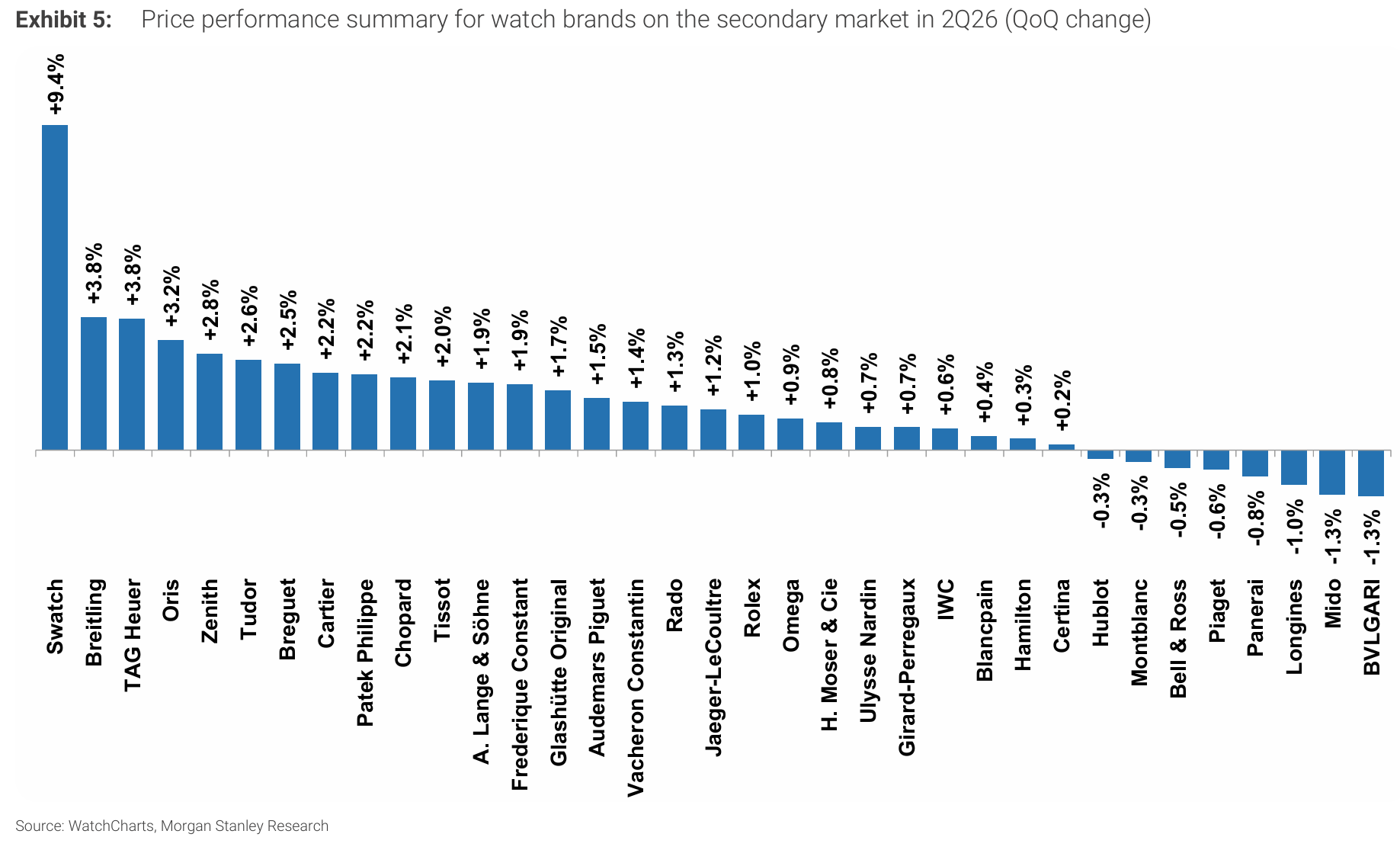
Patek (+2.2%) and AP (+1.5%) both rose, with the same April-loaded shape as everyone else. Patek’s gains were led by the Aquanaut (+3.6%) and, no prizes for guessing in its anniversary year, the Nautilus (+1.7% on the tracker; the in-production models MS uses for value retention did +5.0%). You will not be surprised to learn AP remains a one-watch brand on the secondary market… Royal Oak +2.0%, CODE 11.59 (-0.5%) and the Offshore (-1.5%) continued their long impressions of a shrinking helium balloon one week after a kid’s party (my own kid recently celebrated a birthday so it’s in my head!).
Now, on to the mid-tier… which seems to have a new story to tell. TAG Heuer rose +3.8% QoQ and +9.9% YoY, driven almost entirely by its motorsport collections - Formula 1 +5.0% in the quarter, and Monaco +2.2%. That F1 timekeeper deal (the one I mocked when the Q1 2025 report showed TAG dropping -4.1% despite the sponsorship) seems to be working? Perhaps I was wrong, and it needed a year to show up in the data. Breitling matched TAG at +3.8%, with broad gains led by the Superocean Heritage (+4.5%) and Chronomat (+4.4%).
“So the mid-tier brands are back?”
Ha! Hold that thought until the value retention section… secondary prices rising +5% on something selling at 40% of its sticker price is... well, it’s something, but I wouldn’t call it ‘being back’.
Group Dynamics
For the last couple of years the pattern in these reports has been that private brands have gone up, and listed groups have gone down. That pattern is not as clear this time.
All three listed groups posted sequential gains: LVMH +1.7% (best of the three, of all things), Richemont +1.3%, Swatch Group +1.0%. And all four groups, Rolex SA included, are positive year-on-year for the first time since early 2022. LVMH still has an old (inherent) problem, in that it lacks a solid ‘anchor brand’ with decent secondary market share (like a Cartier), so its long-term chart still trails the pack. But on the bright side, Hublot has stopped falling (-0.3%, effectively flat), Zenith rose +2.8%, and the group is no longer the automatic punchline of this section.
I need a new punchline. Send suggestions. Here’s a couple more charts to tell the story:
Within Richemont, Cartier (+2.2%) is still the machine that it is, and Vacheron posted a third consecutive quarter of recovery (+1.4%, Overseas +1.6%). Even Jaeger-LeCoultre rose +1.2%, and what’s more interesting is that Richemont happened to report its June-quarter sales the same week this report came out. MS triangulated that Cartier’s watch business grew more than 20% year-on-year at constant currency, and that the Specialist Watchmakers division grew +8%, with Vacheron, Lange and JLC all estimated to be up by double digits.
The reason this is interesting, or at least why it should be interesting to you, is because last quarter’s report contained the wildest sentence Morgan Stanley has produced in years… and I promised we’d keep an eye on it. They wrote that improving secondary conditions were “unlikely to translate directly to the primary market and may, in some cases, come at its expense.” Secondary recovers, boutiques suffer; that was the thesis, and at the time it seemed quite plausible. Why pay retail when the same watch is available pre-owned at a 35% discount with the depreciation already priced in?
And yet. Here is Richemont growing its primary watch sales by double digits in the same quarter where the secondary market broadened its recovery.
So how the fvxk does that work? Are people just that stupid? I guess there are 2 options: (1) Maybe the cannibalisation thesis is wrong, and a rising tide lifts both markets; so secondary strength rebuilds confidence, and confidence sends people back to boutiques… everyone wins, and order is restored OR (2) The cannibalisation thesis is right but slow, and what we’re seeing is one strong Richemont print, flattered by soft comparisons and Cartier doing Cartier things, while the slow and steady migration of value-conscious buyers to the secondary market trudges on behind the scenes.
I obviously don’t have my crystal ball to hand, and I guess neither does Morgan Stanley… who softened their language to “limited pricing power outside the Big Three” and left it there. Being the cynic I am, I think it’s option 2, because the value retention numbers (coming right up) still seem to describe a world where most brands’ products lose a third of their value at the boutique door, and no single good quarter changes that basic maths. Then again, I am also the same guy who was sceptical about the Q3 2025 recovery too… and now we are seeing the recovery four quarters old and broadening. Feel free to update your priors accordingly; I certainly have!
Value Retention
For newer readers, value retention (VR) is the premium or discount an in-production watch trades for on the secondary market versus its retail price, averaged across five markets (US, UK, Germany, Japan, Hong Kong).2 This, for better or worse, is the closest thing we have to a desirability meter, with the standing caveat that it’s intrinsically linked to retail prices; when brands raise prices, VR falls, even if nobody wanted the watches any less.
The headline here is that seven of the eight tracked brands improved on a like-for-like basis this quarter. The one exception is interesting as well, but we will come to that. Here’s the list (paid subs can just view the chart below):
Patek: +15.4% (from +12.5%)
Rolex: +9.8% (from +11.1%)
AP: +3.0% (from +2.3%)
Cartier: -27.4% (from -27.3%)
Omega: -32.3% (from -34.6%)
Tudor: -35.7% (from -37.7%)
Vacheron: -37.2% (from -38.5%)
IWC: -37.9% (from -39.0%)
So Patek is back on top, and the gap to Rolex is widening. Part of that is indeed legit momentum (+2.9pp like-for-like, the biggest improvement of any brand, with the Aquanaut at a +90.1% premium, the Nautilus at +74.0%, and the Cubitus at +62.7%) - here’s the list:
But I think part of the story is really just down to Rolex’s choice with the Pepsi. Rolex’s headline VR fell 1.3 points, yet on a like-for-like basis it improved 1.0 point. How can both be true? Well, duh… because the Pepsi left the in-production list when it was discontinued, and the Pepsi was trading at roughly +85% above retail. Rolex removed the single biggest ‘booster’ from its own average. So Rolex’s desirability is basically the same, and only the maths changed. (Oh, Rolex also raised prices on 1 June: +2.6% on average across all five tracked markets, concentrated in gold models at +5.0% while steel was left untouched). Here’s the Rolex list:
What about Cartier? This was the only brand whose like-for-like VR declined (-0.5pp), and it was entirely self-inflicted. In May, Cartier raised retail prices by +5.4% globally, the largest increase of any tracked brand this quarter, and double the next-largest (Vacheron, at +2.7%). So even though their secondary prices actually rose +2.5%, the boutique simply outran the flip. This is a mini version of the retail paradox we discussed last quarter - your Santos is worth more than it was in March, and worth less relative to what replacing it would cost. I suppose Cartier can afford this game better than most (the Panthère trades at just -13.5% below retail and has appreciated +19.2% in a year, which is Big Three behaviour from a “mid-level” brand), but the formulae are doing what formulae do. If you raise prices faster than the secondary market rises, your VR will erode.
Two other details from the VR data I want to touch on… first is regarding geography. Rolex’s VR is +14.0% in the US and +20.9% in Japan, but just +2.8% in the UK. AP is negative in both the US (-0.3%) and UK (-1.5%). If you’re a UK collector, the maths of buying grey versus retail has rarely been this finely balanced; the premium for skipping the waiting list is nearly gone. Whether that says more about the pound, UK pricing, or British sellers’ desperation, I’ll let you decide 😂.
The other thing is culling; Omega’s VR improved +2.3pp, which looks great until you notice only +1.0pp of it is like-for-like. The rest came from Omega slashing its tracked in-production catalogue from 372 models to 257 - more than ten references removed from each of the Aqua Terra, De Ville, Constellation and Seamaster lines, and the entire Globemaster collection discontinued outright.3 Here’s Omega’s VR table:
I mean, most YouTubers have been saying Omega’s catalogue is too dense, so this is good news, no? But more importantly, is this the new magic recipe? If your brand is going down the value-retention'-slide then the fix is yours in a few easy steps…
Your value retention is fvcked.
Select models with the worst VR.
Discontinue them; now that they’re no longer “in production”, they will be removed from the calculation.
Report improved value retention.
Must feel weird when a number suggests your desirability has improved, but your desirability didn’t actually improve? But I guess AP did it with the Offshore last year, Cartier did it with the Ballon Bleu and Pasha last year, Tudor did it this very quarter with two Black Bay 58s and some Royal references, and Vacheron killed the steel FiftySix Complete Calendars. To be fair, trimming your weakest products is of course legit brand management… which is arguably the whole point of reading these numbers. But I guess the lesson here is that when you see a VR improvement, always check the like-for-like comparison before you start clapping like an imbecile. As you can see here, Cartier is rushing to cash in at retail:
Market Health
The four health indicators are: total supply, absorption rate, age of inventory, days on market.4
The defining feature in this quarter was supply; it reached record or near-record highs for every tracked brand across the past two quarters, driven by a flood of new listings in March and April. The explanation seems to be the same Watches & Wonders story - dealers listed aggressively into the anticipation, hoping to catch buyers at peak excitement. Demand held steady, but steady demand meeting surging supply is how you get April’s +2.5% deflating into May and June’s -1.0%. Basic stuff.
The report’s view on what happens next is rather measured… they believe the 1H26 noise “will have limited carryover into the third quarter,” but the excess supply, particularly for Rolex, still needs to be absorbed. That’s a sort of polite way of saying “don’t expect fireworks in Q3.” Here you can see from the chart how inventory is steadily climbing:
Rolex CPO Side Hustle Grows Up
RCPO sales hit $186 million in 2Q26. That’s another record, up +28% on the quarter and +67% on the year. First-half sales of $330 million already amount to two-thirds of everything the programme sold in 2025, and the second half has been the stronger half in every year of the programme’s existence. So if that seasonality holds true again, RCPO will clear $700 million this year, quite comfortably.
I am in awe, and you should be too. If that plays out, it would place a used watch operation above the annual turnover of many Swiss brands’ entire primary businesses:
That said, the composition of the growth has changed. In 2024 and 2025, RCPO grew by adding doors - 26 retailers at the end of 2023 became 144 by the end of 2025. That expansion seems to have stalled, and only three new retailers joined this quarter. The growth seems to be coming from productivity. The median RCPO retailer sold $899K of certified watches in 1H26, up +56% from $578K a year earlier. And for the first time in the programme’s history, inventory declined quarter-on-quarter, from roughly 11,600 watches to 11,300… which would suggest the CPO stock is finally selling faster than it’s being loaded.
Meanwhile, the CPO premium (extra wedge you pay for the crown’s blessing on a used watch) continues to get smaller… a median of +22.6% now, versus roughly 30% at the start of 2025. The Daytona carries the smallest premium of the major collections at +16.1% while the humble Oyster Perpetual is at +27.9%, which tells you the premium is really a trust fee, and trust matters most where buyers feel least expert.
Anyway, I have been saying since 2024 that the grey market should worry when this premium compresses, because every point of compression converts “CPO is for suckers who overpay” into “why on earth would I buy from a stranger to save 15%?” Well, sure as fvck, the premium is compressing. And as you can see in the charts, the volumes are exploding. You can draw your own conclusion on RCPO, but mine hasn’t changed.
Final Thoughts
Honestly, this was fun, as it’s been a while since we did one of these. So where are we? Well, we’re four quarters into a recovery that no longer needs an excuse, but honestly these numbers don’t tell me that the fundamentals of the market have changed significantly. The Big Three still trade above retail; everyone else still trades at least -27% below it, and the report is clear that this implies “limited pricing power” for the listed groups in the coming quarters. So yes, it’s fair to say the recovery is real and, per Morgan Stanley, it’s also increasingly organic. But it is also, so far, a recovery in the price of discounts. An IWC at -37.9% below retail instead of -39.0% is objectively better, but it’s better in the way that being stabbed in the arm is better than being stabbed in the eye.
For collectors, if you’ve been waiting for the bottom, the data now suggests that was roughly a year ago; the window where everything got cheaper every quarter has closed. The secondary market still offers well-regarded watches at 30% or more below retail with the depreciation pre-paid, and with supply at record highs after the Watches & Wonders listing spree… which means Q3 may be a buyer’s last comfortable quarter for a while. Or not! 🤷♂️
And for the brands, Cartier is still a bit puzzling. It was the strongest non-Big-Three brand on the entire secondary market and it responded to a broadening recovery by raising prices +5.4%, twice as hard as anyone else, and quickly became the only brand whose like-for-like desirability metric fell. Rolex, faced with the same recovering market, raised steel prices by… zero. It’s clear that one of these companies is playing the long game with its value retention, and the other is betting that jewellery-maison brand equity is a renewable resource.
You can ask me in four quarters which was right; you may argue that on current form, I’ll be wrong - but hopefully it’ll still be in an interesting way.
Quick favour: hit the ♥ button before you go, and thanks for reading!
Footnotes
A year ago the same tracker had 29 of 35 brands falling… this quarter it has 29 of 35 rising.
Methodology changed in the Q4 2025 report from US-only to this five-market average, so don’t compare current VR figures against anything I have written before
RIP Globemaster, 2015–2026. A METAS pioneer, survived by 257 siblings 😂
Definitions, per the report: total supply is the amount of inventory on the market; absorption rate is sold inventory value divided by total inventory value (how fast stock turns over); age of inventory is the number of days purchased inventory is held by sellers; days on market is the median number of days sold inventory was listed before selling.
Okay, yeah: "Why pay retail when the same watch is available pre-owned at a 35% discount with the depreciation already priced in?" Stupidity, as posited (semi-jokingly) in the next graf? Well, maybe. But maybe just 'cause buyers of new watches like the assurance that they're new, straight off the factory (oh, sorry, atelier) floor, warranted by the maker, and not subject to the perhaps brutal whims of their previous owner. That, and, also, old fart that I am, I like being able to look someone straight in the eye when I buy something pricey. Not straight onto a screen. (It's one thing to buy a lawn chair from Amazon. A fine watch ain't no lawn chair.)
And that, maybe, is also part of why Rolex's CPO program is doing so well. You march into the Rolex AD, all hot and ready to trot out with a brand-new Sub on your wrist, only to find out that...you have no more chance of that than you have of spending a night in bed with your favorite movie star. Oh my gawd, the disappointment! The anguish!
BUT...wait, what's that? Holy crap, could it be? Yes, it could! Just a few feet outside of the room with the crushing emptiness of its "display only" vitrines, you notice a whole showcase full of gleaming Rolex watches, utterly indistinguishable from brand new ones, refurbished and warranted by...yes! Rolex itself! And, oh my dear sweet God in Heaven, there's a Sub in there! And, okay, so it's a few thou more than you were planning to pay, but hey, you were going to fork over quite a few thousands anyway, so what's another few thou if it lets you walk out into the sunshine that very day with the Sub of your dreams sparkling on your wrist?
-6% for the 1908 is unreal! that makes it objectively the most desirable mainstream dress-watch line, even over patek, vacheron and lange, and only eclipsed by journe and low-volume indies.
clears the way for complications in the 1908 line to take over a segment of the market they’ve never dominated before. that is likely where a lot of the additional capacity from their new factories will be directed.