

Nobody Fakes a Mark XVIII
Counterfeiters are great analysts in the watch world, and they have never bothered faking a Mark XVIII. A reader asked if certified pre-owned could rescue IWC, Panerai and Jaeger-LeCoultre...

I think counterfeiters might be some of the most reliable ‘accidental analysts’ the watch industry could ever wish for. These people don’t publish research notes or attend earnings calls, but their opinions do come to us in the form of products. If these people decide your watch merits a £600 superfake with a cloned movement and perfect alignment, then hey, congratulations… the market will have certified that your genuine watch has a premium over its cost of production. And that’s all it is… a counterfeit watch is essentially an arbitrage position on the gap between what a thing costs to make and what your friends at dinner believe it cost you to buy.
And of course, if the counterfeiters can’t be arsed with your brand, that’s a kind of research note too, right? That brings me to IWC’s Mark XVIII. After my recent essay about Richemont, a reader, Richard, left this comment which I promised to chew on:
“Could introducing CPO programs help ailing brands like IWC and Piaget? Or even Panerai? If mid range spenders are priced out of a Mark XX at $6k, maybe a CPO Mark XVIII at $4k looks really attractive and keeps that buyer from going gray?”
I really liked this comment. It’s constructive, commercially minded, and best of all, it’s trying to save both buyer and brand… which is more than most McKinsey decks manage. Unfortunately, I don’t think it would work… and the reasons why it won’t work actually shed light on what’s broken inside Richemont’s watch division.
Estimated reading time: ~19 mins
What does CPO sell?
Ignoring all brand considerations, I think any certified pre-owned programme sells three things. (1) Authentication i.e., the brand promises the watch is real. (2) Factory warranty i.e., the brand swears the watch works and that it will work for a while. (3) Access i.e., they are letting you buy something you otherwise couldn’t have bought immediately.
Rolex is the obvious example and we already know that CPO works well because all the recent reporting seems to point upwards. Authentication of course is worth a lot because Rolex is the most counterfeited watch on earth and the good fakes are now scarily good, to the point where even dealers get caught out. I guess the warranty is nice, but Rolex watches run forever, so, fine. The big draw with Rolex is the third thing: for maybe 8 or so years now, you couldn’t walk into an AD and buy sports models at retail. Having a CPO watch in the display case became ‘access’, and the data shows that people do pay for this. Certified Rolexes are around 25–35% above comparable non-CPO grey-market stock (about 27% on average in North America, per the last data I saw), and frequently, these are above the new retail price.
All this means is that Rolex CPO is just a toll booth on scarcity. It exists to let authorised dealers charge impatient people on the waitlist an impatience tax, and it comes with a green wax seal to boot.
Ok so that’s Rolex. Now try to do this with IWC. Authentication? Well, we’ve already established the counterfeiters don’t give much of a damn. Yes, crude fake IWCs do exist, but there is no superfake industry for the Mark series that I know of, because faking has fixed costs too. If they go through the hassle of setting up the tooling, clone movements, and so on, they’d be manufacturing a counterfeit of a watch whose genuine sibling, with box and papers, goes for just over three grand from mainstream ADs and probably a lot less on Chrono24. Do you think anyone would bother parasitising a premium that isn’t there?1
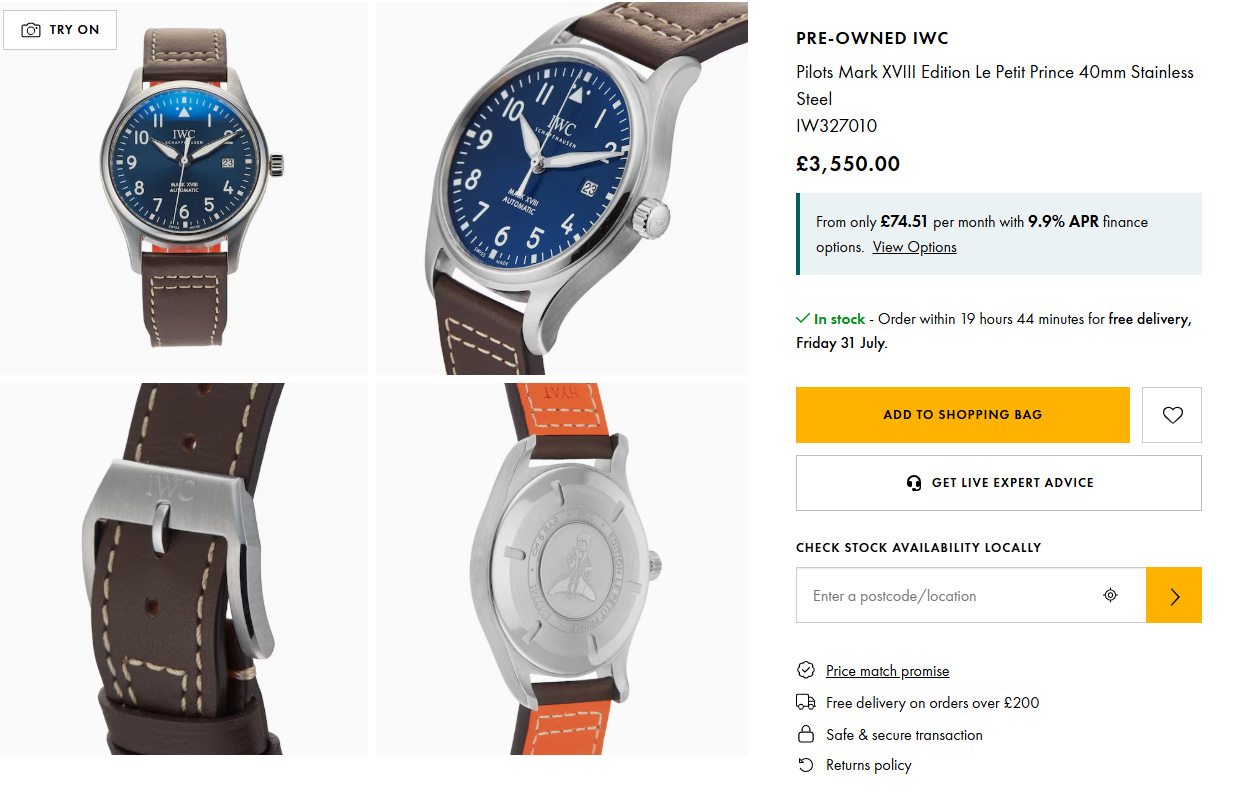
How about the warranty? Well, that’s cheap to offer anyway but IWC has a specific problem, which is that they kinda give this one away. Standard cover is 2-3 years, but then if you register the watch it goes up to eight years of coverage, so a CPO warranty adds almost nothing. So what is the boutique certifying? You can’t exactly sell someone a warranty if they already have one!
As for access… IWC made nearly 120k watches last year. There is no velvet rope here; there is barely a rope at all.
Now suppose the boutique wants to sell that CPO Mark XVIII at £4,000. It buys the watch in at £2,600 or so, puts £600 of factory service into it, reserves a couple of hundred for the warranty, and carries boutique-grade rent and staff on top. Meanwhile, a grey dealer with a website and a camera sells the same watch for £3,120 all day long (20% mark up). This means the brand must now get into a price war against its own depreciation… and it’s fighting that war inside its own shop, because the £4,000 certified Mark XVIII is three feet away from the £6,000 Mark XX… and it seems to be telling every customer that a new IWC is worth a lot less the moment it leaves the building. I have to say it’d be pretty bleak if the boutique so openly presents an argument against itself!
Ok, another angle… forget retail margin for a moment. If IWC went out to the market and bought Mark XVIIIs at £3,200 when other dealers are paying £2,600, it would be boosting its own secondary market. Given this is a brand whose problem is depreciation, they might choose to pay for that. Rolex does something like this by accident; so why shouldn’t IWC do it on purpose?
Well, if IWC made roughly 120,000 watches last year and has been making six figures for years, let’s assume there are north of two million watches to worry about. To move the clearing price for a market of that size you’d need to buy a big chunk of it, above market, all while you’re adding another 120,000 units a year to the ocean you’re trying to empty out. Rolex can hold a hard floor because Rolex controls supply. IWC’s supply is the problem.
“Fine,” I hear you say, “but at least the trade-down buyer stays in the family instead of going grey.” But does he, though? I mean, he was always going to buy the used watch; the only question left to ask is where he was going to buy it. What the brand gains here is a sliver of margin on a discounted sale. But what it loses is the one thing an ailing luxury brand cannot spare, which is the claim that its watches hold their ‘meaning’ over time. All of which is to say… a CPO programme at a depreciating brand simply certifies depreciation!
That said, Jaeger-LeCoultre started this thing called the Collectibles programme in 2023 where they had a dozen museum-grade vintage pieces, sourced from around the world, and restored in-house without ruining any of the patina. Quoting the linked article:
“The scale of the programme is restricted to a curated selection of rare and sought-after Jaeger-LeCoultre timepieces. The announcement coincides with the presentation of the eponymous The Collectibles coffee-table book. This reference book covers 17 of the Grande Maison’s most significant models of the last century, including some Reverso, Geophysic, Futurematic and Memovox watches produced between 1925 and 1974.”
Apparently most of these get sold within hours. You may already know, but Vacheron already does a similar thing with Les Collectionneurs. Regardless, this is a ‘step up’ from pure CPO because CPO tells people “we’d like a cut from selling used watches.” This Collectibles thing says “our past is so valuable we buy it back.” I know it’s subtle, but the framing is everything and I think it’s got legs; we’ll come back to this a bit later.
Same diet, different blood type
Ok so CPO isn’t the right answer… but all of the above isn’t even the main reason it fails. Suggesting CPO as a fix is basically taking something which works for Rolex and copy/pasting it onto IWC. If you’ve ever received advice from an obscure nutritionist, this will make sense: looking at Rolex to work out how to fix another brand is like trying to borrow a diet from someone with a different blood type to yours. (The blood-type diet is, for the record, complete nonsense. That is more or less the point.)
That shit doesn’t work!
This isn’t even limited to CPO… look at what the Richemont group did since the 2000s… build in-house movements (because Rolex has them), roll out boutiques everywhere (because Rolex sells through controlled retail), push prices up all the time (because Rolex can). I suppose it worked out for Vacheron because they had low-enough volumes, some room to climb, and a somewhat iconic sports watch during a sports watch boom - so it went from ~€380m to over €1bn. For the rest of the brands, the same diet, with a different blood type, is what produced the 3.4% margin we discussed a few weeks ago.
In both cases, the mistake was to treat strategy as some sort of cookie-cutter thing. It isn’t. A strategy needs to be developed inside a specific brand the way an organ grows inside a specific body (and why transplants get rejected!). So in terms of setting a strategy, they have been asking “what did the winners do?” when they should be asking “what problem does THIS brand have?”
As for Richemont’s three saddest watch brands, I think they have three different problems (which, to my point, would require 3 different fixes).
IWC has a business-model problem... so the economics are screwed.
Panerai has a trust problem… because they betrayed their tribe of loyal fans.
JLC has a legibility problem… because regular people who aren’t watch nerds have no idea why they should give a damn about JLC.
One solution will never fix all of them equally (or at all), which is why I worry about “shrink to grow” as a group-wide slogan. If you’re wondering what that looks like, I’ve given it a go… let’s look into these three brands and see how they might be fixed.
Note: I know Richard said Piaget and I’ve swapped in JLC instead... mainly because Piaget’s problem is the jewellery version of JLC’s, but also because JLC’s a little more interesting. Sorry, Richard!
Below the paywall: how to fix them... which includes one thing I believe IWC will (foolishly) never do, the reason Panerai is the cheapest fix of them all, and one piece of heresy I think would boost JLC.