
AP's Royal Oak in the Age of Mechanical Reproduction
Walter Benjamin, Richard Dawkins, and an AP you likely can't wear like an AP
I recently made a shockingly poor prediction about Swatch’s next big collaboration. This week, Swatch dropped two new teaser cards:
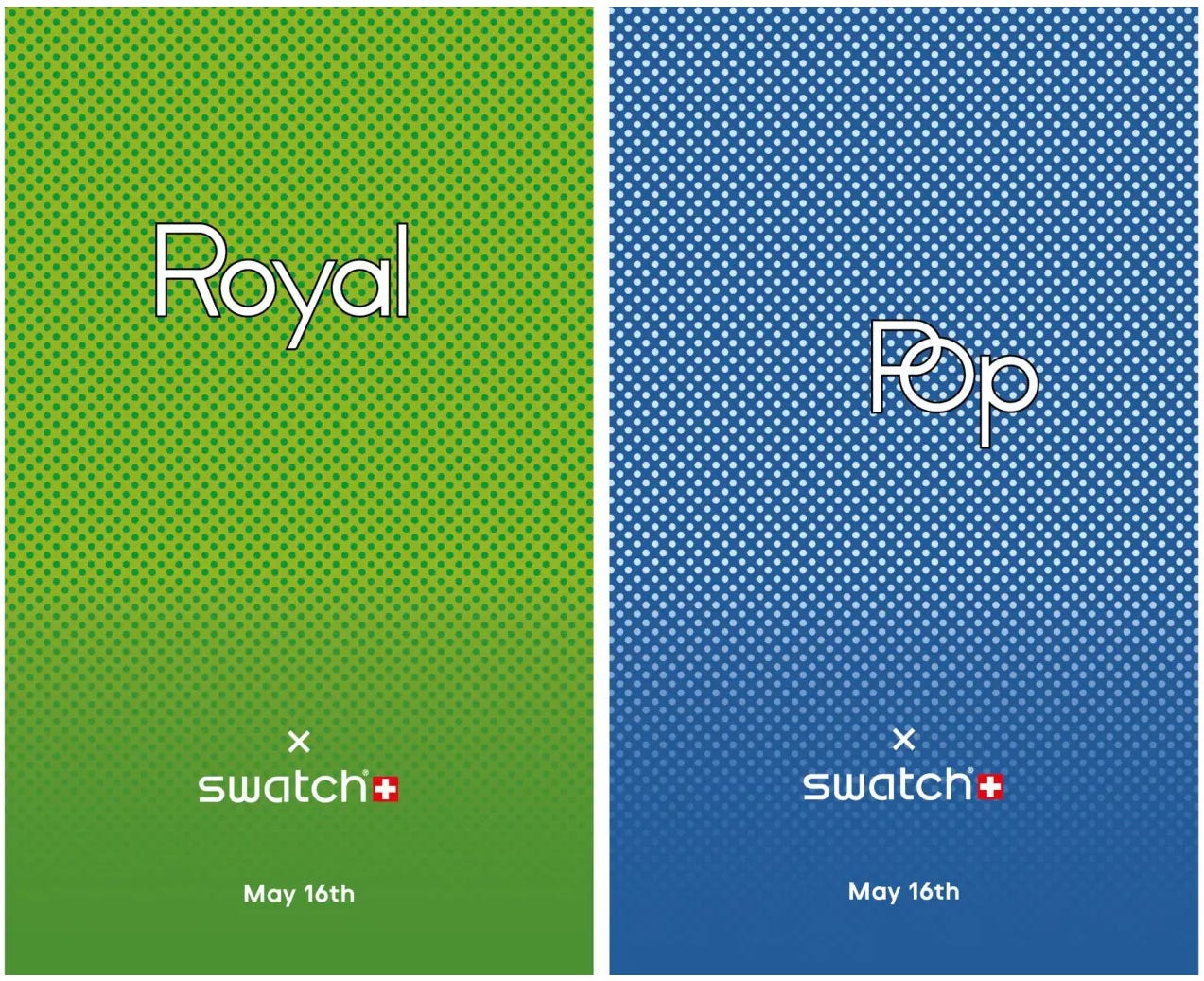
Now, I don’t think anyone is disputing that this is clearly derived from the Royal Oak:
The launch date is the 16th of May, and the trade mark “ROYAL POP” has been registered in class 14, which covers jewellery and watches (cheers @Niccoloy).
So at this point, unless Swatch are running the most elaborate trolling campaign in the history of watch marketing (maybe since the Moser cheese watch), what we are looking at on the 16th of May is an Audemars Piguet x Swatch collaboration.
As Jack Forster might say… who’da thunk?!
Estimated reading time: ~15 minutes
This story did take a turn that I think is more interesting than the original headline of AP and Swatch collaborating at all; the latest rumours suggest this upcoming release is in fact a Royal Oak-esque pocketwatch. The leather loops Swatch have been dangling on Instagram might in fact be pocketwatch holders designed to wear the thing around your neck or out of a watch pocket - kinda like what they do already, but the holder itself would be Royal-Oak-shaped, and the lanyard would be in leather:

Now before we go any further, please understand none of this is officially confirmed. Neither AP nor Swatch have publicly said anything substantive, and the purported “pocketwatch detail” I speak of may or may not be true… with all the AI-generated sh1t doing the rounds I have no idea what to believe. In fact, the very assumption that this is an AP collaboration at all rests on a font choice and a registered trade mark - which, to be fair, is not nothing. Here’s the unconfirmed image which was doing the rounds on WhatsApp:

If the 16th of May rolls around and the product turns out to be a wrist-worn watch, or not an AP, or some Wonderland thing I would have gotten wrong twice in three weeks, you can come back here and laugh.
Anyway, assuming the leaks/guesses are directionally correct (AP collab + pocketwatch format), the rest of this post is about why a Royal Oak pocketwatch from Swatch is a more interesting outcome than a wrist-worn version would have been.
My first reaction, before I saw the pocketwatch bit, was that this is a great piece of business for both companies. Swatch get another MoonSwatch-style halo product to prop up an otherwise dreary quarter... AP get to lean further into the thing they already are, which is to say a Royal Oak company. Nobody is buying a 300-buck Swatch instead of a steel Royal Oak any more than anyone is buying a 200-buck CasiOak instead of a Royal Oak Offshore. There is, you might say, no planet on which this harms the real luxury Royal Oak - again, we will come back to this as well.
That argument felt pretty straightforward, and frankly, the fact that it’s purportedly a pocketwatch, oddly, makes it even more straightforward. To explain why, allow me to take you back in time…
Benjamin saw it coming
Nope, I don’t mean Clymer.
In 1935, a German philosopher named Walter Benjamin wrote an essay called The Work of Art in the Age of Mechanical Reproduction. I actually republished the full text on SDC a few years ago, partly because I love it, and partly because I knew I would inevitably need to refer back to it from time to time.
Benjamin’s argument, removing all of his Marxist foundations and the cinema theory, is that every original work of art has an ‘aura’. The aura is the thing that makes you want to fly to MoMA to see Starry Night in person, even though you have looked at thousands of reproductions of it on dorm-room posters and the back of your phone case and inside an animated film about a poet in Paris.
The aura, then, is what evaporates when something gets mass-produced. You can copy the image perfectly, but the thing itself loses something in the multiplication. Reproduction, in Benjamin’s words, “detaches the reproduced object from the domain of tradition.” The original is in a particular place, made by a particular hand, and embedded in a particular culture or tradition. The reproduction sits everywhere and nowhere, made by a machine, and ‘embedded’ in nothing at all. If you multiply enough copies you slowly empty out the unique existence of the original thing.
What goes with the aura, in Benjamin’s view, is authority. So we could say that the original has ‘standing’, and the reproduction has ‘reach’ - and this tracks with any other thing you want to apply it to, even a Moonwatch vs MoonSwatch(es).
Now, Benjamin was not on any moral high ground about any of this; he saw mechanical reproduction as both a loss and a liberation. Aura is partly just a fancy word for gatekeeping, and gatekeeping is good if you are the high priest of the cult (and rather less good if you are everyone else lol!).
Print and photography pulled art out of cathedrals and salons and into the hands of the masses, which is, on balance, probably good for the masses. It is just less good for the cathedrals.
You can, I hope, see where this is going.
Aura comes for watches too
Watches are a peculiar case for Benjamin, because mechanically they have always been reproducible. There was never one Royal Oak in a museum that everyone else photographed. Every Royal Oak came off the same set of jigs in Le Brassus, and AP have been making them for over half a century now. From a strict Benjaminian view, a Royal Oak is closer to a film print than to Starry Night. The form was designed to be reproduced, and reproduction was inherent in production from day one.
And yet... Anyone who has spent more than five minutes around the watch industry knows that Royal Oaks have an aura the same way Starry Night does, even though there are far more Royal Oaks than there are Starry Nights. AP made over 50k watches in 2025, and the Royal Oak collection accounted for around 88% of AP’s revenue. That is, on the face of it, quite a lot of Royal Oaks. But still, the aura is real! People wait on mythical lists, for years… they read articles about how to play the AP House game, hoping that this will be the year they get the call.
The aura, in other words, is clearly stored in the system that surrounds the watches, rather than within the watches themselves. What do I mean by the system? Well, it is the sum total of all the mechanics which lead up to the watch, from a boutique-only allocation, relationship-building, special John Mayer references, the Genta-designed-it-on-a-napkin story, you name it. AP have spent half a century constructing what is among the most sophisticated aura-machines in the watch industry. The Royal Oak is the Mona Lisa of integrated sports watches because of where, and how, and to whom it is sold.
And so, I think it’s fair to say that dropping its silhouette into a Swatch boutique for a few hundred bucks is, at an absolute minimum, an interesting test of Benjamin’s idea.
Speedmaster experiment
We do, mercifully, have at least one useful data point. In 2022, Swatch and Omega launched the MoonSwatch. I have written about this thing several times, so I will keep the recap brief. They took the Speedmaster Moonwatch, swapped the metal case for bioceramic plastic, dropped a quartz movement inside, and sold them for a few hundred bucks. People queued overnight, fights broke out in some cities, secondary market prices peaked above $2,400, and Nick Hayek sold over two million units by 2023 - probably laughing the entire time.
But did the MoonSwatch hurt the Speedmaster?
On the surface, I don’t think so. As far as I know, real Speedmaster sales reportedly went up about 50% in the year after the MoonSwatch launch. The aura, you might say, leaked onto the plastic version, and the prestige flowed back up to the steel one.
AP’s CEO at the time, François-Henry Bennahmias, publicly praised the MoonSwatch1, and AP’s official Instagram account commented ‘when do we launch?’ under a Blancpain x Swatch post, which in hindsight really makes you wonder how much of the truth hides in plain sight sometimes:
So the simple version of the story so far is that mechanical reproduction has already been tested on a luxury watch, the aura clearly survived, and we should now expect roughly the same result on the 16th of May - only this time with a different silhouette and a slightly bigger queue.
But come on… I think the simple version is too simple, and it’s further complicated by the pocketwatch angle.
Two kinds of aura
The Speedmaster’s aura comes from a story; specifically, the story of a Swiss chronograph being NASA-certified in 1965 and going to the Moon in 1969, strapped to Buzz Aldrin’s wrist on the outside of his spacesuit.
That story is, by definition, unaffected by anything that happens in a Swatch boutique many decades afterwards. You can mass-produce the silhouette in plastic and the original Speedmaster’s aura is exactly where it started, because the aura is anchored in events that already happened. The story does not care how many bioceramic copies are sold. If anything, every plastic Speedmaster on a teenager’s wrist is literally just an advert for the real one.
The Royal Oak’s aura is a bit different. There is a story to be sure (Genta, the napkin, 1972, the Hôtel International, etc), and it is a great story indeed. But the operative aura (the thing that drives behaviour) is mostly just about the present allocation system. The Royal Oak is desirable in part because you cannot just have one. AP is making the retail experience part of the product, which is why they exited almost the entire wholesale channel and built 76 mono-brand boutiques and 25 AP Houses. The story is the wrapper, and the aura is the waiting list.
When you mass-produce something whose aura comes from ‘this happened in 1969’, you do not really threaten the aura at all. When you mass-produce something whose aura comes from ‘you cannot have this’, you brush up against a difficult question, which is: “well, can I have it now, sort of, for a couple of hundred bucks, with 70% of the visual identity intact?”
This is where the form factor does an enormous amount of work, and where the choice of making it a pocketwatch (assuming it is a pocketwatch) starts to feel extremely deliberate.
A plastic wrist-worn Royal Oak would put a cheap version of the silhouette on the same piece of real estate where the steel one would otherwise be seen. People would have walked into Swatch boutiques on the 17th of May and walked out with a Royal-Oak-shaped object on their wrist that you could see from across a coffee shop. That is a more direct piece of mechanical reproduction, in Benjamin’s sense, because the copy and the original would be competing for the same slot on your body - which means that some amount of aura would inevitably leak.
A plastic pocketwatch Royal Oak does not compete for any wrist real-estate at all. It is an accessory at best. It’s a thing you take out of your pocket once in a while to make people laugh, and then you put it away. It carries the silhouette without carrying the function, and function is half the point of a Royal Oak. The Royal Oak is, after all, a sports watch designed to be worn on a wrist while you do approximately whatever you like. Removing the wrist bit of the equation removes most of what the original is for.
So if AP did insist on the pocketwatch format - and we will never know for certain whether they did - I guess that is the cleanest possible way to license the meme without diluting the wrist product. They can take the profit, receive the marketing exposure, and also ensure the real Royal Oak remains the only wrist-worn version… where the queue continues unbothered.
If you are AP’s chief of strategy, this is the deal you ought to have negotiated. You can give Swatch the silhouette but not the form factor. In return, you can collect the brand exposure but not be exposed to any substitution risk.
In essence, you can allow the meme to propagate but not into your lane… which makes it a near-perfect arbitrage on Benjamin’s original model. Now, whether AP were that clever or just lucky is, as I say, an open question… but the outcome is the same either way.
The meme has already escaped
There is a stronger argument, and I think this is the one most people are using when they shrug and say this will all be fine.
The Royal Oak’s silhouette has already been mechanically reproduced; Tissot’s PRX, the CasioOak, at least a dozen microbrands, the ten-thousand-something integrated steel sports watches that flooded the market between 2018 and 2023 (hell, even the damn Nautilus came after!).
All of these, at some level, are versions of Genta’s original 1972 design. AP did not authorise any of them, which has not stopped any of them from existing. By the time Swatch’s version arrives (if it does), the visual language of the Royal Oak is already in the public domain in everything except a strict legal sense. Anyone who wanted a ‘Royal Oak shaped object’ on the cheap has had many options for a long time already.
Which is to say… the meme has already escaped.
I use the word meme quite deliberately here, because it is the right word for this. The biologist Richard Dawkins coined it in The Selfish Gene in 1976 - one year after Genta’s Royal Oak hit the market, and the same year Genta sketched the Nautilus on a Basel restaurant napkin.
Dawkins wanted a monosyllabic word that rhymed with ‘cream’ and that sounded a bit like ‘gene’, but did the work of describing cultural transmission rather than biological transmission. He had been looking for a name for a unit of imitation that could propagate itself between minds the way genes propagate themselves between bodies. Examples he offered, paraphrasing, included tunes, ideas, catch-phrases, fashions, and (this is the bit I love) “ways of making pots or of building arches.”
Note the last one… Memes are not just internet jokes; memes are designs, methods, and recognisable shapes that propagate from brain to brain via imitation… so pots, arches, and even octagonal bezels with visible screws.
The Royal Oak silhouette is, by Dawkins’s definition, a meme. Genta drew an octagonal bezel with visible screws, an integrated bracelet, a tapisserie dial, and the meme started to spread. Patek’s Nautilus showed up four years later, also a Genta. Then Vacheron’s 222. Then a wave of homages. Then microbrand attempts. Then, eventually, a fvcking Casio. Every iteration carries some lossy version of the original information forward, and really, each one is a tiny act of mechanical reproduction - a la Benjamin. So the meme leaps from brain to brain and the shape, in Dawkins’s language, propagates.
So is the “Royal Pop” a nothing burger?
If the meme has already escaped, then surely a Swatch x AP collaboration is not really a ‘fresh’ act of reproduction at all. It is, more accurately, AP ‘officially’ blessing something which has been going on without them for a while. So we might argue that this is less about “do we let our silhouette get reproduced?” because it is already everywhere, anyway. In this case, it’s more like “how do we make a cut?”
If you reframe it that way, the move makes obvious sense, don’t you think? AP are sitting on a brand that generates 88% of its revenue from a single product line, whose secondary market dropped 47% from peak before recovering somewhat, and whose (visual) identity is already plastered across every mall in the developed world in (mostly) a lower-quality form… They can either pretend this is not happening, or grant a single, controlled, slightly ironic version of their silhouette (in a non-wrist format) to a tried-and-tested partner (MoonSwatch proof), take their cut, and let the brand exposure cascade upward into the ‘real’ product line. That cut is, for AP, essentially free money.
If the Royal Oak meme was going to propagate whether they got paid or not, why not get paid?
Now, for Swatch, the calculation is different (and less appealing).
Swatch group’s MoonSwatch is, by their own numbers, losing momentum. Swatch brand sales were down in Q1 2025, and volumes dropped from around 2 million units in 2023 to roughly 1.5 million in 2024. The Blancpain x Swatch Fifty Fathoms did not generate anything like the same mania as the original MoonSwatch. The strategy relies heavily on the mainstream recognition of the luxury partner, and even within Swatch Group there are not many partners left. Bringing in AP - a brand outside the group, with arguably more luxury cachet than Omega has today - is the obvious next move, and possibly the last big card Swatch has to play in this particular game.
Will the Royal Pop replicate the MoonSwatch’s commercial success? I kinda doubt it, and the use of a pocketwatch format is why I think that.
The MoonSwatch sold two million units in 18 months in part because it was a wristwatch. People queued, walked out, put it on their wrist, and broadcast it on Instagram for the next two years. The viral mechanic - I see you wearing one, now I want one - kinda relies on the watch being visible.
Pocketwatches are, almost by definition, less visible. They live in pockets, in drawers, on bedside tables, and maybe on necklaces (but far from ubiquitous). The hype cycle that drove MoonSwatch volumes for nearly two years just does not exist for an object that does not get worn as easily. Pocketwatches have been having a moment among collectors in recent times but that has been about the relative value in high-end mechanical watches when compared with the same complications when found in wristwatches.
So Hayek might sell every unit he produces at first... For sure, the initial batches will move quickly, and it’s likely that the secondary market will spike for a bit… and of course, the press will write enthusiastically about it. But if you expected this to be a multi-year, share-price-sustaining event for Swatch Group in the way the original MoonSwatch was… I’d say don’t hold your breath - but hey, I’ve been wrong before and it might surprise us all. 🤷♂️
What would Benjamin say
If you showed Benjamin the 16th May launch (and again, assuming this all pans out), I think he would shrug and tell you that you are watching, in real time, the thing he described in 1935. This would be a unique, heavily ritualised object (the real Royal Oak, sold via boutique appointments and waiting lists) being mechanically reproduced into a cheap plastic version that anyone can buy, no questions asked, and with no relationship required.
The aura is being democratised.
He would also tell you, and this is the part the AP marketing team will love reading, that a pocketwatch format is rather forgiving on the aura side. The mass-produced object is being sold in a different category from the original; so you could call it a sibling as opposed to a substitute. The real Royal Oak still occupies valuable wrist space, and to do that, you need to go via the boutique and the waiting list. The Royal Pop comes on a lanyard and hides in a pocket... so the two objects can easily coexist without ever competing.
In Benjamin’s terms, we can call this reproduction without cannibalisation. Or, in luxury manager terms, it is exactly the kind of brand extension you would design if you had to license your most precious asset and you wanted to come out the other side with the prized asset intact.
The interesting question, as ever, is who the marginal aura leakage ends up hurting.
AP, sitting at the top, are mostly insulated. The buyer of a 16202 is not making a price-sensitive substitution decision against a piece of plastic on a lanyard. The bigger risk, if there is one, is to the second-tier integrated sports watch market - the Tissot PRX, the dozen microbrand homages, even some of the middle-shelf Hublot inventory. When AP authorises the Royal Oak meme, the unauthorised reproductions look slightly more like what they always were, which is unauthorised reproductions; which also means authority is reasserted by being officially lent out.
And the very long-tail risk, which I will mention as rather speculative, is that an entire generation will form its first impression of the Royal Oak shape via a Swatch boutique instead of a Vallée de Joux atelier. That is more of a slow erosion that plays out over decades, and it will probably be invisible against the backdrop of AP’s growing revenue. Plus, the pocketwatch format makes this slower still... but I reckon it’s definitely non-zero.
Wrapping up
The most likely outcome, by my estimation, is what Benjamin himself probably would have predicted… this will be a profitable (if slightly hollow) act of ‘cultural transmission’ that benefits both parties financially and alters the meme pool by one notch.
It is, in short, a very Swiss outcome, executed with very Swiss restraint, by two companies that understand exactly what they are doing.
One small irony to close on... Benjamin himself observed, in his original essay, that the unique value of an authentic work of art has its basis in ritual. The Royal Oak’s authentic value, as we have established before, is also based in ritual (boutique visits, relationship-building, long waiting times, etc). What Swatch will sell after the launch is not really a watch in the wrist-worn ritual sense. It is actually the opposite of ritual. Walk in, pay peanuts, walk out, drop it in your pocket, never wear it like a real Royal Oak.
This is, depending on how you look at it, either a small triumph for the masses, or a small loss for everyone who liked the ritual, or - and I guess this is how AP’s marketing department would see it - a clever way of selling the meme without selling the ritual at all.
I’d bet Benjamin would say it is almost always all three.
P.S. For the umpteenth time - all of this is based on assumptions… if the 16th turns up a wristwatch, the aura argument would actually get stronger. If it turns up no AP at all, this whole post is a fun exercise about nothing... so be it. At this point I have no choice but to accept either outcome with the dignity of a man who already predicted a fkn Alice in Wonderland collab 😂
Footnotes
”Their collaboration is a great idea, which does not affect the integrity of Omega at all, contrary to what you may have heard. Why is that? Because it educates the younger generation about the icons of watchmaking.”


