

Social comparison Part 2
Developmental psychology, Benign vs Malicious Envy

The first post on the subject discussed Social Comparison Orientation, introduced the concept of envy, and for the most part explored envy from an evolutionary, societal and cultural perspective. Lets continue where we left off…
Developmental psychology is the scientific study of how and why humans grow, change, and adapt across the course of their lives. It examines how thinking, feeling, and behaviour change throughout a person’s life.

Unsurprisingly, there is evidence of status-levelling from studies on children. You will recall from the previous post, the question about pay-rises in an absolute sense versus a relative sense. Would you rather have more pay, or more pay than your colleague? You guessed it: most young children prefer to have more than others.
This study tested children between 7 and 13 years of age with a novel monetary reward-and-punishment task measuring envy and Schadenfreude. Results suggest that when children won, they felt better if the competitor lost instead of winning (i.e., Schadenfreude). Conversely, when children lost, they felt worse if the competitor won instead of losing (i.e., envy). Crucially, levels of envy and Schadenfreude decreased with age.
This suggests at an early age, there seems to be some intrinsic desire to obtain a relative advantage.
Here’s another study which really surprised me. They found 5-6-year-olds will spitefully incur a ‘cost’ to ensure that another’s welfare falls below their own. i.e. they level up, by leveling others down. Savages.
To put this into perspective: if you paired young kids into groups of two, and asked one of the children if they’d rather get 10 treats for themselves and 10 for the other kid, or 8 for themselves and 0 for the other, they’ll be more likely to choose the second option!
This suggests at an early age, there seems to be some intrinsic desire to obtain a relative advantage. As we get older we become, to varying degrees, conditioned to stigmatise envy and take an objective (not subjective) approach to rewards.

Who Wants to Be a Millionaire? is an old game show, where contestants would answer a series of questions to win a million bucks. Part of the show included a ‘lifeline’ where the contestant could “ask the audience” for help when they weren’t sure about an answer.
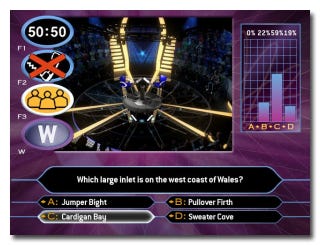
As it turns out, contestants on the Russian version of the show became wary of asking the audience because they would almost always give the wrong answer! This was not the result of intentional sabotage, and it was not due to excessive consumption of vodka. So why was this happening?
In America, when contestants ask the audience for help with a question, the audience tend to give the correct answer and help the contestant. Historically speaking, in communist Russia, everyone in a particular community was expected to pull their weight, and suffer equally as required. Receiving small favours like borrowing fuel, money, or supplies was common, probably expected. As a result, this collective sense of entitlement ensured that anyone who stood out or attempted to make it on their own was cast out (remember the tall poppy syndrome, from Part 1?), and the aforementioned favours which were previously ‘normal’ became nonexistent.
Consider for a moment, growing up with a friend, spending decades suffering through the same struggles, wading through the trenches of life, sharing the same experiences, building a friendship through the bond forged by hardship… and then one day, out of the blue, that person gets a fortune and you’re told to go f*ck yourself. I struggle to think this way, as I imagine the likely outcome with me or my friends would be to share the good fortune, not shun the community. Anyway, in Russia, I guess they think this is unfair; Why should Vladimir get a million rubles instead of Alexey? When will it be Alexey’s turn?
This is one of many cultural differences between American and Russian cultures. Envy is a natural feeling which will be amplified or muted by cultural factors. Japan has no natural resources but is a rich country, in part because they have managed to repress envy. Contrast this with places such as Russia, Venezuela and much of Africa, which significantly more natural resource, but are plagued with cynicism and/or corruption. Here’s another example of cultural difference when it comes to envy (1 min video):
You will often hear arguments about how societies should be, which point toward “evolution”, “natural tendencies” or “reality”… but this logic seems backwards. In fact, humans have developed social norms, laws, and punishments specifically to combat aspects of our natural instincts which we find inappropriate or undesirable. As a cave man, if I was bigger and stronger than another fellow, I could just beat the sh*t ou of him, maybe kill him, and take his food and belongings.
Clearly, any of our behaviours and desires can be considered natural by virtue of them being true for all humans and understood by nearly everyone - however, there are some aspects of our nature which are worth promoting and cultivating, and other aspects which are worth suppressing and ostracising.
The naturalistic fallacy (linked to the “is - ought problem”) is as explained in the above example; Just because a tendency is natural, does not automatically imply it ought to be accepted or allowed. Physical violence may be natural, but it is also a criminal offence and we ought not to promote it outside controlled conditions.
The other fallacy to be mindful of is the moralistic fallacy - one of the common fallacies in Western philosophy. This is the reverse of the is-ought problem. Here, people hold a belief that just because they would like things to be a certain way, this is how they truly are. We like honest people, but this preference doesn’t mean humans are naturally honest. We perhaps universally ‘dislike’ envy and think envious people are ‘bad’ - but this does not mean people do not feel envy.
Envy is natural.
Envy, continued

“Envy is the great leveler: if it cannot level things up, it will level them down.”
Dorothy Sayers (1949)1
Given the discussion up to now, and others before this one, envy would appear to have just one meaning... but that would be too simple!
Envy has two types2.