
Invisible Forces Shaping the Watch Market
In Q1 of 2026, the market seemed stable, auctions were breaking records, and gold was flying. But what is going on beneath the surface? Has the consensus missed anything?

I must begin with a word of thanks to Jack Forster for his invaluable feedback on this essay. I also managed to convince a couple of friends to review it as well. I appreciate you all for taking the time - it certainly helped. The one piece of unanimous advice I did not take on board, was to split or shorten this essay…
—
“I have made this longer than usual because I have not had time to make it shorter.”
―Blaise Pascal, Lettres Provinciales, 1657
If you took a snapshot of the watch industry in mid-May 2026 and you tried to make sense of where things are going by looking only at the headline numbers, what would you see?
The correct answer - if that is all you are looking at - is “not very much, actually.”
On the face of it, we see that Q1 2026 Swiss watch exports rose 1.4% and the WatchCharts Overall Market Index is up 2.4% in the last 3 months - its best period in a while. Phillips Geneva XXIII in May was a 99.6% sell-through with $96.3m in the room and 43 world records - making it the highest-grossing watch auction in history. Sounds epic, but when you look more broadly, the picture changes considerably.
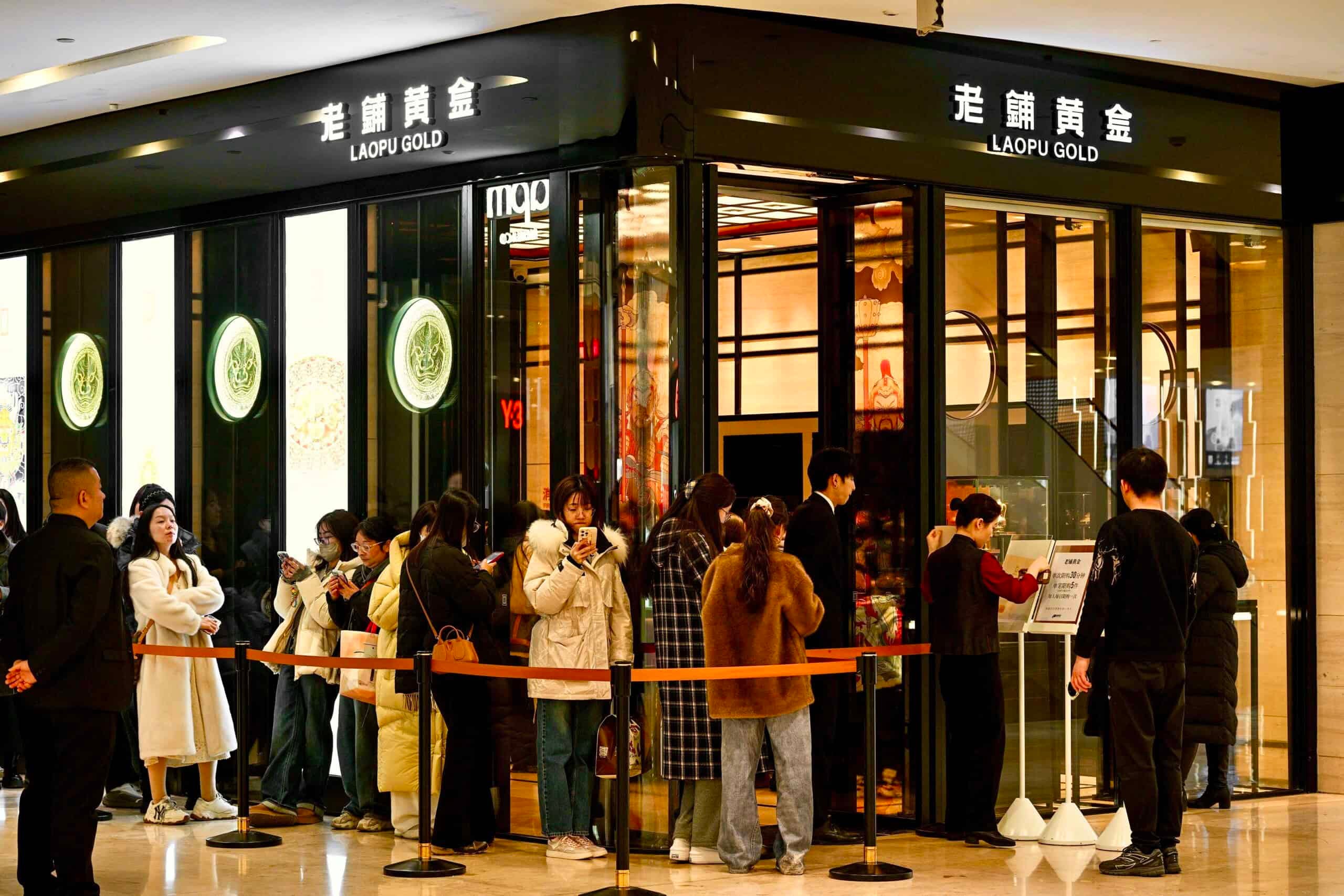
Steel watches were down 9% in value but up 5.8% in volume - this is the textbook definition of trade-down. Precious metal watches were down 4% in value and 5% in volume. The only price bands growing are the cheaper ones. Saudi Arabia was down 16.8%, Qatar down 24.8%, the Middle East luxury sell-out down around 50% per Vontobel’s Manuel Lang. The largest single market, the US, was down 1.6% in March alone. The French re-export fvckery (up 72% in March) is masking what would otherwise be a worse set of numbers. Hong Kong and China are barely 14% of total Swiss exports now, down from a 24% peak in 2021. And meanwhile, a Chinese gold-jewellery company called Laopu Gold posted FY2025 revenue up 221% to RMB 27.3bn - about CHF 3.15bn, which is literally within rounding distance of Richemont’s entire Specialist Watchmakers global business.
That is what I want to explore today. Not so much “what’s happening,” because in some sense that’s the easy part; this is more “what does it mean to interpret all this stuff together.” What does it mean for brands, for collectors, and for the way capital moves through this market?
“If you were designing the worst possible industrial structure for a luxury category navigating an inflationary, geopolitically unstable, taste-shifting decade, you would design something pretty close to what we currently have with Swiss watches.”
The short version, and you can stop reading after this summary if you want, is that I think the watch industry is being altered by four major macro forces. A tariff saga that has technically been settled by the US Supreme Court but practically just moved into a new bucket. A Chinese regulatory change (Decrees 834 and 835, plus the MOFCOM Blocking Order of 2 May 2026) that the watch industry has not even started to grapple with. A gold price boom which is producing a barbell effect within the watch industry that ties back to the K-shaped story everyone has been on about for a while now. And finally, a Chinese consumer adjustment, as demonstrated by Laopu, which is almost rewriting the script on what “Chinese luxury” means (and which European groups do not appear to have a plan to address).
Each of these forces has been written about individually somewhere, but what I have not seen anywhere is a look at the combined effect this will have on the watch industry. So in this post, I’ll try to do just that.
Before we start, just know that I am not trying to ‘pick winners’ or pretend I know how this will unfold - nobody can do that reliably. If there are options for the future, I will spell them out. The point of this post is to map the terrain, and while I doubt this needs repeating, this is not investment advice nor watch buying advice.
Estimated reading time: 34 minutes
Q1 numbers
The most important thing about the Q1 2026 FHS data is that the headline number of +1.4% is a mathematical outcome, but it’s useless for any serious analytics. I say this because of three separate data points that, taken together, tell a different story altogether.
First is the price segments. Watches above CHF 3,000 (export price, so wholesale roughly 2-2.5x cheaper than retail) declined 1.9% across 2025 and the trend has carried into 2026. The CHF 200–500 export-price segment grew 15.4%. So Switzerland is shipping more units, but cheaper ones. The “value” line is being held up by a small number of very expensive watches at the top of the curve, and not by a healthy distribution across the various price points.
Second, the materials mix is wonky. Precious metal watches were down 4% in value, steel watches were down 9% in value but up 5.8% in volume. “Other metals” - titanium, ceramic, bronze - were up 23.8% in volume. So what we see here volume rotation but on the cheap end of the scale. People are still buying watches, but not the watches which FHS numbers would regard as flattering.
Third, look closely at the country breakdown. The US, the single largest market at 18.9% of exports in March, was down 1.6%. France was up 72.4% in March and 55% across Q1 - which might sounds great until the FHS itself points out this is the re-export distortion from the post-tariff routing changes that began in December 2025. Saudi Arabia was down 16.8% (third consecutive negative month), Qatar down 24.8% (also third), Germany down 8.5%, Japan down 12.6%. China was up 4.2% in March, which is the first positive month in over a year - possibly a cycle bottom, possibly noise. Hong Kong stabilised at +0.5%. India was up 36% and is now a top-15 destination. The UK was up 3.2% and still ranks second by end-demand.
If you sum all of this up, what you have is a market shipping more of its cheaper stuff to make up volume, leaning on European re-export traffic to make the value line work, holding on by its fingernails in the US, hollowing out across the Gulf, and waiting on a Chinese recovery that nobody is willing to call time on just yet. So I maintain, the +1.4% is not what most industry people would like to think it is.
Manuel Lang at Vontobel was speaking to Bloomberg about the March data... he said that in the Middle East, the March export numbers are not a clean proxy for end-demand because luxury house sell-out is ‘roughly 50%’ down on the year. Switzerland shipped roughly flat into the Gulf, but the retailers in the Gulf sold about half what they sold a year ago. That gap, between sell-in and sell-through, is a really important number in the big picture but I’ve not seen anyone talking about it.
Sell-in putting up a front for sell-through is how recessions work in luxury. The shipments arrive, the inventory builds up, and the data looks fine for two or three quarters, and then suddenly the retailers stop reordering and the chart falls off a cliff. We have lived through this exact pattern in 2015–16 (China anti-corruption), 2019 (Hong Kong protests), and 2023 (post-COVID hangover). I am not predicting a cliff as such, I am just saying that if you only look at FHS data, you will never see ‘the cliff’ coming.
US tariff drama
For most of 2025 the US watch market was effectively held hostage by a tariff dispute that, by the end of the year, almost nobody understood. We covered this reluctantly but extensively already, but I’ll summarise it briefly.
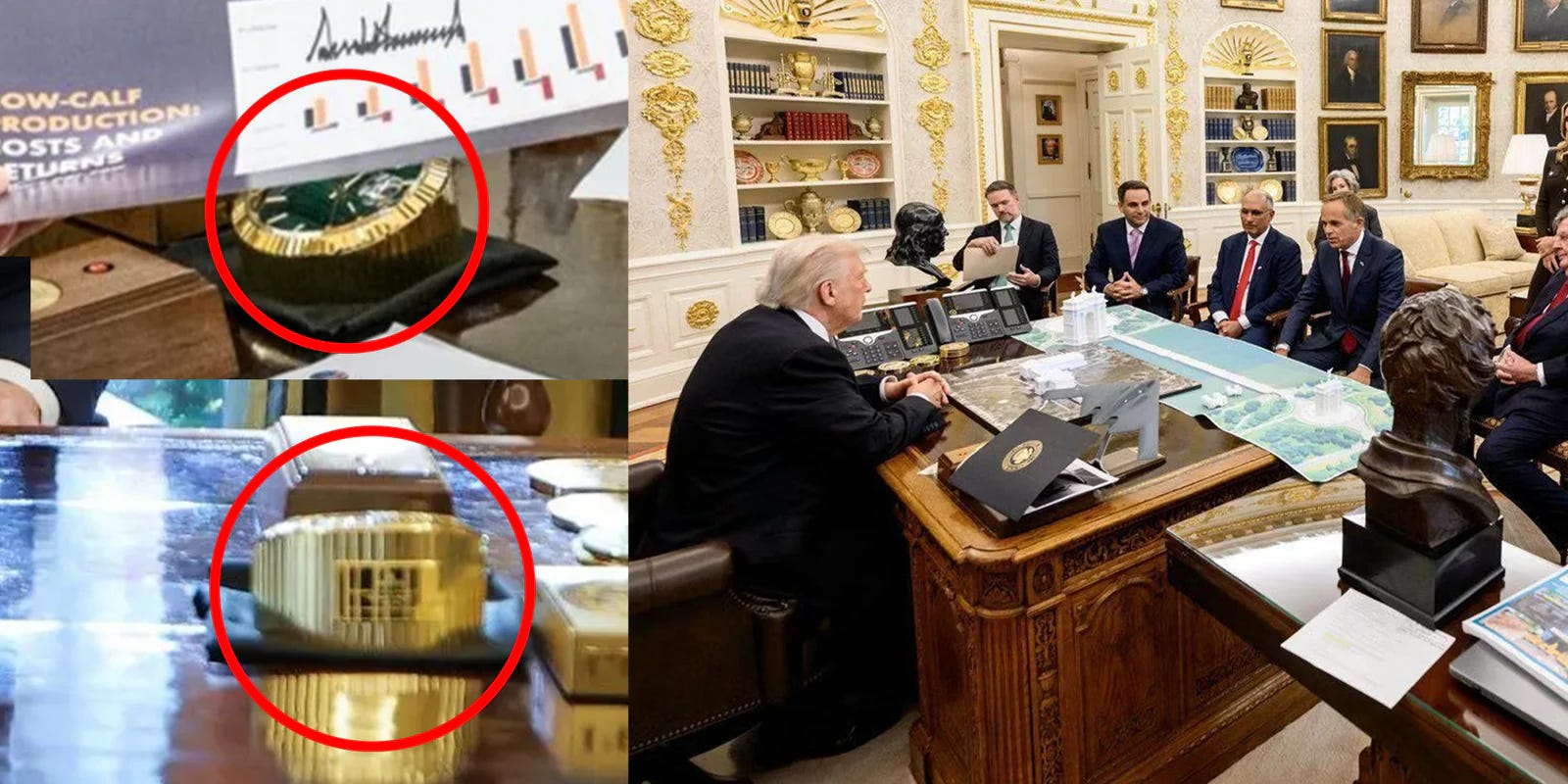
April 2025, the Trump administration imposed a 10% baseline tariff on Swiss imports under IEEPA (the International Emergency Economic Powers Act). August 2025, that rose to 39%, which is the number that triggered a panic. Swiss exports collapsed 56% in September and 46.8% in October - at the time, consumer demand wasn’t even tanking, it was just Swiss manufacturers refusing to clear inventory with a 39% knock. The watches were not going out the door because the math did not work at the new rate. In November 2025, Jean-Frédéric Dufour of Rolex, Johann Rupert of Richemont, and a few other all visited the White House the week of Supreme Court oral arguments - a great piece of choreography that triggered a separate, ongoing Swiss parliamentary inquiry into whether the gold clock Rolex gifted Trump at the US Open constituted a bribe.
Then on 20 February 2026, the Supreme Court ruled 6–3 in Learning Resources, Inc. v. Trump that IEEPA does not authorise tariffs at all. The ruling invalidated the 10% April baseline, the 15-41% reciprocal country tariffs, and also the fentanyl-trafficking tariffs. Around $100bn in collected revenue could legally need to be refunded, with interest accruing at roughly $650m a month, and over 2,000 Court of International Trade lawsuits in the queue. Customs and Border Protection (CBP) has reportedly told the administration it is ‘not able to comply’ with the refund directive logistically.1
The Trump response, within four days, was to move the tariffs into Section 122 of the Trade Act of 1974. Section 122 lets the President impose tariffs of up to 15% for up to 150 days without Congressional authorisation. That is, I believe, the current operative situation with Swiss watches - 15%, effective 24 February 2026, expiring 24 July 2026 unless Congress extends it.
So we are now in a window until the end of July where the legal status of US tariffs is only provisional. If Congress does not extend (and given the political incentives, extension is not a given), Swiss watch tariffs revert toward something close to the 2-3% baseline that prevailed before all of this started. The entire US price structure that Rolex, AP, Patek, Cartier and the rest erected over the last year (pricing in 15% duty plus roughly 12% Swiss franc strengthening on top) would have to be unwound.
What is interesting is that the brands have approached it differently. Rolex hiked steel ~5.6% on average in the US in January 2026, gold +8.7%, white gold Day-Dates roughly +8.6%, the white gold 40mm Daytona crossing $56,400 (up from $51,800). AP hiked +7.5% in the US, +2.5% in the UK, with Royal Oak increases larger than CODE 11.59 increases - which kind of indicated which models they think the market will absorb the pressure on. Tudor hiked prices, but Patek did not, Cartier did not, and Omega, Breitling, IWC, TAG, and VC all held firm. That said, Patek had been the first to raise prices in September 2025 to absorb tariff costs (roughly +15% in the US, cumulatively closer to +22% before the rollback), then partially reversed those US increases when the 15% Section 122 settled - so Patek’s posture, as best I can see, is hold-and-adjust, and not lead-and-defend.
The Trump-Xi meeting in Beijing earlier this month (14–15 May 2026) was framed by some legal analysts as primarily about the next phase of US-China economic friction and the Blocking Statute regime, rather than tariffs per se. If you want to drill deeper, you can start here; but let’s press on.
Dual-compliance trap
I am prepared to bet money that you will not see a single watch-related publication talk about what I am about to describe.
On 7 April 2026, the Chinese State Council announced Decree 834 - Regulations on Industrial and Supply-Chain Security. On 13 April 2026, six days later, it issued Decree 835 - Regulations on Countering Improper Foreign Extraterritorial Jurisdiction. On 2 May 2026, China’s Ministry of Commerce (MOFCOM) issued Announcement No. 21, the first invocation of the Blocking Rules since they were introduced in 2021. Several independent legal experts agree on the fact that this is the first time the Chinese state has actually used the ‘Blocking Statute’ regime since putting it on the books.
The MOFCOM Order followed a series of US’s Office of Foreign Assets Control (OFAC) designations (sanctions) of Chinese refineries for trading Iranian crude (this is where everyone in the world was ordered to stop trading with Chinese refineries). So the Chinese ‘retaliation’ was to issue the MOFCOM order that no person or entity in China may ‘recognise, enforce, or comply with’ the relevant US sanctions.
There are four mechanisms in Decree 835 that European luxury groups, including the watch divisions of Richemont, LVMH, Swatch and Kering, will need to learn the implications of very quickly.
First, the Malicious Entity List. This is a new tool that targets entities which ‘promote or participate in implementing’ foreign measures judged to harm Chinese interests. The Chinese verb tuīdòng (推动) - ‘promote’ - is pretty broad. In theory, public advocacy, lobbying, or even encouraging supply-chain decoupling could plausibly fall within its reach.
Second, the piercing rules. Countermeasures extend to entities ‘actually controlled by or participated in establishing or operating’ by a listed entity. In plain English, if a Swiss watch group has a designated subsidiary, the rest of the group is exposed. There is no ‘clean’ firewall even if it’s a separate entity.
Next, Article 14, the private right of action. This is the big one; Chinese persons or entities harmed by foreign-sanctions compliance can now sue in Chinese courts for damages and injunctive cessation. So if a Cartier boutique in Shanghai refuses to serve a wealthy Chinese client who has been added to the US SDN list (because doing so would expose Richemont to US sanctions), the client can sue Cartier in a Chinese court for the harm caused.
Finally, Article 12, potential criminal liability. Prior regimes were mostly administrative, but this one can escalate.
Now, layer onto this the data that UEL designations (China’s Unreliable Entity List) jumped from 3 in 2024 to 67 in 2025. More than 100 individual organisations and individuals have been hit with countermeasures under one regime or another in 2025 alone. The volume of designations has moved from “occasional and symbolic” to “regular and operational.”
You may be wondering why you should care, and what this has to do with selling or buying watches… well, it does matter.
Richemont, LVMH, Swatch and Kering each operate mono-brand boutique networks in mainland China. Cartier alone has ~695,000 watch units a year flowing through the system at a CHF 3.5bn turnover (wholesale). A meaningful percentage of high-end mono-brand boutique transactions in China are with the kind of HNW individuals who, increasingly, also have US business interests, family members at US schools, or some form of US exposure. If any one of those clients ends up on a US sanctions list, the boutique will have a huge problem.
If they refuse to serve them, the boutique has US sanctions cover but is potentially exposed to Article 14 damages in a Chinese court plus possible inclusion on the Malicious Entity List for the parent group. If they do serve them, the boutique has Decree 835 cover but its parent is exposed to OFAC penalties form the US.
This is called a dual-compliance bind, and it is the same sort of problem that paralysed major banks like HSBC and Standard Chartered in the late 2010s when they got caught between US and Chinese sanctions. The banks figured it out eventually, but at significant cost.
I have looked, and I cannot find a single Q1 or Q2 2026 luxury earnings call where Decree 835 has been raised by an analyst or addressed by an executive in our industry. This is either some sort of news vacuum (the regime is too new, the implications too technical, and the question has not been asked yet) or it is a calculated-collective-silence across the industry on the assumption that flagging it would invite the very enforcement it warns against. Either way you read it, I’d say it’s pretty significant.
For now, pay close attention to the H2 2026 luxury earnings calls. The first time a senior CFO at Richemont, LVMH, Swatch or Kering acknowledges Article 14 on the record, this story will become mainstream ‘proper’.
Of course, this all links back to the recent essay on “Wrist Laundromats” which covered the broader theme of watches as a vehicle for moving capital across borders when conventional banking either cannot or will not suffice. If you assume some percentage of the high-end Chinese luxury watch market has historically been about value transfer and not pure consumption, then Decree 835 changes the cost-benefit calculation for everyone involved (boutique, client, auction house, dealer, freight forwarder etc). None of them are unaffected.
Gold above $5,000
Spot gold broke $5,000/oz for the first time in late January this year, briefly hitting $5,110-5,115 before dropping again. By early February it was bouncing between $4k and $5k and the market was struggling to find a stable clearing level. The year-on-year move from end-2024 to end-2025 was about 64%, which is the largest annual gain since 1979.
Bank forecasts for end-2026 are, in the spirit of late-cycle gold targets, all over the map. Goldman is at $5,400, JPMorgan $6,300, Deutsche Bank $6,000, UBP $5,200, Morgan Stanley between a $4,500 base case and a $5,700 bull case, SocGen $6,000 as a ‘conservative’ read. That is a roughly 40% dispersion seven months out. Clearly, what everyone is agreeing on is the upward trajectory.
Why is it happening? The short answer is some combination of central-bank gold buying2, Chinese gold accumulation3, ETF inflows, private HNW physical purchases, the “debasement trade,” concerns about Fed independence, and safe-haven flow into the (kinetic) Iran war. The bull case for gold is pretty much fully priced. The bear case requires a pretty serious de-escalation on multiple geopolitical issues all at once.
Maybe you’re just wondering what this does to watches? Ha! The popular story is that “gold is up, so gold watches are a hedge, so all watches must be appreciating in real terms” - but I reckon this is not the right angle to view things from.