

UBS Global Wealth Report 2026
Global wealth grew 10.8% in 2025 and median wealth fell in most markets. We look at the UBS report and a Goldman Sachs demographics study to figure out what this means for the luxury watch market.

There are two ways to answer the question “did people get richer last year?” You can take everyone’s wealth, add it up, and divide by the number of people; that’s the average, and it goes up whenever the people at the top have a great year. Or you can line everyone up from poorest to richest and ask the person standing exactly in the middle how they’re doing; that’s the median, and it only goes up if the typical person actually got richer. Making this distinction is pretty important if you want to understand the new UBS Global Wealth Report 2026.
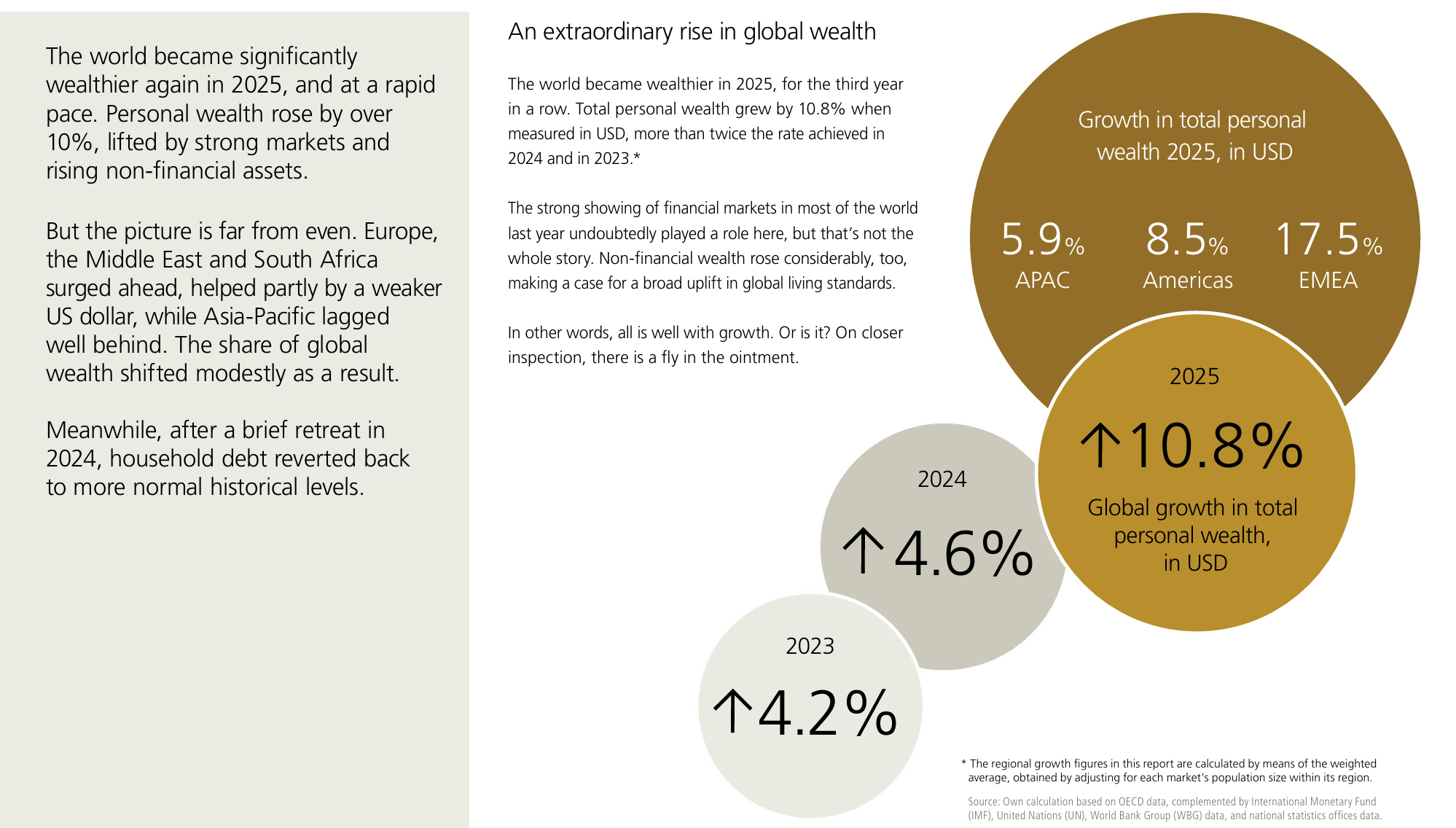
When I wrote about the previous UBS wealth report for 2025, I confessed to a degree of confirmation bias, because it validated a lot of what we’d been discussing on SDC about bifurcation and the K-shaped economy. This year I don’t even need any such confession. This time, UBS wrote about the K-shape in their own findings: global personal wealth rose 10.8% in 2025, the fastest pace in years, and median wealth declined in most of the markets they track. Both of those statements are in the same report, about the same year, and they basically form a K-shape.
Estimated reading time: ~14 mins
Good year with a caveat
The good year headline is that total personal wealth grew 10.8% in USD terms in 2025, which is more than double the 4.6% recorded in 2024 and the 4.2% of 2023. Financial markets did a lot of the heavy lifting, but non-financial wealth (mostly property) grew as well, for the first time since 2023. Household debt also rose at its fastest pace since 2017, which UBS reckons was just normalisation after a rare year of deleveraging. Let’s go with that for now.
The caveat is that everything here is measured in US dollars, and the dollar had a stinker in 2025 given the euro rose almost 9% against it. So when UBS reports EMEA wealth growing 17.5% and Western Europe nearly 17%, a fair chunk of that is currency maths as opposed to Europeans getting richer - UBS says as much in the report. This is the same shrinking-ruler problem I have flagged with the USD-denominated watch price trackers before. i.e., if your measuring stick gets shorter, everything measured with it will look taller.
Why does this matter for watches? Because 2025, the year global wealth grew at its fastest rate in years, was also the first year since 2022 in which the secondary watch market posted an annual gain (+4.9% per the Morgan Stanley/WatchCharts full-year numbers). UBS gives that story a demand-side explanation: the people who buy watches got 10.8% richer in the year watch prices turned. I know that correlation does not imply causation, but I am just pointing out how these two things rhyming is perhaps what you’d expect if wealth effects were doing some of the work.
Average got richer, median got poorer
The chart below compares average and median wealth per adult since 2020, in local currency, net of inflation. In market after market, the average bar goes up and the median bar goes down. Since the start of the decade, median wealth per adult has fallen 3.1% in Brazil, 4.5% in France, 14.4% in the Netherlands and (a frankly astonishing) 23.2% in the UK, all while the averages in most of those places climbed. Fewer than half the countries in the sample have a higher median wealth than they did at the start of 2020.
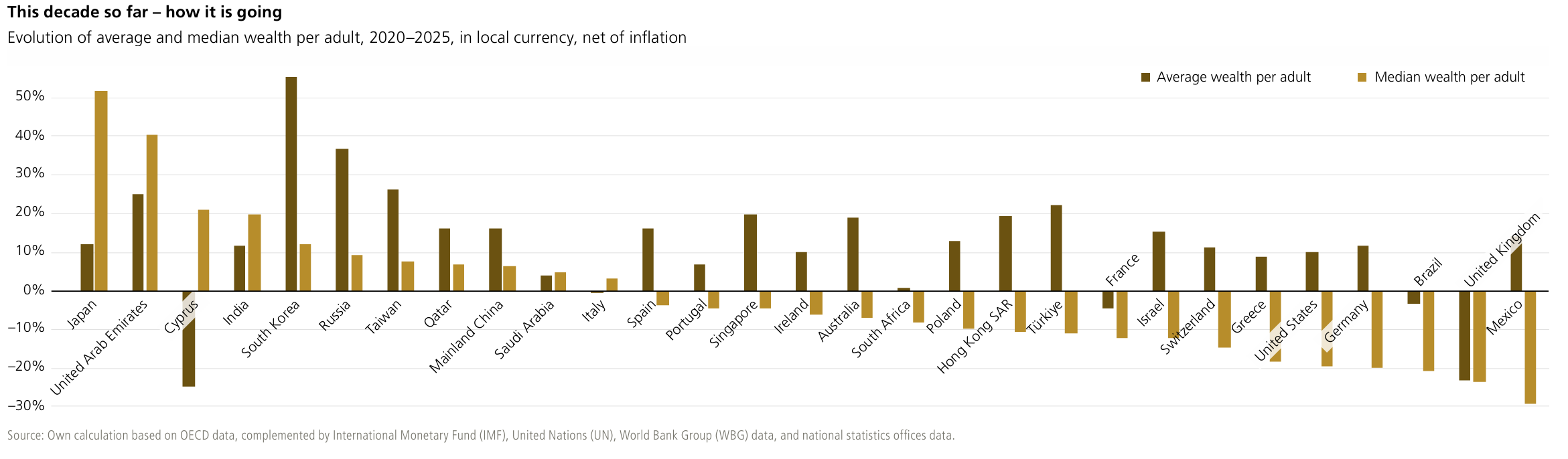
Average customers got richer but the median customer got poorer, and that pair of statistics explains the entire watch market right now.
If you have a rising average with a falling median, the gains mainly went to the top of the distribution and the middle went backwards in real terms. If you map that onto what the watch industry has been reporting, it kinda tracks. Swiss export data shows watches priced above CHF 50,000 accounted for barely over 1% of units but nearly all of 2025’s export growth. Icons and haute horlogerie thrive; the CHF 3–15k middle, the stuff the median millionaire buys, is still impaired. This polarisation started in the customers’ bank accounts long before it showed up in any brand strategy deck, and the UBS chart is proof of this.
As for the UK number… this is pretty insane. Median wealth per adult is down 23.2% in real terms since 2020. If you’ve wondered why the British watch scene feels increasingly like window-shopping even while boutiques report decent numbers, that’s your answer. The typical Brit has a quarter less real wealth than at the start of the decade, and the buyers who keep tills ringing are drawn from a thinner and thinner slice at the top.
UBS abandons the middle too (EMILLI grows up)
Last year’s report introduced the EMILLI, the Everyday MILLIonaire with USD 1–5 million, and back then I wrote about the liquidity paradox i.e., asset-rich, cash-poor people who look like watch customers on paper but can’t actually buy. So what did UBS do this year? They moved upmarket. The 2026 edition explicitly turns its attention to the EMILLIs’ “elder siblings” i.e., the brackets from USD 5-100 million.
I find this hilarious. Even the people whose job is counting wealth have concluded the interesting story is no longer in the middle. The wealth report itself has premiumised. It seems everyone’s doing it!
Roughly seven million adults worldwide hold more than USD 5m in net assets, and more than four million of them live in the United States. Seven million people, out of roughly 3.8 billion adults in the UBS sample; call it one in every five hundred adults, or about 0.2%.
I keep going on about this because that cohort is, to a first approximation, the entire addressable market for the watches driving all of the industry’s growth. If CHF 50k+ pieces generated nearly all of 2025’s export growth, then the customer base for the industry’s growth engine is a group of people UBS can now literally enumerate - about seven million humans, of which the majority are American. Not “the top 1%”, which is pretty vague after all. Seven million countable adults, 4.1 million of whom hold US passports (their table breaks it down further: 516,000 in mainland China, 244,000 in Germany, 164,000 in Japan, 114,000 in Switzerland).
“Hang on,” you might object, “plenty of people below USD 5m buy expensive watches; a banker with USD 2 million in assets can still stretch to a Nautilus.” True! And plenty of people worth USD 20 million couldn’t tell a tourbillon from a doorknob. The multiplier cuts both ways; the cohort is just a proxy, not a full census of buyers. But as proxies go, it’s a vivid one, and it makes the industry’s concentration risk feel a lot more physical. The Swiss watch industry’s growth is a bet on the continued enrichment of roughly 0.2% of the world’s adults, most of whom hold their wealth in US financial markets.
Which brings us to...
America mints, China stalls
In 2025 the world created nearly one million new USD millionaires, about 2,680 per day, and for the first time every single market UBS tracks ended the year with more millionaires than it started with. The United States accounted for 441,078 of them, almost half the global total, or roughly 1,200 new American millionaires every day. The US is now home to 23.6 million millionaires, about 41% of the world’s 57.5 million overall1.
And mainland China? It added only 14,079. That’s growth of 0.3%, which is the joint-lowest rate in the entire 56-market sample alongside Hong Kong. Which means, the US minted roughly 31 new millionaires for every one produced in China. Four years into China’s property-crisis wealth destruction, the engine that powered the 2017–2021 watch boom is still stalled (we covered this). China’s share of Swiss exports has roughly halved since 2012, and this report offers no reason to expect it to be back anytime soon.
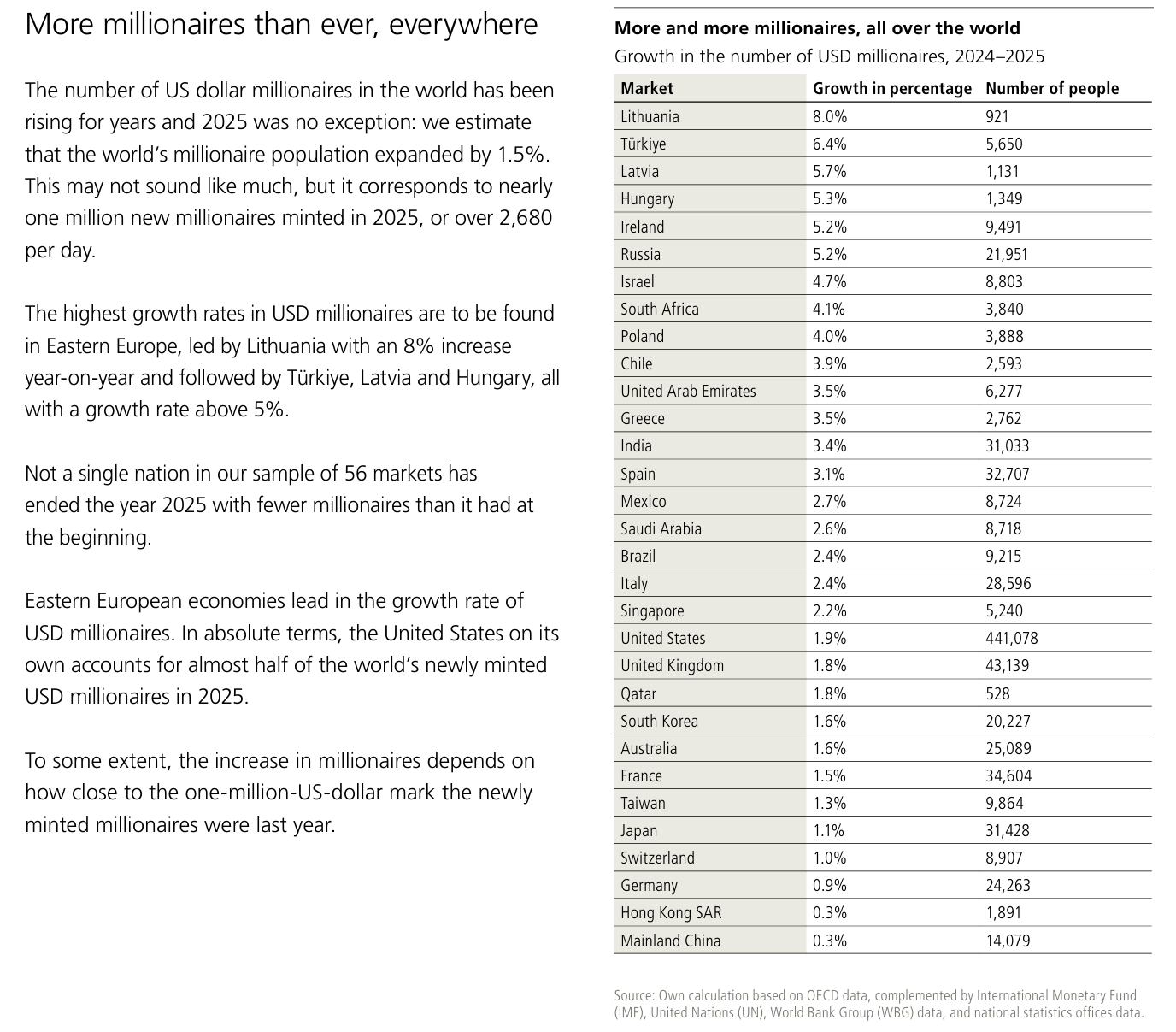
So the industry’s demand base is rich, American, and narrow - if you wanted to explain this to your kid, you might as well tell them the Swiss watch industry has become a leveraged play on US equity markets. American millionaires hold nearly 79% of their wealth in financial assets, the highest large-market share in the sample, which is why US watch demand responds to the S&P 500 with almost no lag. It’s also why a serious Nasdaq correction would do more damage to Swiss watch demand than the 39% tariff ever did. The tariff settled at ~15% and the market kinda just shrugged it off. I’d bet there is no settling a 25% drawdown in the accounts of the four million Americans who constitute most of the industry’s growth market.
Pyramid becomes a diamond over time
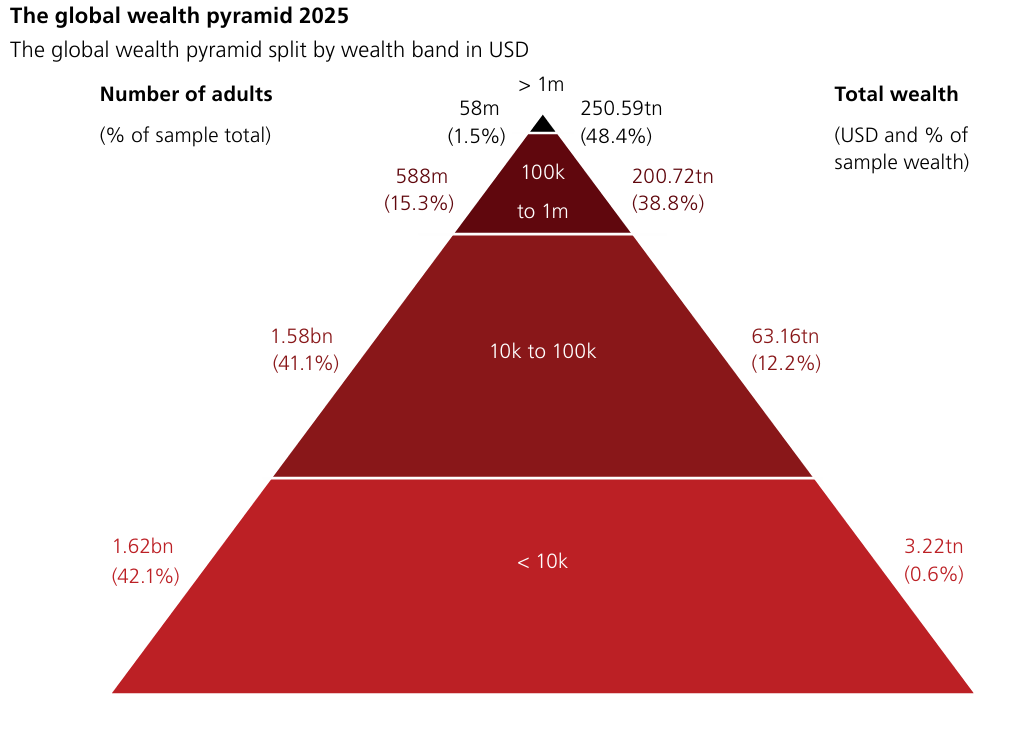
One more nugget before we get to demographics. UBS notes that the classic wealth pyramid is close to no longer being a pyramid. The lowest wealth band is now only marginally wider than the band above it, and on current trends they’ll switch places before 2030. The middle of the global distribution is filling out, largely thanks to Asia; which tells us this shape is heading towards a diamond.
At the top, the numbers remain absurd as ever… 1.5% of adults are millionaires and hold 48.4% of the sample’s wealth. At the very top, UBS counts 3,302 billionaires, up 383 in a year (+13.1%), whose wealth rose by close to 25% on average. If you’ve wondered how Richard Mille sells six thousand watches a year at an average price of nearly CHF 300,000, the billionaire count growing 13% a year while billionaire wealth grows 25% gives you most of the answer (the rest of the answer might be in this essay).
There’s also a snapshot page on liquidity that settles a question from the essay covering the 2025 report. I’d argued that the liquidity paradox (wealthy on paper, illiquid in practice) explained why mid-tier watches struggle even as millionaire counts rise. In this new data, what we see is that in the United States, 47% of net personal wealth is liquid, up from 40% in 2011, mostly via direct equity holdings and funds. In Italy it’s 24%. Germany, 25%. So we know the US is where the millionaires are; and this chart tells us that the US is also where the millionaires can actually pull the trigger and buy things. Going on this chart alone, the whole geographic shift of post-2021 watch demand actually makes a bit more sense.
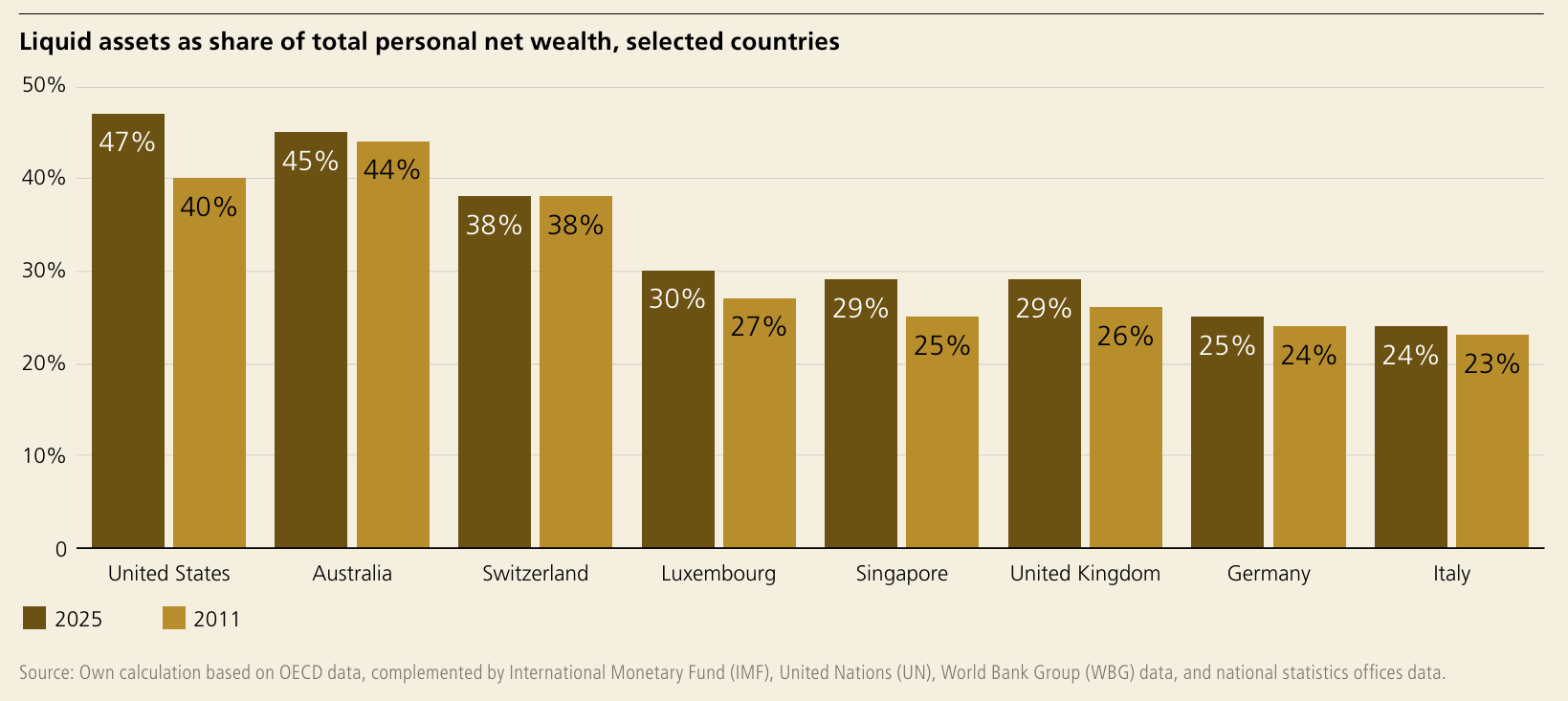
“It’s mainly thanks to direct holdings of equities and investments in mutual funds that in the United States almost half of net wealth is liquid.” (From the report)
Goldman Sachs on future customers
Now despite the title, I will also cover another document I found last week. Goldman Sachs Research published a report in June introducing a Demographic-Driven Demand framework, or, DDD for short. The idea is to take detailed data on what people spend at each age, take the UN’s population projections for who will exist at each age, then multiply the two together across roughly 3,000 listed companies, to get a forecast of how much demand demographics will give or take away from each industry.
If you’re wondering whether the watch industry appears in this report… it doesn’t. But two findings hit pretty close to home.
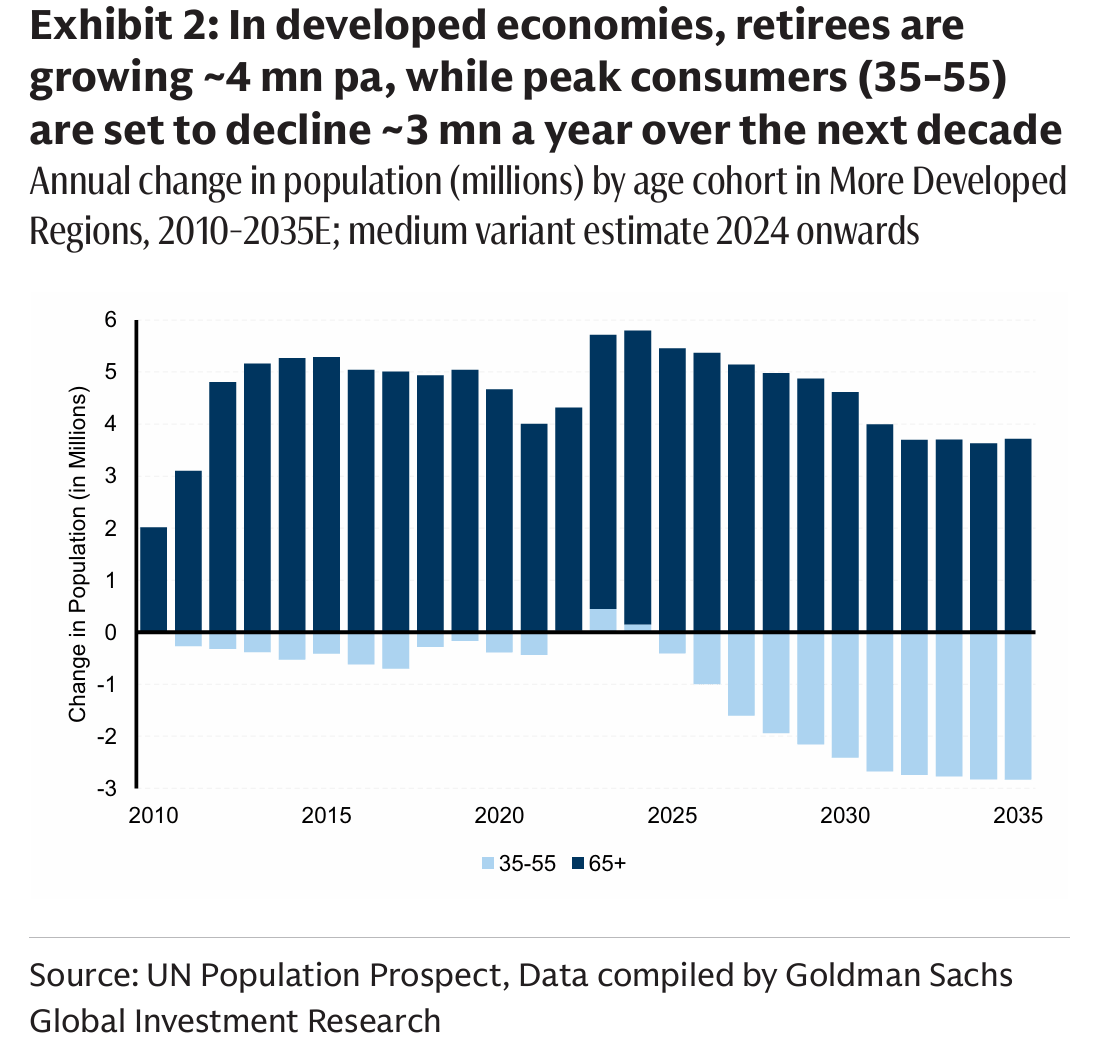
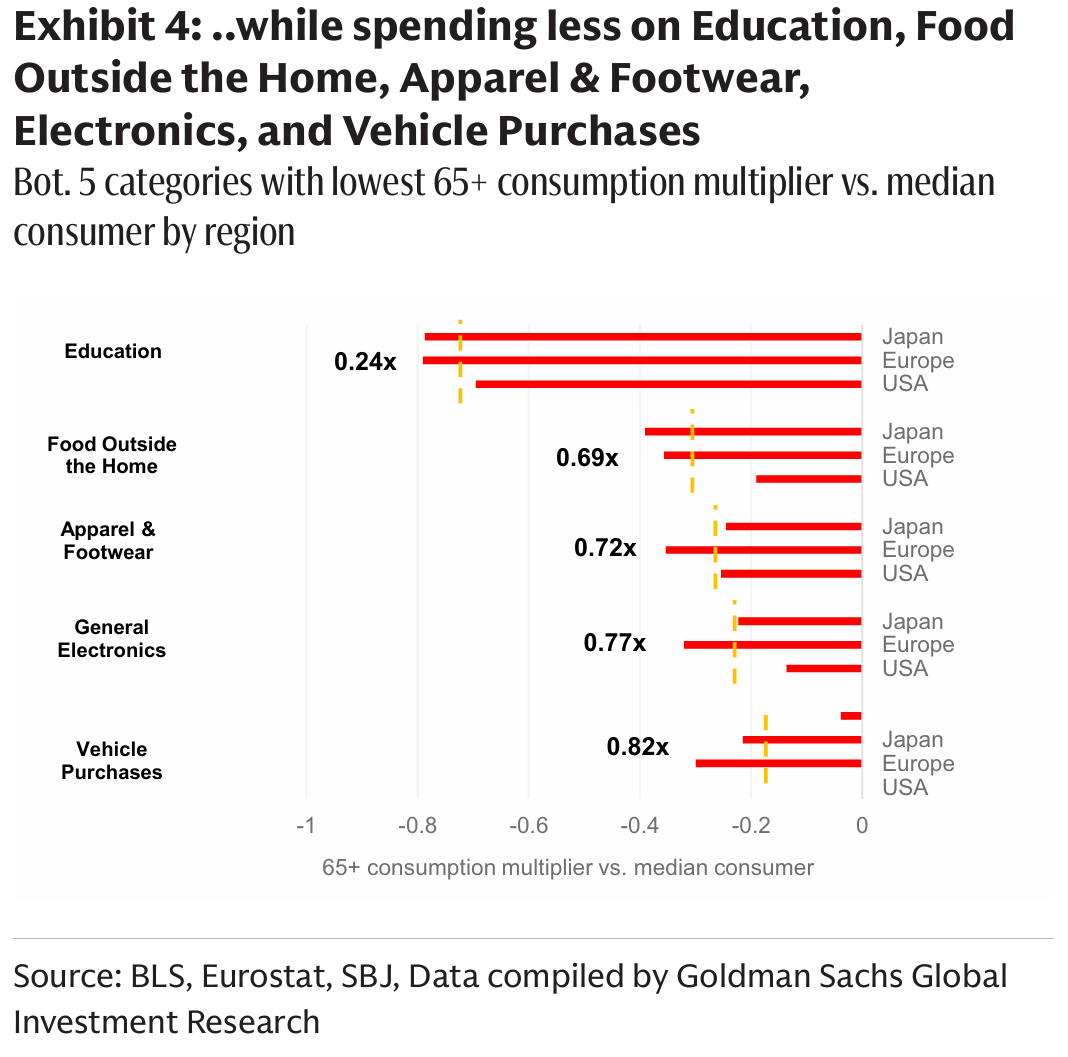
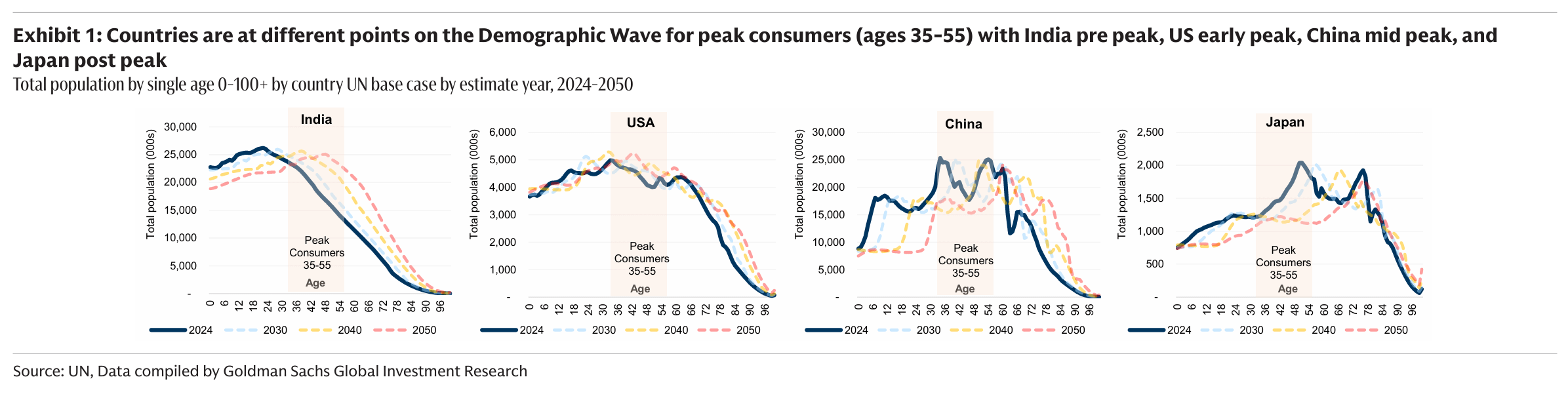
First is the direction of spending as people age. People over 65 spend just 0.72x what the median consumer spends on apparel and footwear; the categories they overweight are home improvement (1.92x), healthcare (1.54x) and, Substackers rejoice… reading (1.61x). It also looks like the developed world is about to produce a lot more of these people; retirees (65+) are growing by about 4 million a year, and the core consuming cohort aged 35–55 will start shrinking by about 3 million a year from 2030 (Exhibit 2 below).
The other finding is about what all this does to demand. Under the UN’s base case, Goldman’s framework gives clothing and apparel brands a demographic ‘tailwind’ of just 1.5% cumulative by 2030 and 2.8% by 2040. What’s worse is that under the low-fertility scenario the 2040 figure turns negative (−1.2%), and with zero migration it’s −2.0% by 2040 and −5.2% by 2050.
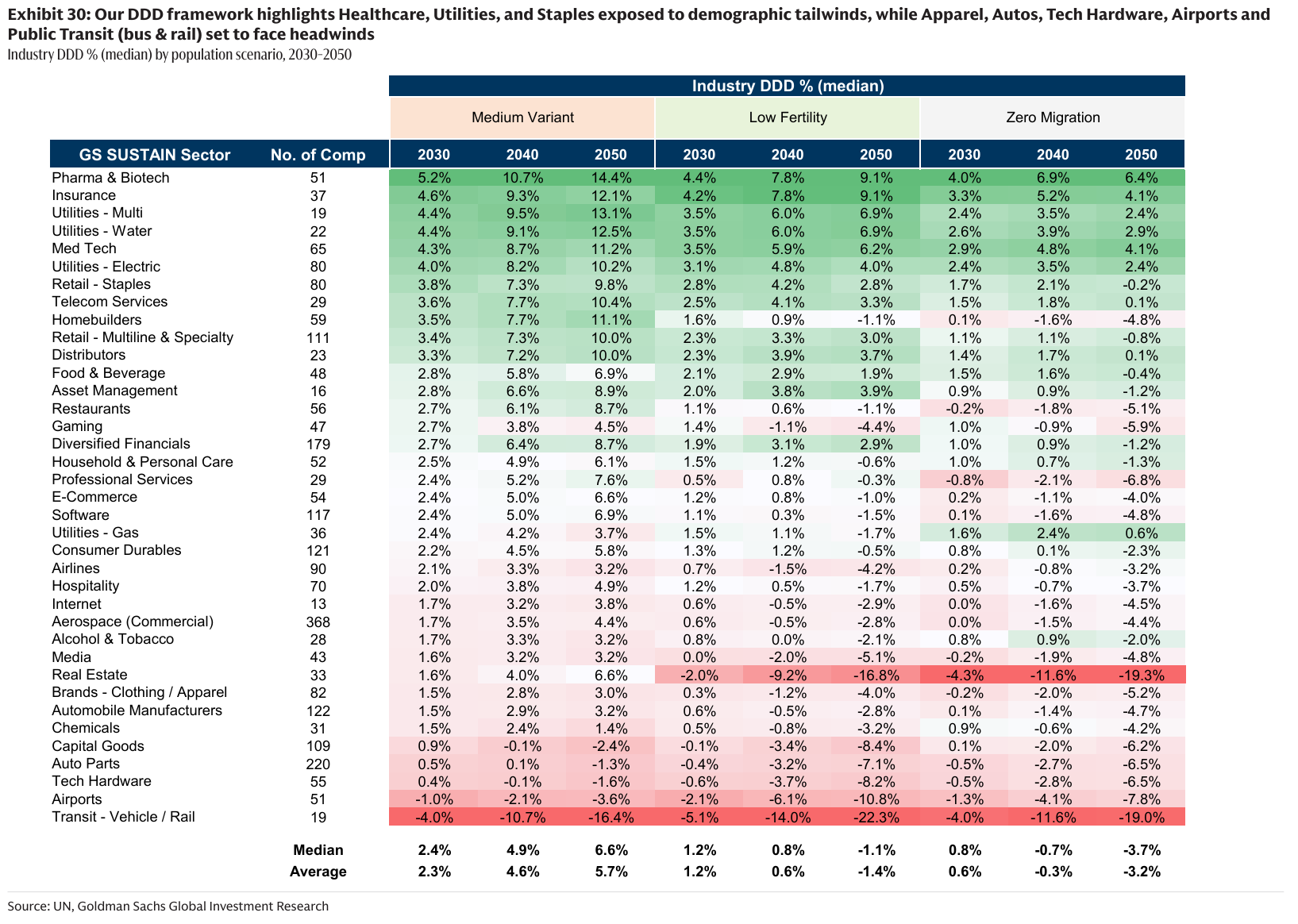
Multiline and specialty retail does do better (+3.4% by 2030, +7.3% by 2040 in the base case) but that also flattens or contracts in the pessimistic scenarios too. In other words, it seems that for discretionary things you wear, the rich world’s population structure is moving from tailwind to headwind within the working lifetime of a watch that’s currently under warranty.
And you might say “But watches aren’t apparel,” but maybe I’d only half agree with you. A 50k watch works more like jewellery than a jumper because you can see it as a store of value or an heirloom; the 65+ underspend on fashion may not apply to ‘objects people buy’ precisely because they’re finally old enough to afford them. People’s peak watch-buying years plausibly occur later than the peak T-shirt years. I don’t have age-cohort spending data for mechanical watches and neither, apparently, does Goldman, so who knows. But still, the 35–55 cohort which is shrinking by 3 million a year from 2030, is pretty much who we would label as the first-serious-watch-buying demographic. Knowing there will be fewer of those people each year is not nothing.
What makes the Goldman report most interesting for us is their prescribed “antidotes” for industries facing demographic decline. Their thinking is inspired by what Western carmakers are already doing. The advice is to push hyper-customisation and higher-priced models to extract more value from older, wealthier customers; and to expand into younger markets, above all India, which is just entering its prime consumer window.
I really hope this sounds familiar to you; it should, at least to any SDC regular… restrict volume, raise average prices, court the ageing rich, and open boutiques in India. The Swiss watch industry has been using Goldman’s demographic-survival advice for close to a decade, don’t you think? Industry unit volumes have halved since 2011 and value grew in the same period; Rolex’s volumes have now declined two years running (a first in over two decades) but its average price is up roughly 50% since 2019. We’ve been calling it premiumisation, and from Goldman’s perspective it looks more like adaptation. Either way, the watch industry may have simply been responding, rationally and early, to the same shrinking-customer maths that is hitting carmakers.
Now that’s a neat story and it would be comforting were it not for the second edge of this sword. Premiumisation only works as a demographic strategy while the older, wealthier cohort lasts… and it also, by design, sacrifices the young. The watch industry has spent a decade closing its own entry points (a CHF 3,000 starter mechanical watch from a mainstream brand is becoming a fiction; even Tudor’s average price is up ~50% since 2019) - this is all while the global cohort of under-19s has already peaked and begun declining. So we have fewer young people, facing higher entry prices, in countries where the median adult is getting poorer. If you want to know where the collectors of 2045 might come from, we’ve just pointed out three separate headwinds stacked on the same question… and to my knowledge nobody in Geneva seems to be asking it. I will give credit to microbrands, Seiko, Citizen, and the smartwatch people mind you... because they are asking it.
As for India… this is the only major market still “pre-peak” in Goldman’s demographic wave chart. UBS counts 944,000 Indian millionaires (up 31,033 in 2025) and 211 billionaires; and Indian median wealth is up roughly 20% since 2020. So the India growth story is real, but it’s definitely still tiny next to 23.6 million American millionaires. I said in the last essay that India is a 2030s story that requires patience, and both of today’s reports confirm this theory. The demographic window in India is indeed opening, but the wealth is compounding from a low base. This means anyone planning to capitalise on India in the next few quarters will be disappointed.
So what?
If you’re American, or hold your wealth in US markets: you are the market. In the US we will find nearly half the world’s new millionaires, the deepest liquidity, and four out of the seven million adults above USD 5m. Enjoy the pricing attention every brand is lavishing on you, and understand that your watch demand is now correlated with the Nasdaq to a degree that should inform how much of your net worth can be worn on your wrist. Diversification means the other kind too.
If you’re British or European: the median-wealth numbers explain the vibe here. Real median wealth is down 23.2% in the UK since 2020 and that’s why everything feels expensive; the watches mostly stayed the same, and the ruler used to measure everything shrank in the meantime. The pre-owned market, where prices adjust to what people can actually pay, is your best friend (and non-Big-Three discounts of 30–40% below retail are the market quoting you the true price of admission).
If you’re buying in the middle of the market: the maths hasn’t moved since January. A typical buyer for CHF 3–15k watches is the median consumer, and the median consumer is going backwards in most places on earth. This will keep a lid on mid-tier prices for years, which is pretty bleak if you’re Longines and perhaps delightful if you just love watches… a beautifully made JLC or Grand Seiko at a steep discount to retail is the value trade of this cycle. So yeah, buy the discount instead of hype.
If you’re thinking a generation ahead: you probably want to focus more on the Goldman report than the UBS one. What we see for the foreseeable future is shrinking cohorts of young people, entry prices creeping upward and out of reach, and a global middle whose wealth is stagnant or shrinking. The argument to “buy it for your kids” inherently assumes your kids’ generation will want these objects, but unfortunately the industry is doing very little to make sure this is true. If I were a brand CEO, the chart that would keep me up at night isn’t any of the wealth ones; it’s Goldman’s Exhibit 2 (the one showing minus-three-million-a-year in the cohort aged 35–55).
—
Last year I wondered whether my take on the UBS report was confirmation bias, but it feels like the new report has converged on the thesis all by itself. The wealth data now openly says what the watch market has been pricing for four years, which is that the average is not the median, the top is not the middle, and the industry’s future is a bet on an ever-narrower, ever-richer, mostly American few - and let’s not forget there is a demographic time-bomb ticking under the surface. I’d love to be argued out of the gloomier bits in this forecast... see you in the comments section.
Footnotes
Rounded to 58m elsewhere in the report
A fairly dire picture of the next 12 months. The image of 4 out of 7 million $0.5E7aires being Americans with most of their wealth in the stock market is pretty vivid.
Thanks for the brilliant insights, KF! Sample of one here, from the old-fart cohort:
Your assessment that the 30-55 age group is prime first-nice-watch territory is right on target for me: after a few years with a fairly nice Seiko chronograph, I finally reached the level where I could afford a Rolex as my first "serious" watch (early GMT Master II, "Fat Lady", for a wallet-crushing $1,350 brand new, Tiffany-branded on the dial. God knows what that would be worth now if I had kept it). That was somewhere in the mid-late '80s, and I was somewhere around 30.
And in my 50's I had a sequence of maybe 6-8 very good years, which enabled my current life: comfortably retired, not working and not needing to. But there's no money coming in other than whatever my not-huge portfolio brings in each year, and so my willingness to spend thousands of dollars on things that are far from necessary (as opposed to, say, a new HVAC when the old one breaks) is very, very, very low. And nice watches, while a blast to read about and think about and comment on, are definitely not necessary. So yeah, I'm in that EMILLI group, but I'm not one of its "elder siblings," and although there are vast numbers of people who would love to be where I am, it doesn't quite feel like really rich. Not when I can see people like Jeff Bezos renting the city of Venice for his wedding, or Taylor Swift renting out Madison Square Garden and cordoning off a few blocks around it on the July 4th weekend for hers. (To be clear, I'm not complaining--I have a good life, and I've been very lucky, and as I mentioned a few words ago, I know damn well that the vast majority of Americans, never mind everyone else in the world, would love to have what I do.)
So yeah, I'm not a person of interest to the makers of uber-expensive watches (never really have been, though for years I deluded myself to thinking I was), and I'm also far less willing to spring for a $5K-$10K watch, more or less on a whim, than I was 15 or more years ago. Will younger age groups come along to replace me? Probably, and the Swiss watch industry had better hope so.