
What Your WhatsApp Group is Doing to Your Opinions
Research on the psychology of group polarisation explains how collector circles manufacture enthusiasm, neutralise critics, and push everyone toward the extremes

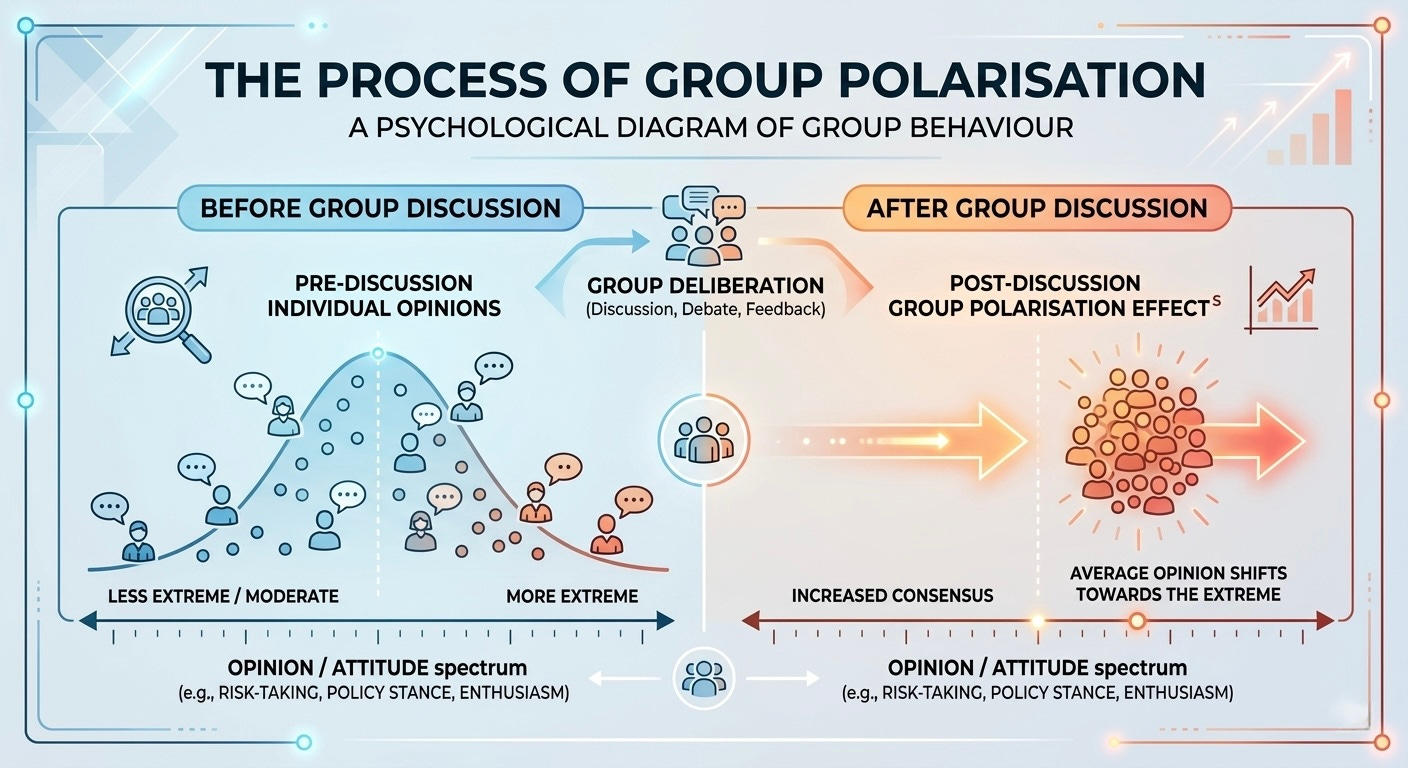
Let’s say you’re in a WhatsApp group with several other collectors, and someone posts a photo of a newly released watch. A bunch of people say it looks great, a few say the dial colour is interesting... but mainly, you note that nobody says anything particularly negative - and this may even be because the guy who posted it is well-liked and seems excited about it, and since you’re all mates nobody feels the need to rain on anyone’s parade. So within an hour or two, many in the group seem to have decided this is an impressive release and by that evening, a bunch of people are asking their ADs about availability.
Now… let’s rewind.
If every one of those people who piped up about the watch in the first scenario had found the watch on their own, and then thought about it in isolation without any subsequent group discussion, what would they have thought? It might have been something more moderate like “it’s alright” or “not for me, but I can see the appeal.”
In the first scenario, the group looked like a place for sharing opinions, but in reality, it ended up manufacturing enthusiasm. This phenomenon is called group polarisation, and you won’t be surprised to hear that it’s quite well-documented in social psychology.
Today we will be discussing an old paper by Cass Sunstein which sets out a lot of the core research in detail, and the key issue we’re addressing is this: when a group of people who already lean in a certain direction discuss something together, they almost always end up leaning further in that direction than any individual would have managed on their own. So what can we do to stop this? Should we try to? Why?
Estimated reading time: 18 minutes
How it works
It would be too easy to chalk this up to basic peer pressure or social conformity and leave it at that. Sunstein reckons it’s more interesting than that, and identifies two specific mechanisms which will sound familiar if you’ve spent any time in collecting circles (or reading SDC).
The first is social comparison, and if you really feel like doing a deep-dive into this topic, you’re in luck, because I have a 3-part series on this exact topic. Basically, people want to be perceived favourably by others in their peer group, and they also want to perceive themselves favourably. So when you hear everyone else’s opinion, you adjust your position to maintain the relative standing you thought you already had in that group.
If you considered yourself a ‘knowledgeable and discerning collector’ before the discussion started, and the group consensus seems to be trending toward excitement about some new release, you are more likely to shift your own position to stay ahead of (or at least be consistent with) the others1.
Don’t brush this off as someone ‘weakly’ going along with the crowd; what we’re talking about here is more subtle than that. You’re trying to stay in the same relative position to the group, so as others shift, you will shift too. Generally, you end up somewhere more extreme than where you started.
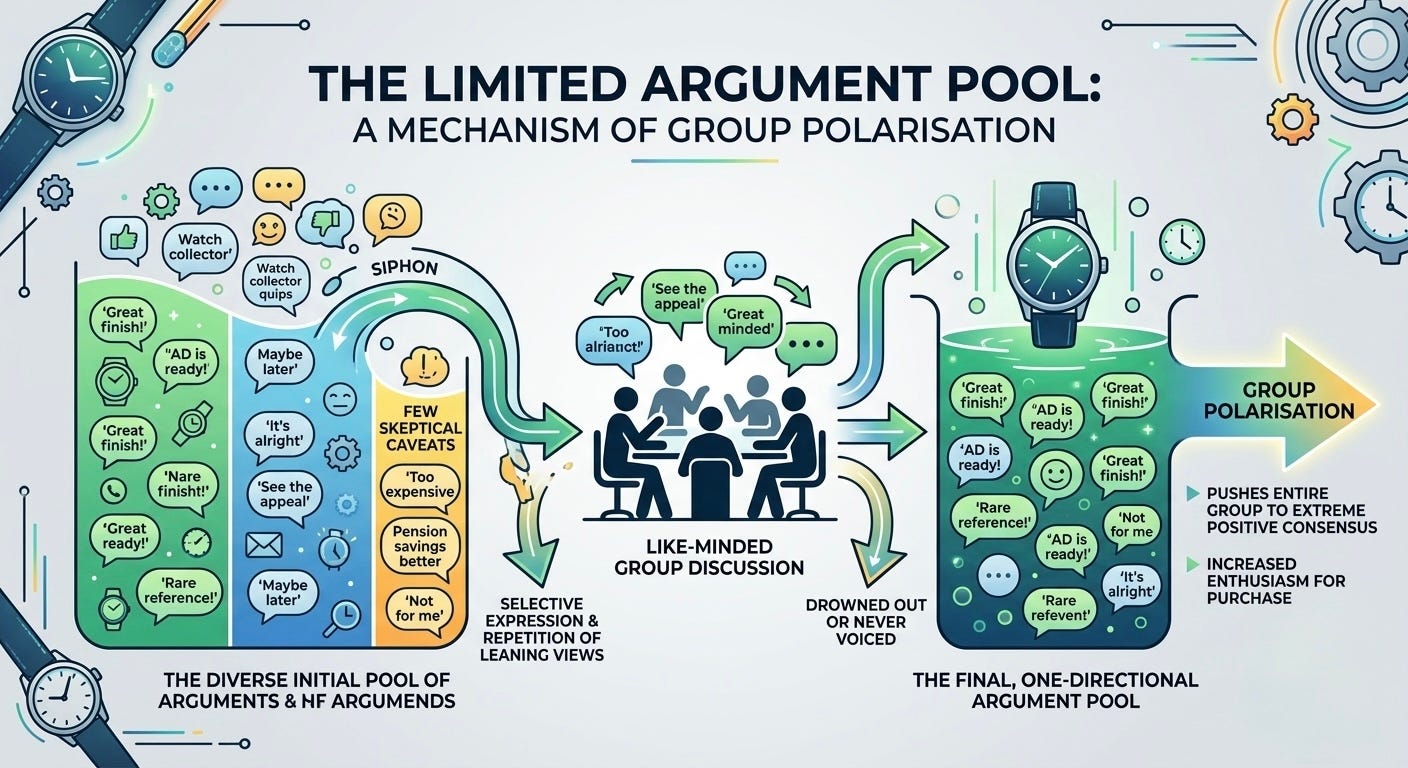
The second mechanism Sunstein covers is a limited argument pool. When a group is already leaning in a particular direction, the arguments that surface during a discussion will naturally be skewed in that direction. If a large proportion of your group are mildly enthusiastic about a watch, the discussion will produce far more reasons to like it than reasons to be sceptical. The few sceptical thoughts someone might have had get drowned out, or simply never get voiced at all. So in total, maybe you hear 10-20 arguments in favour, 1-5 lukewarm caveats, and 1-5 ‘serious’ objections... odds are, you will end up more enthusiastic than you were before starting.
This is basically a supercharged version of concepts we explored in this old post about probabilistic collecting, where I talked about how we process information and evaluate evidence with inherent biases. Group polarisation takes the standard confirmation bias - which is an individual tendency - and puts it on steroids, because now it’s happening across a whole group at the same time.
WhatsApp problems
Last year I wrote this joke-essay about a collector’s wife, where she mentioned her husband being in at WhatsApp groups, ‘…constantly buzzing with photos, questions, memes, and what appears to be endless debates...’ She described the phenomenon of her husband disappearing into the toilet to entertain a long discussion about whether someone should ‘pull the trigger’ on a purchase.
Based on my own participation in many such groups, I’d wager that in the vast majority of those ‘should I pull the trigger?’ discussions, the answer from the group is yes. Always yes... pull the trigger, life is short, you deserve it, suits you… worst case, you can sell it, but at least you tried it.
Why is that? Well, because the people in that group are all insane watch collectors. They’re already predisposed to think that buying watches, in general, is a good idea. This means the argument pool is inherently skewed toward acquisition. Nobody in a watch collecting WhatsApp group is going to say “honestly bro, you probably have enough watches and should put the money into your pension or something more sensible” because that’s not why they’re in that group. I mean, that’s exactly why people don’t ask their financial advisors whether they should buy a watch.
Even if people in the WhatsApp group think you shouldn’t buy the watch, they’d rarely ever say so, because it would mark them as someone who is negative, or maybe just doesn’t really ‘get the watch.’ And if the person ends up buying the watch, then this person will be remembered as the naysayer. It’s like if your friend is in a serious relationship and then asks you whether he should marry the girl… this actually happened to me, and I was honest with the guy about why she might not be good for him, and he ended up marrying her anyway - this affected our friendship forever. I can’t change who I am, but you get the idea… the WhatsApp group, generally speaking, will produce exactly the kind of one-directional argument pool that Sunstein describes in his paper, and the guy in the toilet finishes his dump having been nudged closer to a purchase he was already considering.
Sunstein also brings up these ‘iterated polarisation games’ which is what happens when the same group keeps meeting and having discussions over time. His prediction is that the groups’ overall views should get progressively more extreme with each round of discussion. Now, in this paper, Sunstein says there aren’t formal studies of this, but argues it’s a plausible real-world phenomenon - he apparently didn’t look hard enough because there is this study published a few years before Sunstein’s paper, which tested the iterated discussion idea. They manipulated how many times group members expressed their views and how many times they heard others express theirs. They found that repetition increased extremity, and that the effect was strongest in groups where members repeated each other’s arguments and incorporated them into their own reasoning.2
I am sure you’ll agree, this is basically a perfect description of what happens in any active WhatsApp group. Someone says “the finishing is incredible,” then someone else repeats it in their own words, then a third person brings up a comparison to back up this line of reasoning, and the uses that reinforcement when making the case to a fourth person... every repetition, according to the research, will compound the reinforcing effects.
What about the “real” critics?
You may be wondering who these real critics are? Well, I have a collector friend who goes by the nickname A Watch Critic - this guy loves arguing, and he’s constantly on a pursuit of truth and objectivity. To demonstrate this, he identifies flaws and shortcomings on watches he owns and enjoys wearing, and maintains that no watch can be ‘perfect’. I brought him up as example because he’s the one guy who, in our circles, doesn’t seem to ‘conform’ to the theory I described at the start.
To address this apparent outlier, I want to point out the distinction in the literature between authentic minority dissent and role-based dissent - the second one is basically people playing “devil’s advocate”. Research has found that people who hold a different view and express it because they truly believe it are very effective at improving group decision-making. Such people force the group to consider alternatives, widen the argument pool, and reduce polarisation.
But but but… and this is the key part, devil’s advocates and known contrarians are significantly less effective, even when they raise the exact same points (as the authentic minority). The reason for this is that the whole group tends to discount the argument (from the devil’s advocate) because they’ve already ‘categorised’ the source in their mind… “That’s just Kevin being Kevin” they might say to themselves. So apparently, the arguments from these known contrarians are processed differently by the group when they know (or believe) that person is ‘performing their usual role’ instead of expressing any serious conviction regarding the issues they raise.
Back to my friend A Watch Critic - he’s actually in a more interesting category because he isn’t even playing devil’s advocate… he usually does believe in being rigorous and critical. But the issue he faces, is that his contrarianism has become so predictable that the group has essentially absorbed it into the social structure or the group dynamic.
What follows is not specifically about my friend, it’s a more general breakdown of the archetype; and it turns out, being a known ‘critic’ seems to create a couple of problems…