
There Is No Fair
A conversation with Jason Lu of 1776 Atelier, on hand finishing, flags, and the strictest label in watchmaking

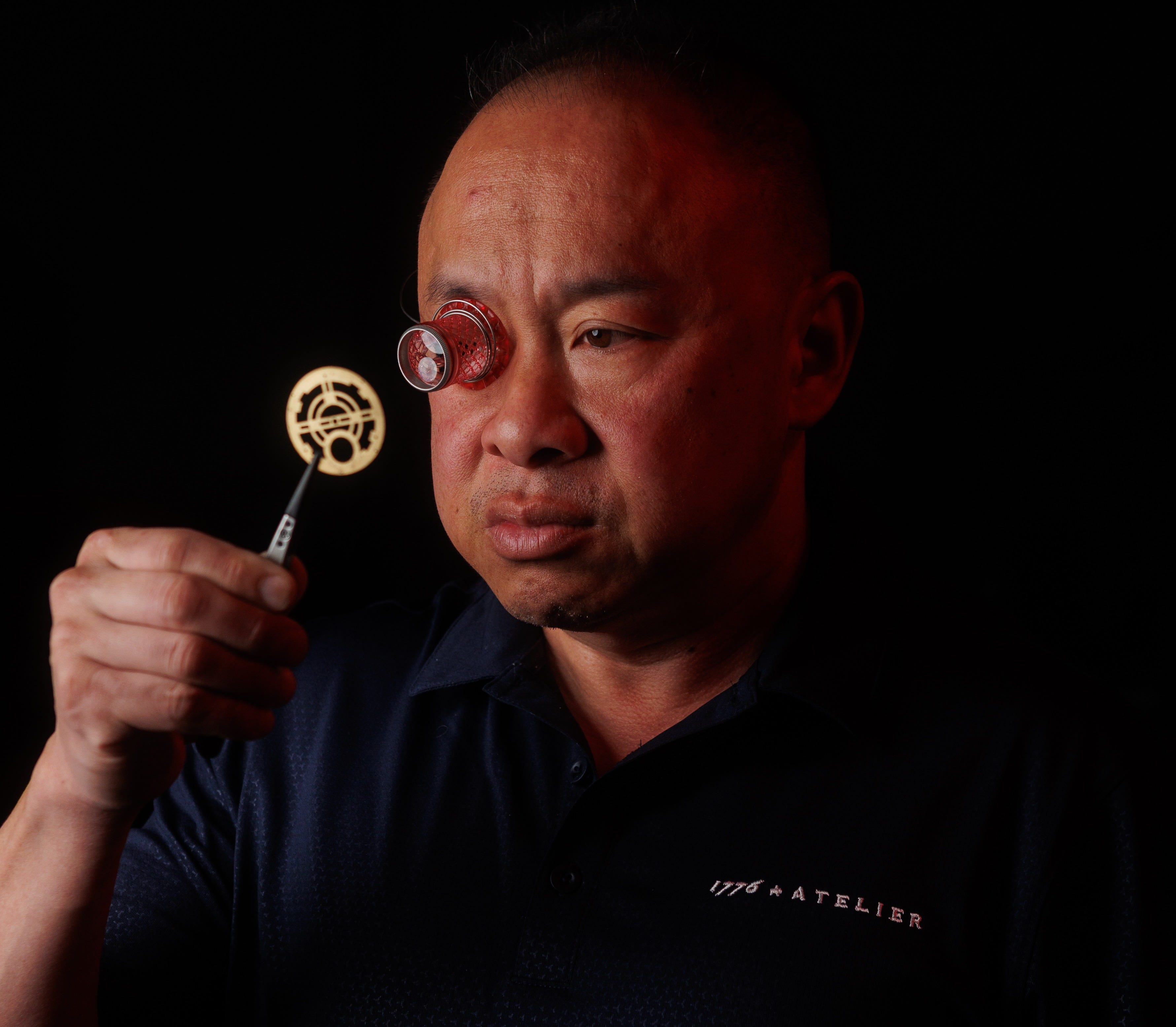
Jason Lu proposed to his wife in front of the Jefferson Memorial. I offer this trivia off the bat simply because it’s an easy bit of due diligence I can share regarding whether the name of his watch company, 1776 Atelier, is a marketing ploy or more of a sincere commitment. Nobody stages a proposal at a neoclassical rotunda dedicated to the author of the Declaration of Independence just so he can use this trivia later on in life for building his watch brand; I guess the man just likes American history!
Before you even begin to wonder, allow me to clarify that this post is not a paid promotion, and I have no commercial interest in this brand. I don’t own one of their watches, and I have not placed an order for a watch from 1776 Atelier.
How this post came to be was pretty simple. I read about their newest watch on several watch media pages, and then I sent Jason a bunch of questions. Several questions were intended to feel awkward, because I figured a new ‘American brand’ with a patriotic name and big finishing claims is exactly the sort of thing this newsletter exists to investigate.
I sh1t you not, Jason sent me back over 10,000 words; I figured this was either the behaviour of a man with something to hide behind all these words, or a man who has been waiting a long time for someone to ask. Having read through all of it more than a few times, I personally lean towards the latter, but I must caveat all of this by saying I have not held a watch from 1776 Atelier in my own hands. Perhaps that looks bad for now, but I got some really good images with labels from Jason to back up his claims - just wait and see.
Jason’s answers are quoted verbatim throughout (American spelling and all).
Estimate reading time: ~24 minutes
I’ve always wanted to use the term dramatis personae, and now I have, and that’s what I will start with. 1776 is a two-man show. Jason Lu is a Texan, a mechanical engineer by education (with a minor in US history, of course), and until recently a technology executive who spent two decades running large manufacturing operations (often in turnaround and private-equity settings). He came to watchmaking as a collector first, restoring pocket watches as a hobby, and then crossed over from consumer to creator.
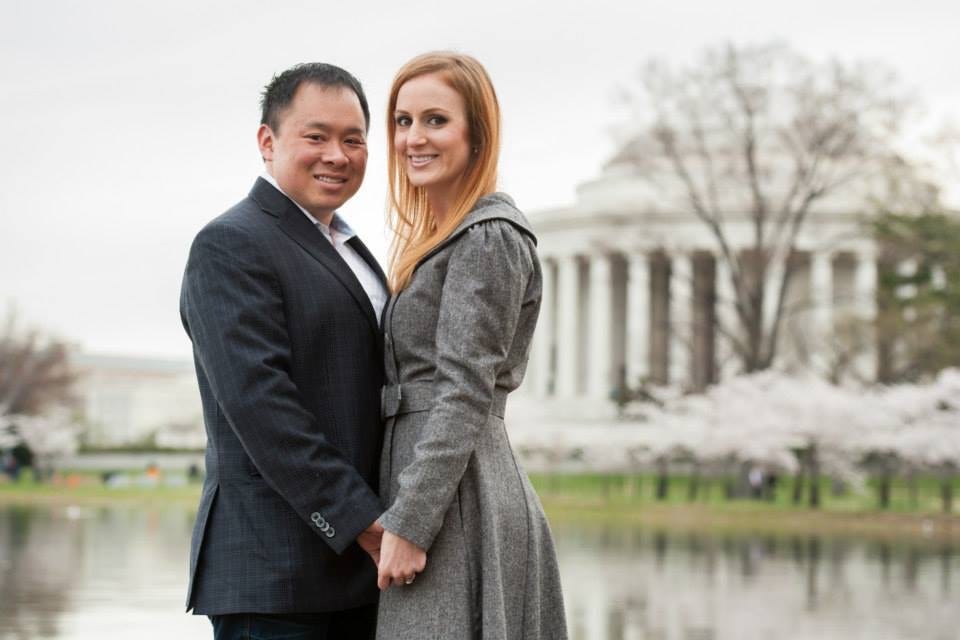
The other half is Zach Smith, a WOSTEP-trained watchmaker who owns Hour Precision in Ohio (one of the very few precision component suppliers in American watchmaking), with a background supporting machining for aerospace and biomedical customers, and a fleet of KERN mills to show for it. Smith became co-owner of the brand, and between the two of them they design, machine, finish, assemble, regulate, photograph, market and sell everything. Last year, per Jason, this two-person operation shipped well over 100 watches.
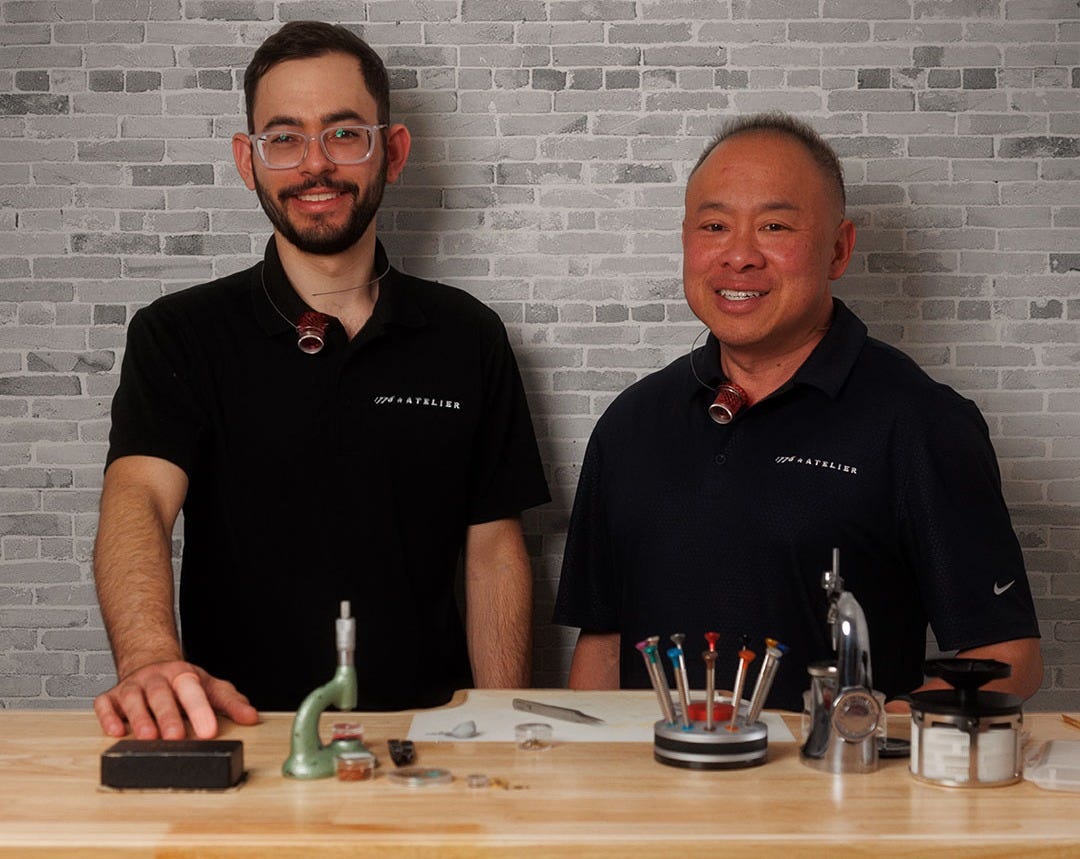
In our interview, I was mostly focused on Jason and 1776, and less focused on his team. We didn’t go into much detail about Zach, but I flagged this in my review and Jason sent me additional context on how he met Zach and how he views team selection. I decided to include it in full, because it does a great job highlighting how much Jason values Zach, and how important Zach is to the 1776 value proposition:
“Every team I’ve ever built in both my careers has been centered around building a team that can execute at a standard deviation or two above average. That African proverb of “if you want to go fast go alone, if you want to go far, go together” is bullshit. The reality is that the modern world doesn’t allow us to pick just between going fast or going far. The real world, whether it’s tech or independent watchmaking, demands that we do both. A maniacal focus on building a team that can execute with speed and breadth is the proverbial silver bullet that very founder should be focusing on.”
Donat Kornagel [more on him later] introduced Zach and me because the two of them had worked together before. As our projects became more ambitious, Zach naturally became a bigger part of what we were doing.
At first glance, Zach is already uncommon because he’s a trained watchmaker. In the United States, that’s rare enough. But most trained watchmakers spend their careers restoring and repairing watches. Zach also learned how to manufacture them. That’s a completely different discipline. Then he went a step further and built one of the few full-scale precision manufacturing operations in the country with some of the best equipment in the world for producing watch components. But even that isn’t what makes him exceptional. Anyone with enough money can buy a machine. The hard part is knowing how to program it, maintain it, repair it, develop the manufacturing processes, and consistently make it produce watch components to micron-level tolerances.
Stack all of those skills together in one person, and finding someone like Zach is like finding a one-eyed purple unicorn. That’s what made him such an obvious fit as a co-founder and operating partner.
Their watches are named after presidential homes; Mount Vernon (a fully hand-engraved movement for under $7,500), Montpelier at $17,800, and now the Liberty 250. The last one is a 25-piece rose gold skeleton at $44,000, launched on 4 July 2026 for America’s 250th birthday, with a free-sprung balance made from American raw materials and a movement the brand describes, very deliberately, as “more than 90% manufactured in-house from raw American materials.” That quoted part is deliberate - to cover some legal requirements but we’ll get to those details a bit later.
Before we kick this off, let me frame this whole essay with one macro thought; 1776 Atelier has a foundational belief that finishing is the one claim in watchmaking you cannot fake, and the market still misprices it. You don’t have to agree with them just yet… you can make that call once you’re done reading this.
Loupe test
I opened with a sceptical question and asked, if a collector picks up your watch knowing nothing about the brand, what, physically, should convince them, and what separates it from a $2,000 watch with “hand-finished” in the description?
Jason’s answer was about eight paragraphs long, but the main line is this one:
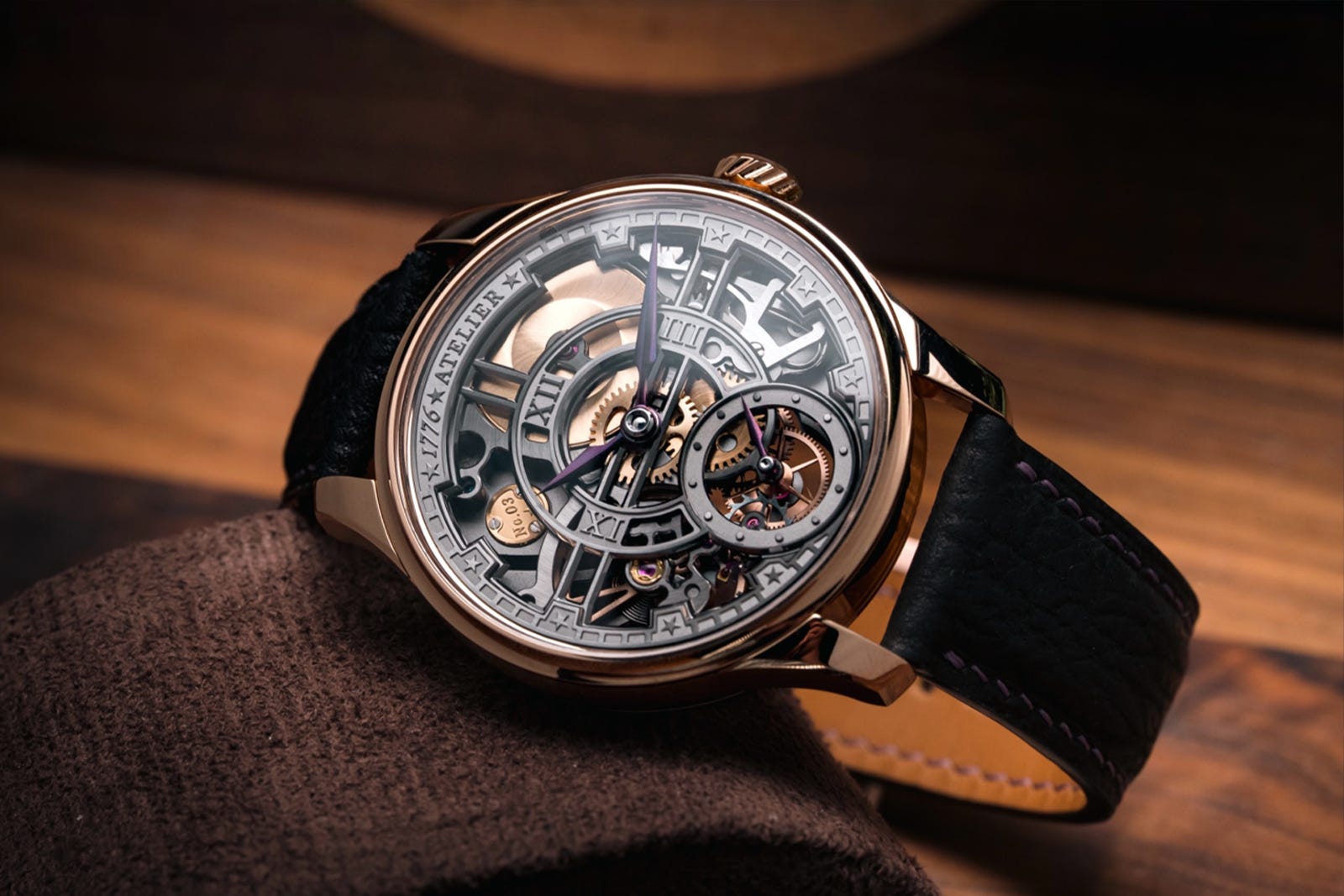
“Nothing leaves our workshop unless we’re satisfied with it under 40x beneath a microscope. That doesn’t mean every surface is mathematically perfect, but it does mean every visible surface has been intentionally considered.”
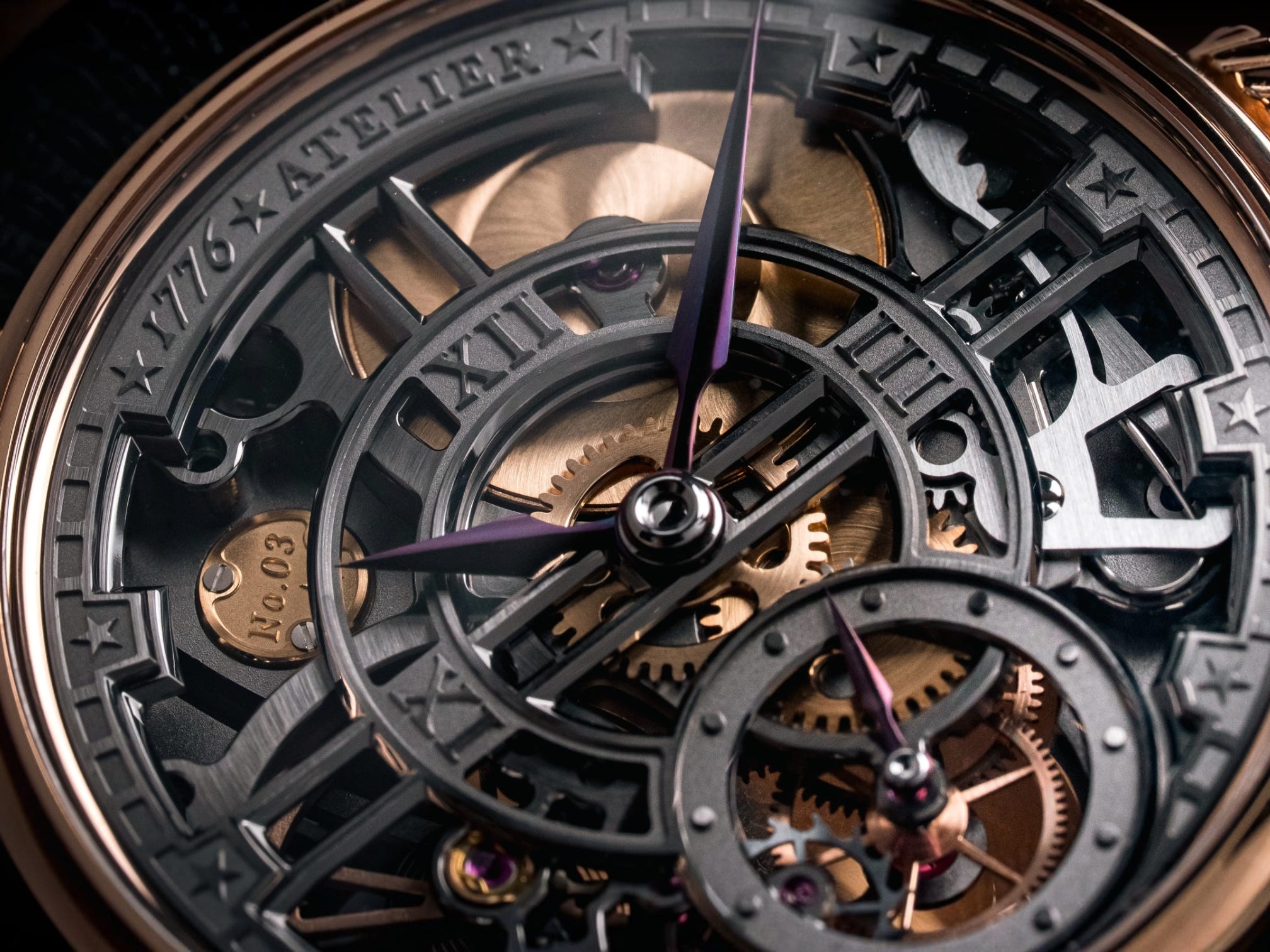
He’s invoking quite the standard here. Most finishing is judged at reading distance; the loupe crowd typically goes up to 10x, maybe 20x. He’s volunteering 40x, at which point I’d imagine all possible excuses will die. Some of the specifics he rattles off seem easily checkable; two-piece hands with polished bushings and riveted construction rather than stamped blanks, 62 hand-finished internal angles on the dial alone, wheels machined not stamped, and then bevelled on both sides (the movement is openworked, so you see the gear train from both directions), every screw chamfered before the head is black polished and thermally coloured to plum instead of blue.1
“Those are the details that tell you whether the same level of care was applied to the entire movement or only to the parts that photograph well.”
Longtime readers know why this section matters to me; when we discussed The Hand-Finishing Fairy Tale, the argument was that “hand-finished” had become the most elastic phrase in the industry, stretched over everything from Dufour with his gentian wood to a polishing wheel bolted next to a CNC machine. So a brand whose entire pitch is around that same fairy tale phrase kinda deserves an interrogation. To Jason’s credit, he didn’t seem to flinch at any of it; in fact, I think he did better than I’d expected - and we will get to that in the taxonomy section.
No participation trophies
Jason is a self-taught watchmaker, in the sense that there is no ‘Swiss diploma’ on his wall. I asked him why anyone should trust the finishing judgement of a former technology executive without an apprenticeship.
“It’s a fair question, and honestly one I expect collectors to ask. Neither of us believes a collector should trust a résumé or a marketing story. They should trust the work. Watchmaking is unusual in that [you get] respect because the evidence is sitting there in plain view... Simply put, watchmaking doesn’t provide participation trophies. Collectors and the press can be unforgiving, especially when you’re new.”
To be fair, the self-taught label turns out to be only half true anyway. Jason spent years making repeated trips to Glashütte to work alongside Donat Kornagel of DK Precision, in what he calls an informal apprenticeship; Kornagel corrected everything from how he held a micromotor to his perlage, and helped him source tooling as well. The specialised grinding lathe 1776 uses for its solarisation grinding came out of the region, from a retired watchmaker at one of Glashütte’s historic manufactures. We can also add Philippe Narbel’s master finishing course on top of all that. So the training did happen in more than one way; it just doesn’t come with a certificate from a canton.
Also, touching on economics for a moment, watch movements are unusual among luxury goods in that a quality claim is fully inspectable by the customer. You cannot verify the provenance of the leather used in a handbag or the “in-house” content of most watches (without subpoena powers, anyway); but anglage under a loupe is a matter of public record. The information asymmetry that props up so much of luxury pricing (I’ve written about this in What you pay for when you buy a watch) goes away at 10x magnification. A brand that readily invites inspections under a loupe is voluntarily surrendering that asymmetry which many brands rely on. I suppose you could argue it is either confidence or foolishness - all I can say is at least this is testable, and an owner can quickly determine which one it is.
Dependent watchmakers
I asked whether he’d describe their work as in-house, hybrid, or something else - since the Liberty 250 is neither a modified ébauche nor a from-scratch calibre. He opened his answer with an anecdote I enjoyed, since it was related to a Romain Gauthier video we shot for The Escapement (totally unbeknownst to him!):
“This weekend I watched an interview with Romain Gauthier where the interviewer brought up the term ‘independent watchmaker.’ Romain’s response was that it’s a term we shouldn’t use anymore because, in his words, there are only ‘dependent watchmakers.’ I had to chuckle because I think he’s absolutely right... The question isn’t whether you’re dependent. It’s where you choose to develop capability yourself and where it makes more sense to rely on true specialists.”
The Liberty 250’s movement keeps the architecture of the Unitas 6498, the pocket-watch calibre that half of independent watchmaking has used as a canvas at some point.2 Jason doesn’t apologise for this, and quotes Clausewitz at me instead (“the enemy of a good plan is the hope of a better plan”). His argument is that the gear train layout is the only thing that survives a comparison. The bridges, main plate, wheels (six spokes now, not five), free-sprung balance, crown and ratchet wheels, click system, screws, and even the bridge alignment pins, are made by the two of them, from American brass, steel and German silver bought as raw stock, ground flat in-house before a mill ever touches it.
If that wasn’t already impressive, Jason then described their development cadence. They control everything from raw material forward, they machine multiple iterations of a component in a single day, inspect under the microscope, refine, and cut the next version by the afternoon. They’ve evaluated different materials for the same part inside one working day. Anyone who has dealt with Swiss supplier lead times will recognise this as being close to science fiction. It’s also the best answer I’ve ever heard to the question of what America actually offers a watchmaker - note it has nothing to do with the flag! It must be lovely when nobody will make you wait four months for a barquette, or take 4-8 weeks off in the summer.
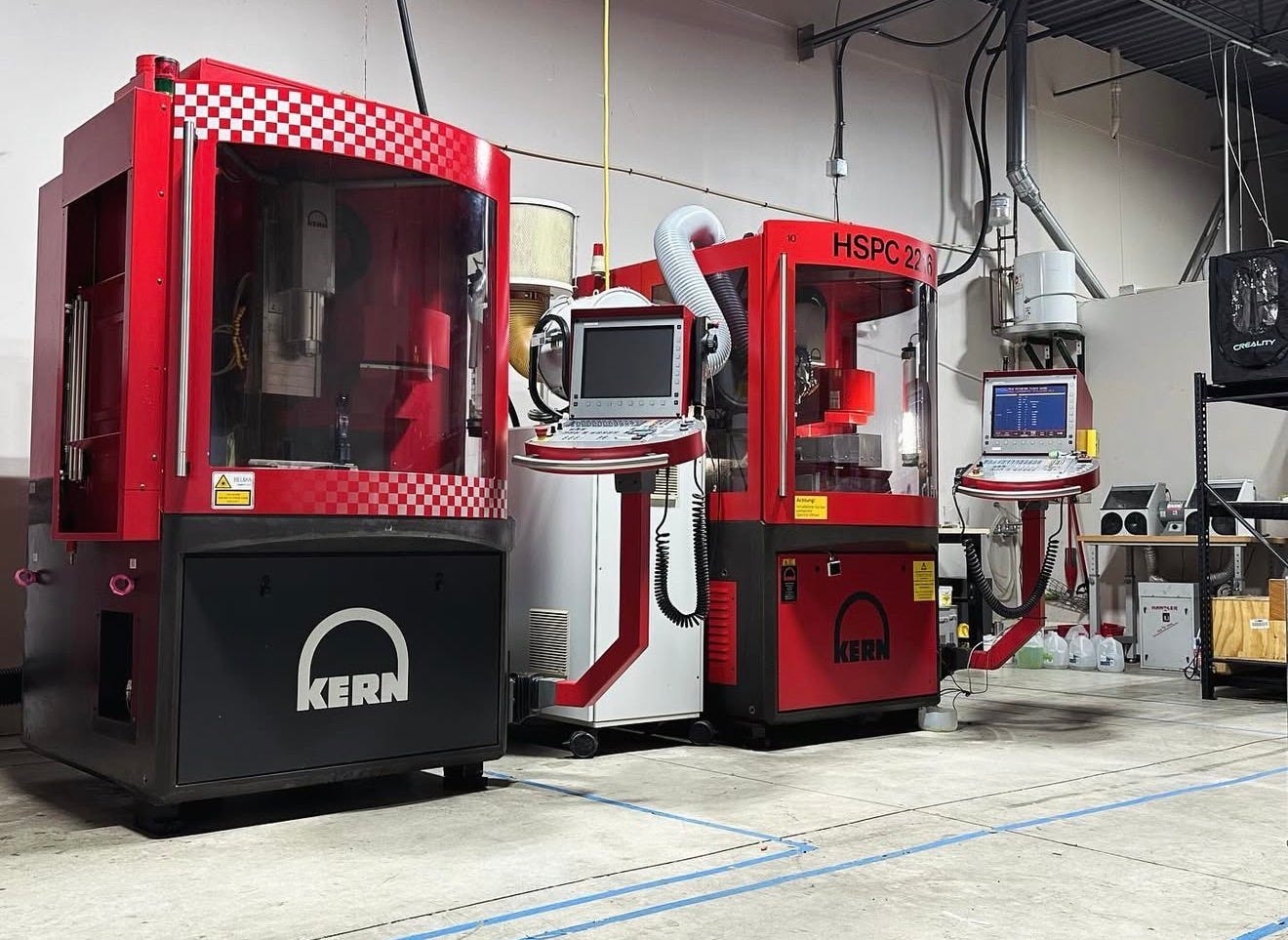
Many will already know their watch case is German - made by RP Uhrgehäuse. Andrew Cavanaugh’s coverage raised an eyebrow at that, and so I raised the same eyebrow to Jason:
“The answer is simple… because they’re among the finest case manufacturers in the world... If we believe we can produce something to an equal or higher standard ourselves, we’ll make it. If someone else genuinely does it better, we’re perfectly comfortable saying so.”
He added, on priorities, “For us, the case frames the watch. The movement IS the watch.” I’m sure many would quibble with that perspective (a De Bethune owner might tell you the case is half the object), but as a resource-allocation statement from a two-man shop with a hard deadline, it’s pretty coherent. This is a version of the Spectrum of Independence argument; in-house as a binary concept was always a dead end. The question today is where a maker draws the line, and whether they’ll show you the line at all. Jason publishes his line items openly: sapphire crystals, jewels, mainsprings, and hairsprings are all bought in. Everything else is made in Texas and Ohio.
Forbidden labels
Why does the Liberty 250 say “more than 90% manufactured in-house from raw American materials” instead of “Made in USA”? Because the Federal Trade Commission (FTC) would like a word, that’s why. For an unqualified “Made in USA” claim, the FTC standard is that a product must be “all or virtually all” made in the United States - not just assembled there, or designed there, or have lots of value come from there. The parts themselves must be of US origin, more or less to the last one. Jason, who clearly enjoys this subject the way other people enjoy drinking beer:
“It is not enough that the watch is assembled here. It is not enough that most of the value is created here... The parts themselves must also be of U.S. origin. That is the distinction many people miss.”
Now compare this to the competition. “Swiss Made” requires 60% of manufacturing cost to be Swiss, plus a Swiss movement, casing and inspection. Canada offers a two-tier system (98% for “Product of Canada”, 51% for a qualified “Made in Canada”). The UK and most of the EU run on “substantial transformation,” which is lawyer-speak for it became the thing here, near enough. The American standard seems like the strictest country-of-origin bar in the world, and the penalties for faking it now run past $50,000 per violation, where every label, webpage and advert can count as its own violation.3

So here is the situation, and I’m sure you’ll find it as baffling as I did. A watch whose main plate, bridges, wheels, screws, hands and balance were cut from American raw stock, in America, by Americans, somehow can’t legally call itself Made in USA because of the Swiss mainspring and jewels? Meanwhile, as Cavanaugh points out, if the American standard were applied in Switzerland, even Rolex might not count, since its movements are made from German brass - and I’m sure everyone will agree this is moronic. And yet, an horde of “American” lifestyle brands with Asian supply chains wrap themselves in the flag every day, protected by absurd fact that the FTC really can’t chase everyone.
I asked Jason if the irony bothered him, and his answer is where the title of this essay came from:
“My dad taught me a lesson when I was little that’s stayed with me my entire life. He used to say, ‘There is no fair.’ I didn’t always like hearing it, but over the years I’ve come to realize he was right. You don’t get to choose every challenge in life. You either spend your time complaining about it, or you accept it and make the best of the situation.”
In fact, he knew about the FTC standard before he named the company. This tells you how crazy he is. He chose the most scrutiny-attracting name available in American commerce, for a product category where the ‘made in’ label is legally difficult to pass - on purpose. This could go either way; this is either a guy who likes living life on hard mode, or the name was never about the ‘made in’ label at all (more on this later).
There’s a great epilogue to the question of claims made by watchmakers and brands. When Cavanaugh reviewed the Liberty 250, he didn’t take the brand’s “222 hand-finished internal angles” on faith; he counted them using DotDotGoose (an open-source tool built for counting birds in aerial photographs).4 The tally came to 230, meaning Jason and Zach under-claimed by eight angles. I have consumed maybe a decade of watch marketing in which every number is rounded up, and I cannot remember any occasion where someone fact-checked a watch brand and found their claims to be on the conservative side. Whatever else you take from this essay, I’d say that’s at least worth an approving nod.
“Hand-finished” handbook
I asked Jason to give readers a taxonomy of how the term “hand-finished” gets stretched in marketing - without naming names. He responded with a four-level classification system, which I suspect he had been carrying around fully formed, waiting for someone like me to ask. I have copied and pasted Jason’s exact response here so I don’t misrepresent or fumble his words. Jason and Zach kindly obliged when I asked for images to explain some of the terminology used these descriptions - thank you guys for preparing these images, I hope readers find them useful.