


If you missed Part One, start there.
If you’ve already seen it, you will hopefully recall we covered topics such as removing jewellery before handling someone else’s watch, never asking what someone paid unless you know them well, and celebrating others’ grails even when your ego would rather not. Most of that essay was about behaviour; today’s post is more about character.
Part Two was harder to write, because it covers qualities which can’t be reduced to simple dos and don’ts. This stuff gets cultivated over years, tested in moments of temptation, and revealed gradually in “how you show up in the community.” If you haven’t ‘got it’ you will not be able to fake it for too long and above all, you certainly can’t buy it!
What is it? Let’s find out…
Estimated reading time: ~13 minutes
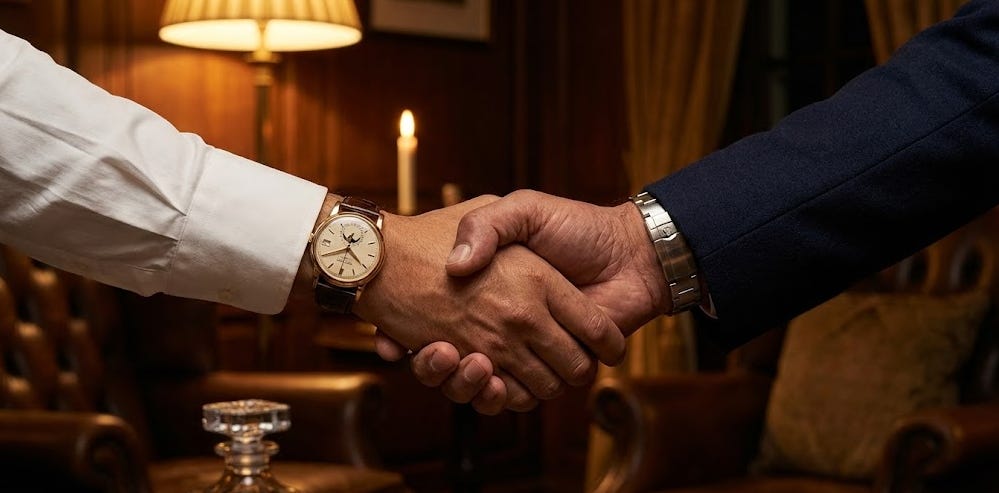
Part Two: What Money Can’t Buy
Taking the time to acquire knowledge
Anyone can memorise watch specifications or recite the marketing materials verbatim. What separates enthusiasts is deeper understanding beneath the headline facts. Can you tell why certain complications are difficult to execute? Do you understand how different finishing techniques achieve their effects? Are you able to appreciate what makes one movement architecture superior to another for any given purpose1.
If you don’t care to learn any of this, and you just like watches because they look good or give you status, good for you. On the surface, being that way does not make you any less of an enthusiast; but it does make you less of a serious enthusiast. I appreciate how this must make me sound like my head is too far up my own arse to hear the war cries, but please bear with me. I do not say any of this with ego; I am the first to admit I know very little, and that is precisely why I write everything I do: to learn!
Gaining and really absorbing decent knowledge, is always going to take time. It requires reading beyond the obvious sources, handling pieces across the price spectrum, asking questions of people who know more than you, and being willing to be wrong in public occasionally2. The reality is that there are no shortcuts, and the depth of someone’s knowledge will reveal itself in any conversation.
You might be wondering what the point is… “Why can’t I just enjoy my watches for the aesthetics? Do I really need to care what a swan-neck regulator does?” Well, you can do whatever you like, but I’d bet a decent sum that you aren’t reading SDC because you want to be a surface-level enthusiast! Improving yourself will ensure you bring something to the community that money alone will never provide; you become a source of value to yourself, and to those around you.
Appreciate watches you may never own
This really is a mark of pure enthusiasm. Many people have a weird monocle through which they view the world, and this monocle depicts every watch they look at from the perspective of personal ownership. That’s a real shame for any budding enthusiast.
Honestly, the ability to look at a watches from any number of makers and appreciate their brilliance without needing to own or possess it, is a world of great abundance and intrigue. The moment you are able to celebrate the existence of watches in the world, without that appreciation being poisoned by desire or envy, is the moment you’ve entered a different league of enthusiasm.
This is a world defined by curiosity, filled with gratitude, and devoid of hierarchy. Everything is just stuff, and you’re just an observer passing through, learning about and appreciating all this stuff. It doesn’t matter who owns what. In short, appreciation must be untethered from ownership, to enjoy its purest form.
Your own taste
It takes time to develop your own taste - to understand what you actually respond to instead of what you think you should respond to. Early in collecting, everyone’s preferences are shaped by what’s popular, what’s featured in media, and of course, what their collecting-friends own. That’s natural, and it’s fine as a starting point. (More on taste here)