
🚨 Welcome to the first SDC Weekly of 2026. A couple of days ago, the U.S. launched airstrikes on Venezuela and kidnapped President Maduro and his wife. Swiss watch exports to America collapsed ~50 % in the final months of 2024 following tariff chaos. China recently conducted the largest military exercises around Taiwan in years. If that wasn’t enough, the weekly high for gold was above $4,500 per ounce.
With all that in mind, I am sitting here staring at a blank page wondering where to begin. I think it would be helpful to map out what’s happening, and then explore what might happen next. Of course, given this is primarily about watches, we’ll also talk about what all of this means for the luxury watch market.
Admin note: The Unofficial Editor became a father in December; our hearty congratulations go out to him and his growing family! In case he does read this later, please click here to see this post online with corrections made after publishing.
If you’re new to SDC, welcome! Please find older editions of SDC Weekly here, and longer posts in the archive here.
Estimated reading time: ~30 mins
🚀 Maduro, Missiles, and (Luxury Watch) Markets
Venezuela
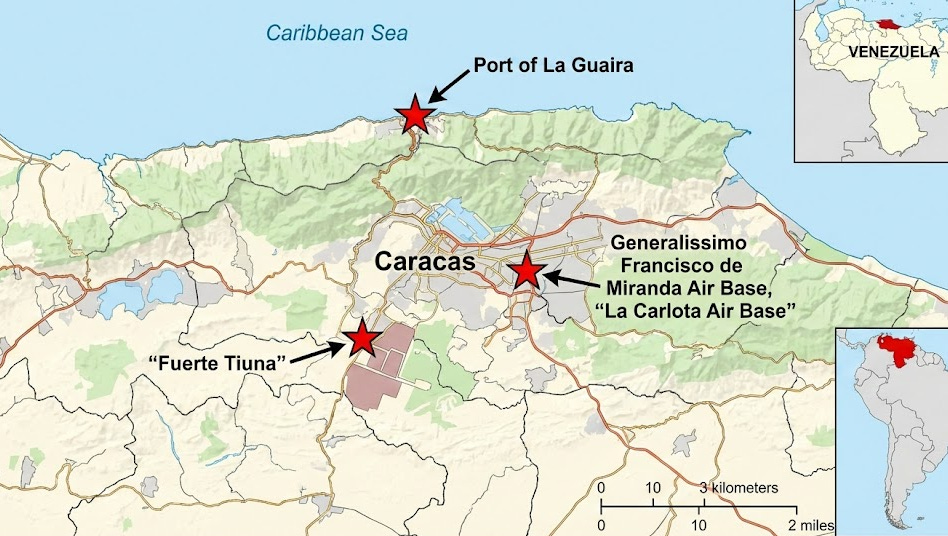
On January 3, 2026, U.S. forces struck multiple military installations in Caracas; La Carlota air base, Fuerte Tiuna military complex, the Port of La Guaira were all hit. Nicolas Maduro and his wife Cilia Flores were captured during the operation, transferred to USS Iwo Jima, then flown to New York. They’re now in DEA custody facing narco-terrorism charges amongst other things, and arraignment is expected on January 6.
This came after months of escalation and posturing. The U.S. conducted 35 strikes on alleged drug vessels under “Operation Southern Spear,” killing 115+ people. They declared Venezuelan airspace “closed,” imposed a naval blockade, and deployed 11 ships including the USS Eisenhower carrier strike group. About 15,000 U.S. personnel are now positioned in the Caribbean and Gulf region.
The operation was formally designated “Operation Absolute Resolve.” Trump has already announced intentions to “run the country” temporarily, but for now, Vice President Delcy Rodríguez has been appointed Acting President by Venezuela’s Supreme Court, demanded Maduro’s release, and is refusing cooperation with the U.S.
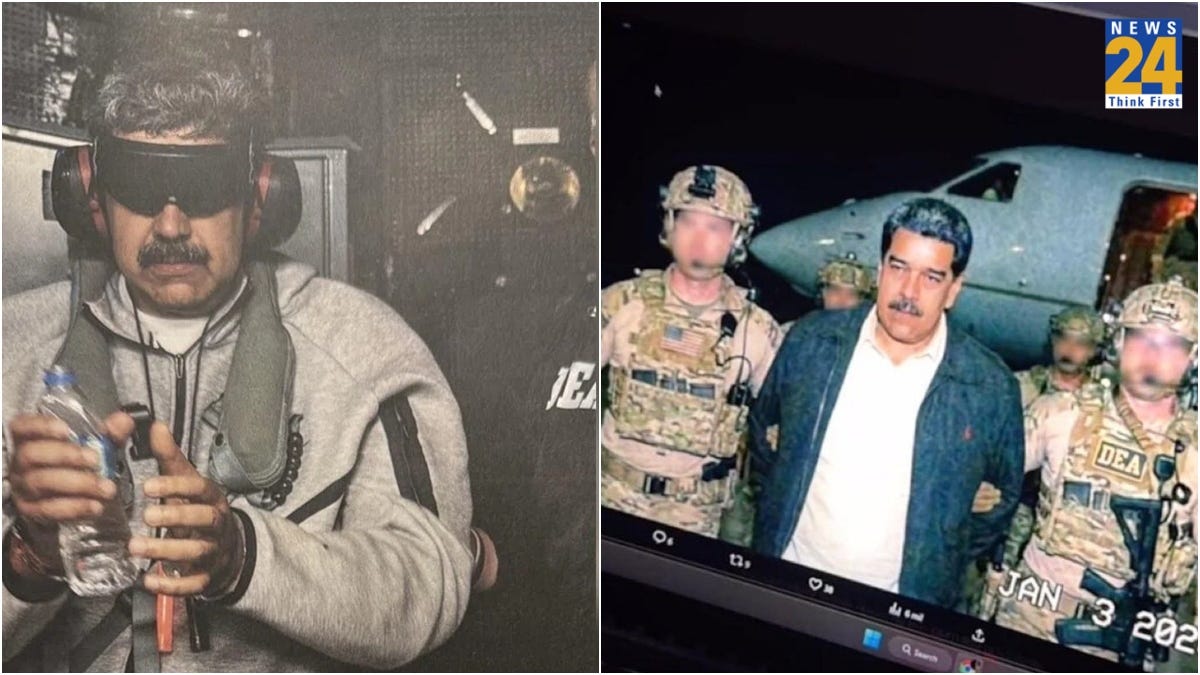
The operation itself was supremely efficient; to the point where you wonder how they took so long to ‘get’ Bin Laden and others. According to tactical reports, Delta Force and FBI Hostage Rescue Team operators were inserted directly into Fuerte Tiuna’s compound by the 160th Special Operations Aviation Regiment using stealth-modified helicopters. Before they arrived, EA-18G Growlers had jammed Venezuelan air defences (Russian-made S-300 and Buk systems) and this created what one analyst called a “digital blackout.” The ground phase only lasted about 25 minutes or so!
Maduro was reportedly heading toward a five-level underground bunker (built by Chinese engineers, obviously) when the raid began, but did not reach the blast doors in time. The resistance came primarily from Wagner Group mercenaries and Cuban-trained Presidential Guard. Casualties have been estiamted at between 40-60 Venezuelan and mercenary forces, with zero American fatalities (but two wounded).
Since the operation, Trump has already doubled down; in an interview mentioned by The Atlantic yesterday, he issued a direct threat to Rodríguez: “if she doesn’t do what’s right, she is going to pay a very big price, probably bigger than Maduro.” He also confirmed that “rebuilding there and regime change, anything you want to call it, is better than what you have right now” – which is clearly a wild reversal from his 2016 position against nation-building. When he was asked about Greenland, he said: “We do need Greenland, absolutely.” Secretary of State Rubio’s comment that the world should “take notice” would suggest that Venezuela may indeed not be the last intervention.
I am no expert but by many accounts this is already the most significant U.S. military intervention in Latin America since 1989. It’s also the physical manifestation of the “Trump Corollary” to the Monroe Doctrine (“Donroe” lol!), which designated the Western Hemisphere as America’s top strategic priority - they explicitly deny “non-hemispheric competitors” (read: China and Russia) the ability to control strategic assets in the Americas.
The international response has been predictably, umm, bifurcated1! Brazil’s Lula condemned it as “an unacceptable line” and “grave affront to sovereignty.” Colombia deployed border troops. Argentina’s Milei hailed it as a “victory for freedom.” China and Russia condemned violations of international law (also lol!). The UN Secretary-General declared himself “deeply alarmed.” Of course he did.
If you’re a new subscriber and are wondering what this has to do with watches, bear with me. We’ll get there eventually. But first, we must look at the other major geopolitical pressure point.
Taiwan
From December 29-30, 2025, China conducted “Justice Mission 2025” which was purported to be the largest Taiwan-focused military exercises since Nancy Pelosi’s 2022 visit. The PLA deployed 130+ aircraft, 14 warships, and 8 coast guard vessels. Ninety aircraft crossed the median line, and live rockets landed just 44km off Taiwan’s coast (the closest PLA projectiles have ever come to Taiwan itself).
This marked the first large-scale exercise explicitly rehearsing blockade scenarios and the first breach of Taiwan’s territorial waters. The exercises followed Trump’s approval of an $11.1 billion arms package to Taiwan (the largest in history, exceeding total Biden administration sales). It includes 82 HIMARS systems (rocket launchers) with ATACMS missiles2, autonomous aerial vehicles, and Javelin missiles.
Despite all these military tensions, U.S.-China economic relations kinda stabilised after the October 2025 Trump-Xi meeting in Busan. Tariffs came down from peak levels of 145%/125% to 30%/10% through November 2026. China generously committed to purchase 25 million metric tons of U.S. soybeans annually through 2028.
But a key point in all of this was that Taiwan “did not feature prominently” in their discussions. Some analysts suggest this is because “an increasingly confident China feels no need to discuss Taiwan with the U.S. anymore.” That’s not exactly comforting, is it?
Xi Jinping’s New Year 2026 address declared Taiwan “reunification” as “unstoppable.” Taiwan’s President Lai committed to raising defence spending to 5% of GDP by 2030 and announced a $40 billion supplementary defence budget. The PLA has been directed to achieve readiness for a Taiwan operation by 2027 - this is the “Davidson Window” (cited by U.S. military assessors).
So… we’ve got Venezuela exploding on one side of the world and Taiwan simmering on the other. Keep this in mind as we consider the Swiss watch industry which is trying to navigate the fallout.
Beyond oil
The conventional explanation for the whole Venezuela situation is based on oil and access to heavy crude. Trump himself has leaned heavily into this framing so far, and it makes intuitive sense to everyone who hears it, given Venezuela holds the world’s largest proven reserves. That said, there is a compelling alternative thesis circulating in strategic circles that deserves some attention, and that is the oil narrative is actually a distraction, and the real driver was critical minerals and national security which is reminiscent of the Cuban Missile Crisis.
The argument goes like this; Venezuelan oil production has collapsed from 3 million barrels per day to roughly 700,000, and their infrastructure is heavily degraded. If this were purely about oil, the operation would have happened in 2019 during the Guaidó crisis when production was higher (and international support much stronger).
The timing right now, corresponds to a few other interesting events; the Pentagon elevated critical minerals to being a “top strategic priority” (allocating $7.5 billion under recent legislation), China imposed rare earth export restrictions last year (we discussed it here) which demonstrated willingness to weaponise supply chains, and the Chinese purportedly gained “indirect operational control” of Venezuelan mining operations.
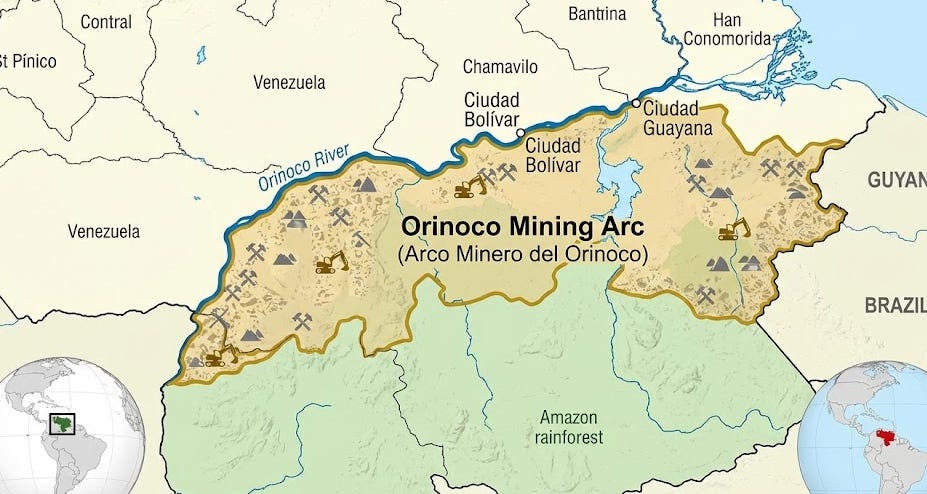
Venezuela’s Orinoco Mining Arc (111,843 square kilometres across Bolívar and Amazonas states) contains documented deposits of coltan (the ore for tantalum), rare earth elements, and cassiterite. Investigative reporting has documented Chinese buyers operating directly at mining sites, and coordinating with both Colombian guerrilla groups who control physical security and Venezuelan state security (they facilitate transport). One miner described seeing Chinese operatives and ELN commanders “eating together, buying material together, and getting off the helicopter together.”
Tantalum is lovely in watches, but it’s also essential for capacitors in military electronics, missile guidance systems, and radar equipment. Who knew! Rare earth minerals also enable permanent magnets in precision-guided munitions. The United States is 100% import-reliant for 12 critical minerals and over 50% reliant for 28 of the 50 minerals classified as essential to national security. As we all know, China controls 91% of global rare earth processing. So when Pentagon weapons systems potentially incorporate materials extracted “under Chinese supervision in Venezuelan territory, then processed in Chinese refineries controlled by Beijing” … you can see why this might concern the U.S. even more than oil and money!
That’s bad enough, but this is also a convergence of all three major U.S. adversaries in one location. China is controlling critical mineral extraction, Iran is operating IRGC drone manufacturing facilities with 2,000-kilometre range (sufficient to reach Florida), and Russia has 120+ military advisers under a general who commanded the Kakhovka Dam operation in Ukraine. So it turns out, Venezuela may have become the only place in the Western Hemisphere where all three established an operational presence. From a Pentagon perspective, breaking Chinese supply chain dominance, eliminating Iranian manufacturing capability, and expelling Russian military presence may have been primary objectives – with oil being the convenient ‘public messaging’ choice.
I am not saying the ‘oil thesis’ is wrong, and both explanations likely contain some truth. Trump talks about oil because voters understand oil and the Iraq precedent is already established. Pentagon planners may have approved the operation for entirely different reasons, but what matters for our purposes is recognising that the strategic calculus here is more complex than “America wants Venezuelan crude.” The critical minerals angle, in particular, has implications for manufacturing supply chains that extend well beyond defence – including, by the way, the CNC machines and electronic components used in watchmaking!
Watch market recap
Note: All of this section has been covered in some way on SDC before, but for newcomers, a brief recap seemed worthwhile.
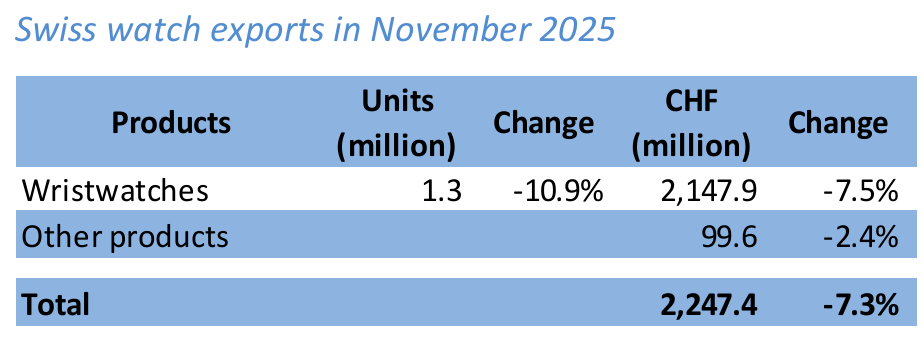
Through November 2025, Swiss watch exports declined 2.2% year-to-date, November specifically was down 7.3%, and volume fell to historic lows (December data isn’t released yet). The industry, it seems, is shifting decisively toward high-value pieces.