SDC Weekly 136; Hajime Asaoka and the economics of scaling craft
Citrini moves markets, Morgan Stanley's Swiss Watcher errors keep stacking up, the Via Negativa approach to better collecting, why parenting trends work exactly like watch size trends, and more!

🚨 Welcome back to SDC Weekly!
In case you missed it… The Swatch Group have issued a scathing open letter to Morgan Stanley Investment Management about its Research “Ninth Annual Swiss Watcher” and it is, to put it mildly, a demolition job. The letter opens by quoting Morgan Stanley’s own Code of Ethics back at them… something about having a duty to “deal fairly and act in the best interests of its clients at all times” − and then it proceeds to explain, in forensic detail, why the Ninth Swiss Watcher fails to meet that standard.
I’ll let you read the letter for yourself, but I’d like to add one additional finding… This year’s report stated that MB&F achieved a turnover of CHF 52 million; this part is correct, and verified by MB&F. The report then assumes an implied retail value of CHF 70 million, and based on this figure, divides this figure by 420 units sold to arrive at an implied average retail price per watch of CHF ~166k. This figure is incorrect.
According to Max himself (on the podcast shared below), MB&F typically has three main revenue streams, one of which is the ~5,000 M.A.D. Editions watches they sold last year.
The ‘number of units sold’ in the MS/LC report is therefore incorrect by a factor of 12. Nevertheless, a very quick calculation; at ~ CHF 3,000 retail price, and 5000 units, this is ~ CHF 15 million of revenue from the M.A.D. Editions. This means the report has overstated the implied average retail price per watch by at least 27%. Funny enough, this is close to the amount they understated Tudor’s revenue in the 2025 report.
Anyway, onward!
Admin note: The Unofficial Editor is currently visiting his proctologist and refused to edit this newsletter. We’d complain about him being gone, but frankly, he’s always been a massive pain in the a$$. Please click here to read this post online and ensure you see all corrections made after publishing.
If you’re new to SDC, welcome! If you have time to spare, check out some older editions of SDC Weekly here, and longer posts in the archive here.
Estimated reading time: ~30 mins
🎭 Hajime Asaoka and the economics of scaling craft
I will state upfront, I have no sources in Japan; I can’t pick up the phone and call someone in Tokyo to verify details the way I might with a Swiss contact. Most of what follows is based on published interviews, public records, and a few other documents that I’ve tried to cross-reference and fact-check as thoroughly as I can1.
This is meant purely as an exploration of Japanese independent watchmaking. Grand Seiko is undoubtedly a phenomenal operation - Morgan Stanley estimates they did around CHF 210 million in sales with roughly 50,000 units in 2025, which would rank them approximately 27th if they were Swiss2. Seiko, Citizen, and Casio are world-class manufacturers.
What I’m exploring below is a different part of the Japanese watchmaking landscape; this is a part which most Western collectors know through the Kurono Tokyo hype drops, if anything. There’s a much bigger story behind those sellout launches, and I found the process of understanding it quite eye-opening.
A garage in Otsuka
In November 2024, a watch made by a self-taught Japanese watchmaker named Jiro Katayama won the GPHG Challenge Prize. Here’s an interview he did with Mark Cho:
I was surprised to learn that the brand, Ōtsuka Lōtec, is named after the Tokyo neighbourhood where Jiro works and the Japanese pronunciation of ‘low-tech’ 😂. He had been producing watches since around 2012, but selling exclusively in Japan, mostly through word of mouth. The total output since 2008 was approximately 400-500 watches3.
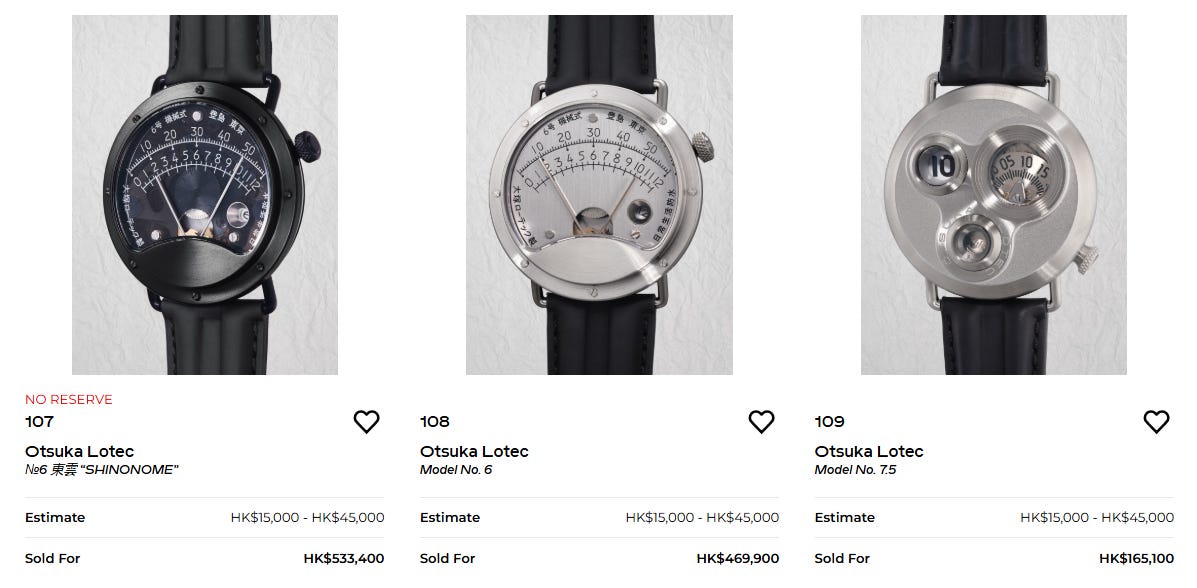
A few weeks after the GPHG win, three of his watches went to auction at Phillips’ TOKI sale in Hong Kong4. Both the No. 6 and its Shinonome variant hammered at about ten times their upper estimates (i.e. ~£50,000). These watches retail for between ¥400,000 and ¥800,000, so roughly ~£2,000 to £5,000, so the auction results were… wild.
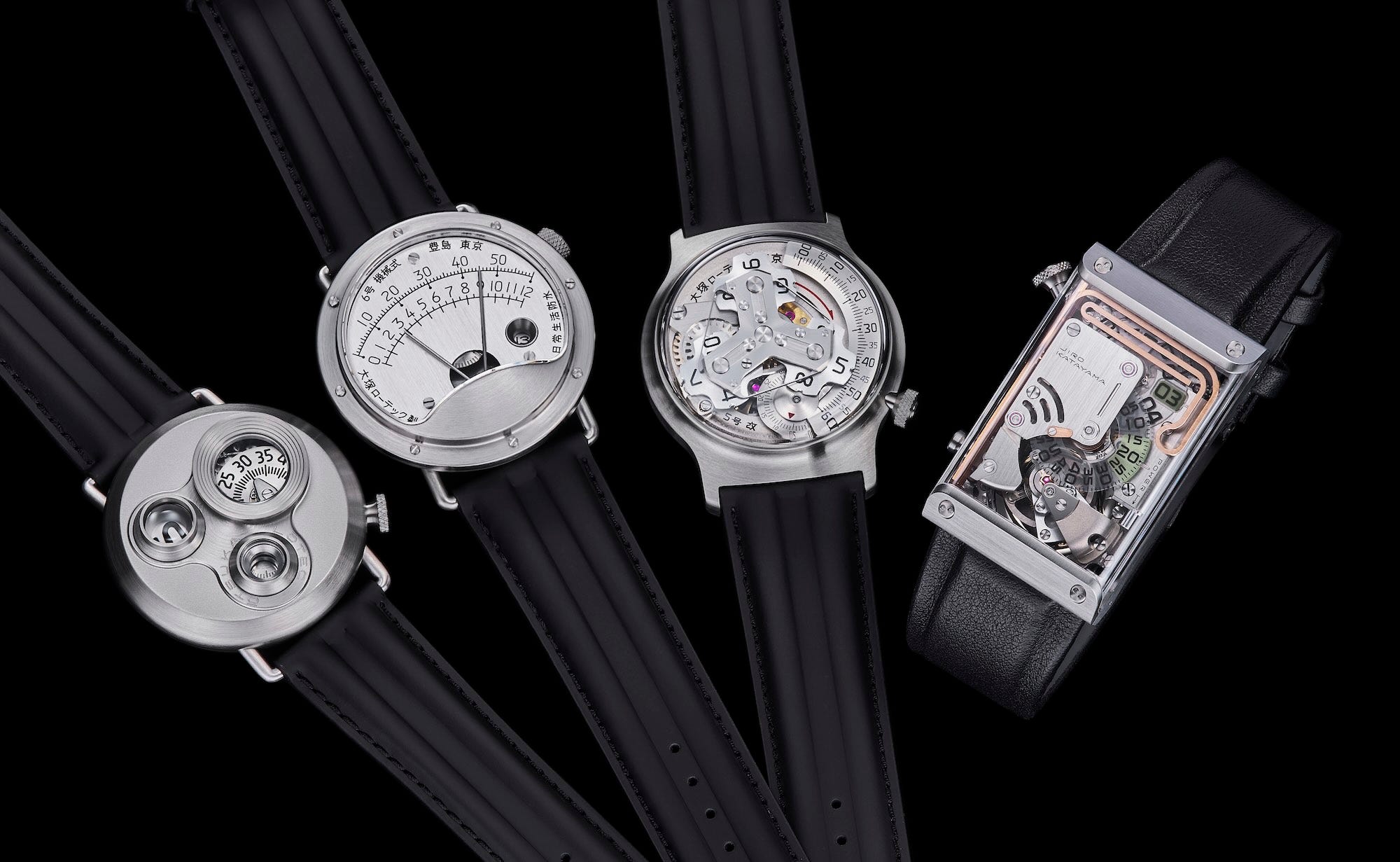
Then, in late 2025, Katayama unveiled the No. 9, which is a fully in-house movement with a tourbillon, jumping hours, retrograde minutes, a power reserve display, and a striking mechanism. All of this is housed within a 13mm high case. This one was priced at ¥17.6 million, so about £80,000-90,0005… this from a guy who learned machining through Google and YouTube6.
All of this raises an interesting question… How does someone go from a kitchen lathe to a GPHG-winning complication? It would appear that the answer to this question traces back to a workshop in Bunkyo, Tokyo, and a company called Precision Watch Tokyo.
Designer come watchmaker
Hajime Asaoka is another guy who didn’t come up through a watchmaking school. He didn’t apprentice at Seiko nor did he train in Switzerland. He graduated from the Tokyo University of the Arts with a design degree and set up the Hajime Asaoka Design Office in 19927. For over a decade, he worked as a product and graphic designer, building up serious skills in CAD modelling and industrial design.