

SDC Weekly 141; Beyer Chronometrie, 1760-2026; The Watch Industry’s Quince Problem
Rexhep Rexhepi launches the Chronograph Flyback, on handing down watches versus curiosity, safe queen parenting, Roosevelt's White House circus, the DTC death spiral, SJX podcast appearance & more!

🚨 Welcome back to SDC Weekly! I had a historical post about the Nautilus planned for this week (anniversary year), but I cut it in favour of the Beyer story… Might do it as a standalone, might bin it… We’ll see. Hope you had an enjoyable Easter weekend.
Admin note: The Unofficial Editor declined to check this edition because he’s currently obsessed with buying cheap imitations of expensive brands online. We asked him if his new fake Rolex was any good, and he said it was absolutely super, dupe-r; please tap the title of this post or click here to read it online and see all corrections made after publishing.
If you’re new to SDC, welcome! If you have time to kill, you’ll find older editions of SDC Weekly here, and longer posts in the archive here.
Estimated reading time: ~30 mins
🕰️ Beyer Chronometrie, 1760–2026
Beyer Chronometrie is closing… after 266 years. The world’s oldest watch retailer, founded in 1760 (around the time when George III was on the British throne), will shut its doors at the end of this year. Patek is buying the business and will convert the entire 600-square-metre, three-storey space on Zürich’s Bahnhofstrasse into another Salon, joining Geneva, Paris, and London.
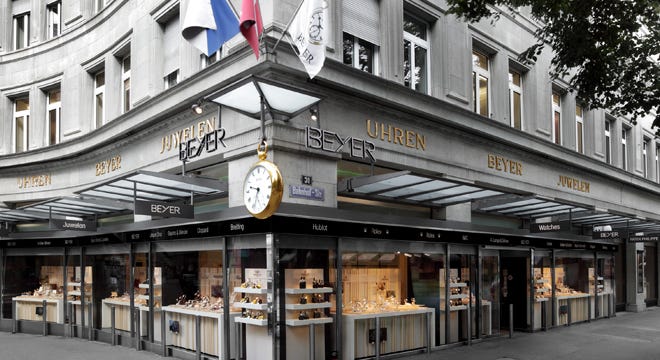

The multi-brand section (Rolex, Tudor, IWC, Chanel, etc) will be removed but ~25 employees who currently staff the existing Patek boutique (which has been operating inside the Beyer space since 2011) will keep their jobs. Sadly, the remaining 35 or so staff are on their way out.
Regarding the family’s watch museum, one of the most important private horological collections in the world, SJX writes:
According to Tages-Anzeiger, the impressive watch museum now located in the basement of the Beyer store – which has been in its current spot for almost a century – is not part of the sale, and will most likely be relocated to another venue in Zurich.
I think this is one of those stories that seems to be about a shop in Zürich, but the gravity around it feels more intense… I remember seeing industry veterans react with shock when they first saw the news dropped into various chat groups. After looking into it a bit more, I think I have a better understanding of their initial reaction.
Succession problem
René Beyer, who ran the business as the eighth generation of the founding family, died unexpectedly in April 2025 at the age of 61. He had no children, and his sister Muriel Zahn-Beyer, who took over, has no children either. So that’s basically it… end of the line.
What’s crazy is how we’ve seen this movie before, quite recently in fact. Jörg Bucherer died in 2023 without heirs, and his retail empire (which is the largest watch retail group in the world) was sold to Rolex. Isn’t it curious how both family businesses had no succession plan, and then both got acquired by the dominant brand partner?
René Beyer apparently saw this coming, though. According to his sister, he’d been thinking about the future of the business for some time, and Patek had in fact acquired a minority stake in Beyer back in 2024. The full sale was, in her words, “the logical consequence of a partnership that had grown over decades.”
Beyer was one of the few retailers on earth that carried both Rolex and Patek, and these sorts of relationships exist almost entirely because of personal trust between families built over generations. If you sold Beyer to a third party (like a private equity firm, another retail group, or anyone outside the circle of trust) there would be a very real chance that Rolex or Patek (or both) would have pulled their allocation from the stores eventually. And I guess without those two brands, there is no Beyer. The business would essentially fail to continue commercially, regardless of what name sits above the door.
So the ‘choice’ faced by Muriel Zahn-Beyer was not much of a choice, all things considered. She could either sell to Patek (who already had a stake and a long-term relationship), keep a third of the employees, and preserve something... Or try to sell externally and the brands would walk away - which would effectively destroy the value of the thing she is trying to sell. I thought about whether she could have approached Rolex, but given the Bucherer deal is still fresh in everyone’s mind, I suspect the deal would not have passed due to competition laws… Rolex owning both Bucherer and Beyer might be a step too far, even for them.
Patek’s revolution
I wrote about gatekeepers and retail carriage a few months ago, and one of the things I mentioned was that Rolex and Patek were, until the Bucherer deal, the only two major Swiss watch brands that had essentially zero direct retail presence. AP had already gone almost entirely mono-brand. Cartier, Omega, everybody else in the top tier are all heavily invested in directly operated stores.
Rolex and Patek were like the anomalies in the matrix; the ones who still believed in the multi-brand retail model, or at least in letting someone else deal with leases and shop assistants while they concentrated on making watches. Then Rolex bought Bucherer, and one of those two anomalies disappeared.
Now Patek is opening yet another directly-owned Salon, and while the Stern family will probably tell you that this is a sentimental decision driven by a longstanding friendship (and it partly is - Thierry Stern did an internship at Beyer, Adelrich Beyer did an apprenticeship at Patek in 1880 and met his wife there, so the families seem close), let’s think about the real-world dynamics for a second.
Patek has been steadily reducing its retail footprint for a decade. Morgan Stanley estimates they’ve gone from over 400 points of sale to under 300 globally. The forecast is that they’ll eventually get down to under 150 doors, with a gradual expansion of directly owned Salons including maybe 10-12 additional brand-owned locations over time.
The Bond Street Salon in London generated £89 million in revenue in its 2024-25 financial year from a single shop. When you’re doing those kinds of numbers, the economic argument for owning your own retail is fairly compelling, even if you’ve spent the last century insisting that the third-party retailer model is sacred.
So I think this isn’t some sort of grand pivot for Patek at all, and more like a gradual, considered, very Patek-like slide from wholesale toward DTC. They’re just doing it politely, one dead retailer at a time, instead of making some grand strategic announcement. Besides, according to Miss Tweed, Thierry reckons it will take 10 years to pass the baton to his two sons.
Domino effect
If we zoom out a little, it might help paint a clearer picture.