

SDC Weekly 143; Rolex gives us a clue; Sotheby’s has a ‘new’ way of borrowing money; Wei Koh launches Legare Chapter One
Baillod acquires BCP Tourbillons, Watches and Wonders 2026 recap, an end note on stories, stereos, and secondary-market noise, plus... why your kids are better off unpolished.

🚨 Welcome back to SDC Weekly!
To quote a dear friend… “perhaps the most bizarre news released around Watches and Wonders…” is that Patek has apparently instituted a policy where only one archive can be issued - ever - for any particular watch. Another friend who is close to the brand has confirmed this to be true. What this means is that if you happen to buy a watch that has had an extract issued from the archive before, you can’t ever get one again, even if it’s lost, damaged, or stolen.
And just like that, Thierry has created a new hierarchy in the pre-owned Patek market. You think he’s a wizard, or just a moron?
Admin note: The Unofficial Editor declined to check this edition. With the price of absolutely everything going up these days, he said he simply couldn’t afford to pay attention. Please tap the title of this post or click here to read it online and see any corrections made after publishing.
If you’re new to SDC, welcome! If you have time to kill, find older editions of SDC Weekly here, and longer posts in the archive here.
Estimated reading time: ~30 mins, unless you want to read about W&W 2026, in which case it will be 44 mins. I put the W&W section at the very end, in case you’re tired of reading about W&W (I know I am!).
🆕 Wei Koh launches Legare
This apparently happened at Watches and Wonders but it’s likely you didn’t hear about it, because as far as I can tell… almost nobody reported on it. Wei Koh appears to have launched his watch brand; it’s called Legare. He confirmed this on camera to Tim Green of Subdial, who bumped into him at the show and conducted what is, as far as I can tell, one of only two interviews about this launch.
That is pretty weird, don’t you think?
Wei runs Revolution, and The Rake; he hosts Man of the Hour on Discovery Channel, which is a multi-part documentary series about independent watchmakers that is airing right now. He is, by his own publication’s estimation, “one of the most well-respected voices in contemporary watchmaking.” If anyone could arrange for their own brand’s launch to receive better coverage across global watch media, it ought to be this guy.
And instead, the confirmation that the thing exists comes via a chance encounter with Tim Green on a trade show floor, recorded in low-res and uploaded to social media. I’d guess this low-key approach is no accident. Wei is now the President of the GPHG Jury, and there are obvious reasons to handle the “I have just launched my own watch” moment super carefully when your new high-profile gig involves judging other people’s watches. Chris Hall wrote “Wei reportedly says that there’s no chance it’ll be put up for a GPHG while he’s jury president.” Well that’s a relief… if true.
From the Subdial interview, we know the brand is called Legare, which Wei says derives from the Latin carrying the sense of legacy or ‘to bequeath’. It is the verb root that gets you, eventually, to the English word legacy. The brand motto is “à la recherche du temps perdu”, which is French for “in search of lost time” and also, as most of you will of course know, the title of Proust’s seven-volume novel about memory, cake, and jealousy.
The watch itself is called Chapter One and it measures 37.5mm in diameter and 9.9mm thick, cased in grade 5 titanium.
Wei’s co-founder is Guillaume Tetu, who co-founded Hautlence back in 2004, left to run product and later become COO at Ralph Lauren Watch & Jewelry, and then returned to Hautlence in March 2025 as Chairman and Advisor. Quite how all of that sits alongside a separate start-up venture, I do not know; it seems like the kind of thing a lawyer would have views on, but that is apparently the arrangement. Some images from the Subdial video:
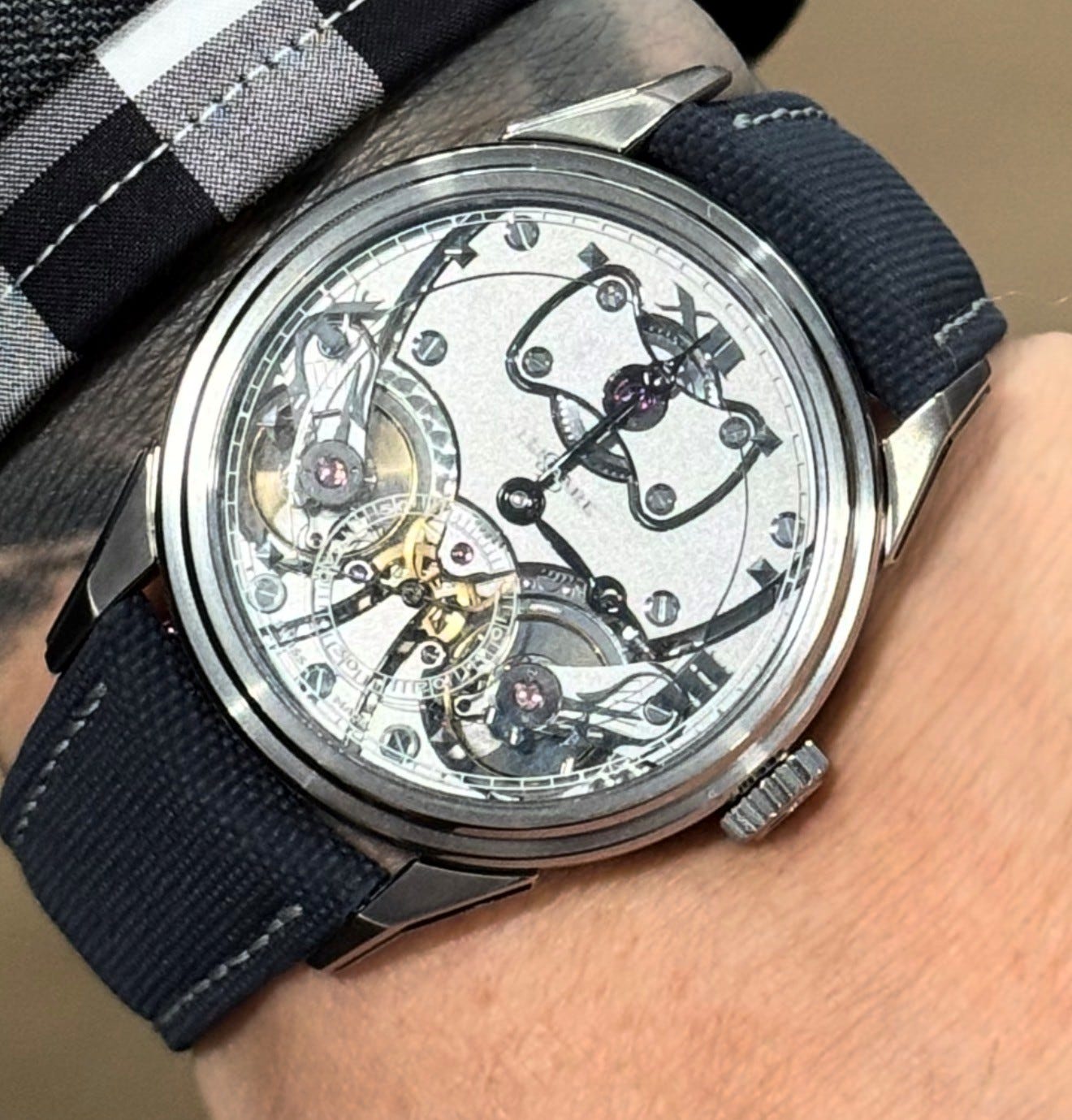
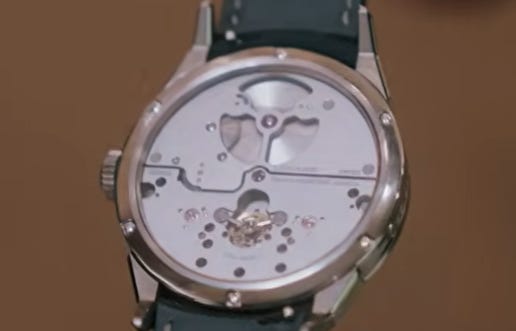
So that is the what; which is to say, it seems like a Dufour Duality, but inverted. Turns out, that is no accident.
Piguet’s pocket watch
In 2019, Sotheby’s sold a pocket watch for CHF 250,000, when the estimate going in was only CHF 7,000–10,000 - which kinda tells you everyone in the room knew what they were bidding on but the cataloguer did not have a clue.
The movement was made in 1933 by a 19-year-old student named Albert Gustav Piguet, who was graduating from the École d’Horlogerie in Le Sentier, at the time the pre-eminent watchmaking school in the Vallée de Joux. Under the supervision of the headmaster Marcel Bulleumier, six student-made double-balance pocket watches were produced between 1932 and 1934; two at 38mm, two at 43mm, and two at 48mm. Piguet’s was one of the smallest, at 38mm.
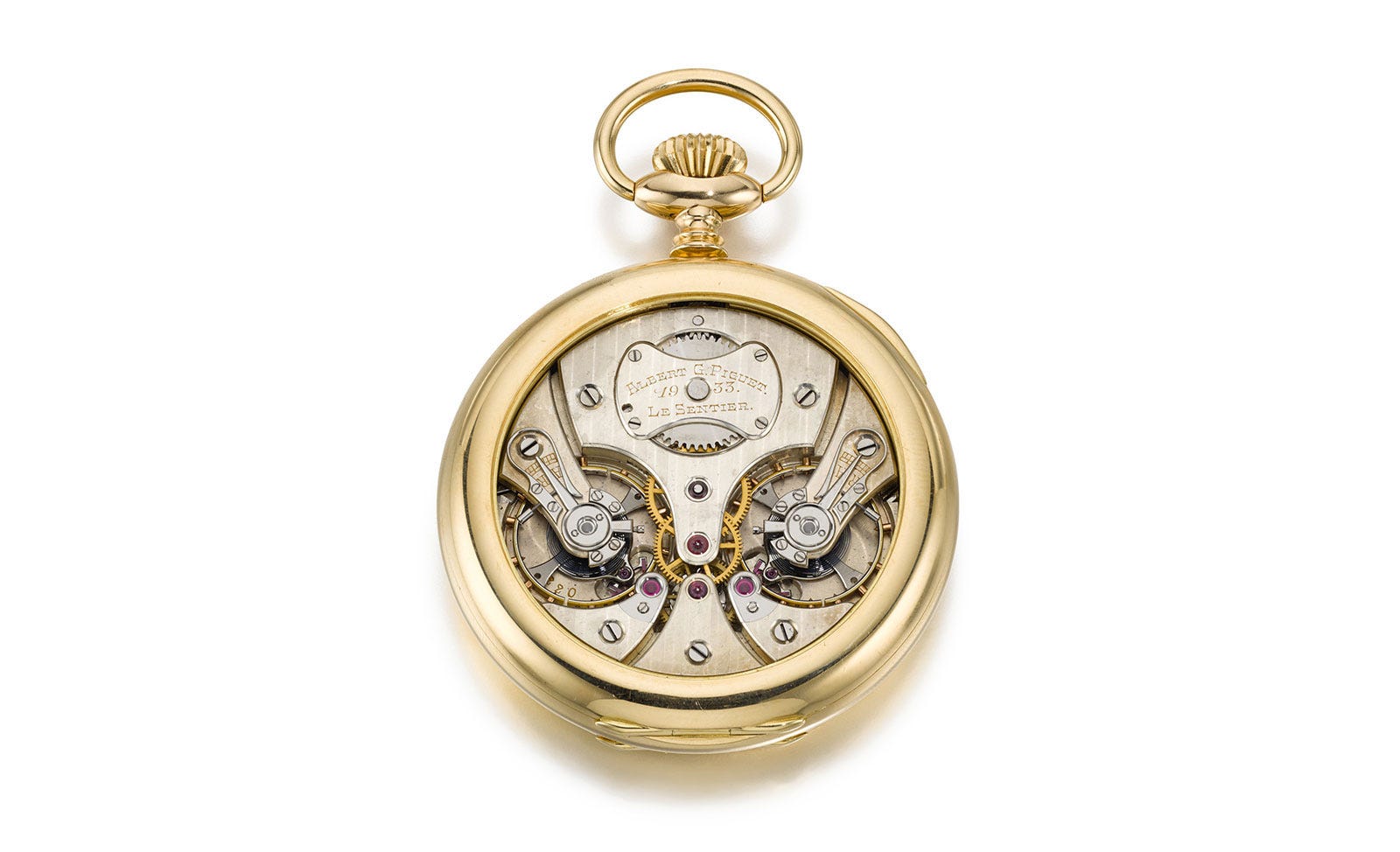
The movement architecture is the main thing to note here; it’s a single gear train driving two balance wheels linked by a differential, built to run on the principles of resonance1. Pulling that off as a graduation project, in 1933, aged 19, feels rather prodigious if you ask me.
Piguet - I suppose unsurprisingly - went on to have a highly consequential career. He joined Lemania after graduation and rose to technical director, a role he held from 1948 to 1980. During that tenure he developed the CH27 chronograph calibre, later rebadged as the Omega cal. 321 - the same one that ended up on Buzz Aldrin’s wrist on the Moon. He also developed the legendary Lemania cal. 2310, which became a base for some of the most revered vintage chronograph movements used by the big names in watchmaking. If you collect vintage chronographs, there is a good chance you have looked through a caseback at one of Albert Piguet’s designs without even knowing it. Heck, I myself have enjoyed one of these in my Breguet 3237.
Duality links
Dufour told Josué Hernandez (and I covered this back in SDC Weekly 133) that he decided to make the Duality in 1996 after seeing a 1930s double-balance pocket watch in a book from the Rockford Time Museum. His recollection was that the pocket watch had been made at a watchmaking school in Le Locle. SJX’s essay on the 2019 Sotheby’s lot suggests the school was actually Le Sentier, and that a sister example of the Piguet (from the same 1932–34 batch) was the Time Museum piece, later sold when the collection was dispersed in 2004.
Le Locle and Le Sentier are not the same place, so either Dufour is remembering a different watch, or he is mis-remembering this one, or the book mis-captioned it. Who knows... what is not in dispute is that the Piguet-style 1930s double-balance pocket watches are the conceptual ancestor of Dufour’s Duality, of which he has made about ten.
Dufour’s technical premise was that by running one balance very slightly fast and the other very slightly slow, and averaging their rates via a differential, you can tighten positional variance across the six positions. Normally you try to minimise the spread, but with two balances, the errors should in theory cancel out. It is undoubtedly an elegant piece of horological gadgetry with essentially zero commercial justification, which is perhaps why people love it.
Which brings us back to Wei’s watch.
Legare Chapter One
Legare Chapter One is 37.5mm in diameter, and Piguet’s 1933 pocket watch movement was one of the 38mm calibres from the school batch; that delta is presumably the case flange, give or take?
My point is, the whole schtick of this new watch looks like it is to take the Piguet movement lineage, the same lineage that gave us the Duality, and simply copy it. That would make the motto “à la recherche du temps perdu” rather literal; you go into the archives, find a seminal creation in watchmaking, and then just remake it with modern materials and an inverted design.
For full disclosure, I would have tried to reach out to Wei for better images and a few more specs directly, but he blocked me on Instagram a while back. I have no idea why; likely a meme that landed badly, but no hard feelings on my end. If you are reading this Wei, DMs are hypothetically open; I think the watch looks interesting and I would love to know more.
🕵️ Rolex gives us a clue
At the bottom of Rolex’s Oyster 100 celebration page, you will find this little teaser:

And on Friday last week, Niccoloy shared a recently published Rolex patent on Instagram, suggesting it may be linked to whatever Rolex is about to announce.
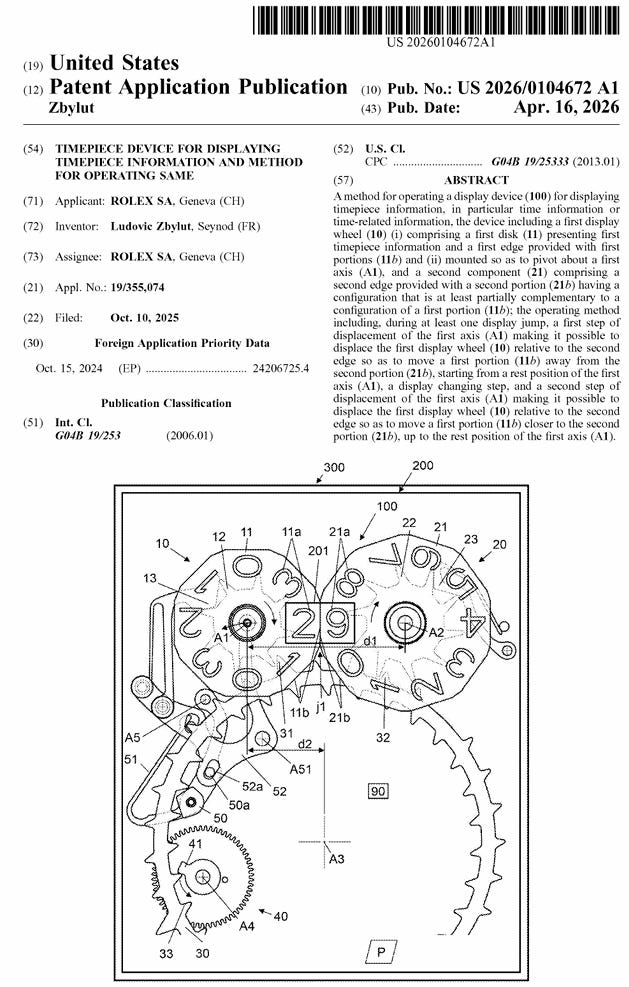
Esquire picked it up within hours and wrote a quick story about it, speculating that this might be the 1908 getting a calendar upgrade in May. Which… fine. Rolex speculation is a sport for all of us, and I’ve played it more than once in these pages as you know. Today, instead of the usual guessing game, I want to talk about the patent itself because the ingenuity here makes me wonder why it took so long for us to see such a thing in a wristwatch.