
SDC Weekly 146; Three quarters of nice; Moser's D2C maths; New Interview with Thierry Stern
Morgan Stanley's Q1 2026 Swiss Watch Market Report, Baltic x SpaceOne bargain, Pratt's water clocks, Guochao in the Swiss Watch world, charm pricing's origin story, second-order effects, and more!

🚨 Welcome back to SDC Weekly!
Admin note: The Unofficial Editor declined to check this edition because he’s currently stuck in a broken elevator. He claims he’s fine, but honestly, the whole situation is wrong on so many levels. Please tap the title of this post or click here to ensure you read the most recent edition, which may include corrections made after publishing.
If you’re new to SDC, welcome! When you have some time, check out prior editions of SDC Weekly here, or find enlightenment in the archive here.
Estimated reading time: ~30 mins
📊 Three quarters of “nice”
There is a great Warren Buffett line about how you only find out who’s been swimming naked when the tide goes out… and in this case, the Swiss watch market spent four years with the tide on its way out, and this produced a great deal of analysis about who was naked. If all the prior Morgan Stanley/WatchCharts essays I have written are anything to go by, the answer was “most of them”, and in the case of one or two, distressingly so.
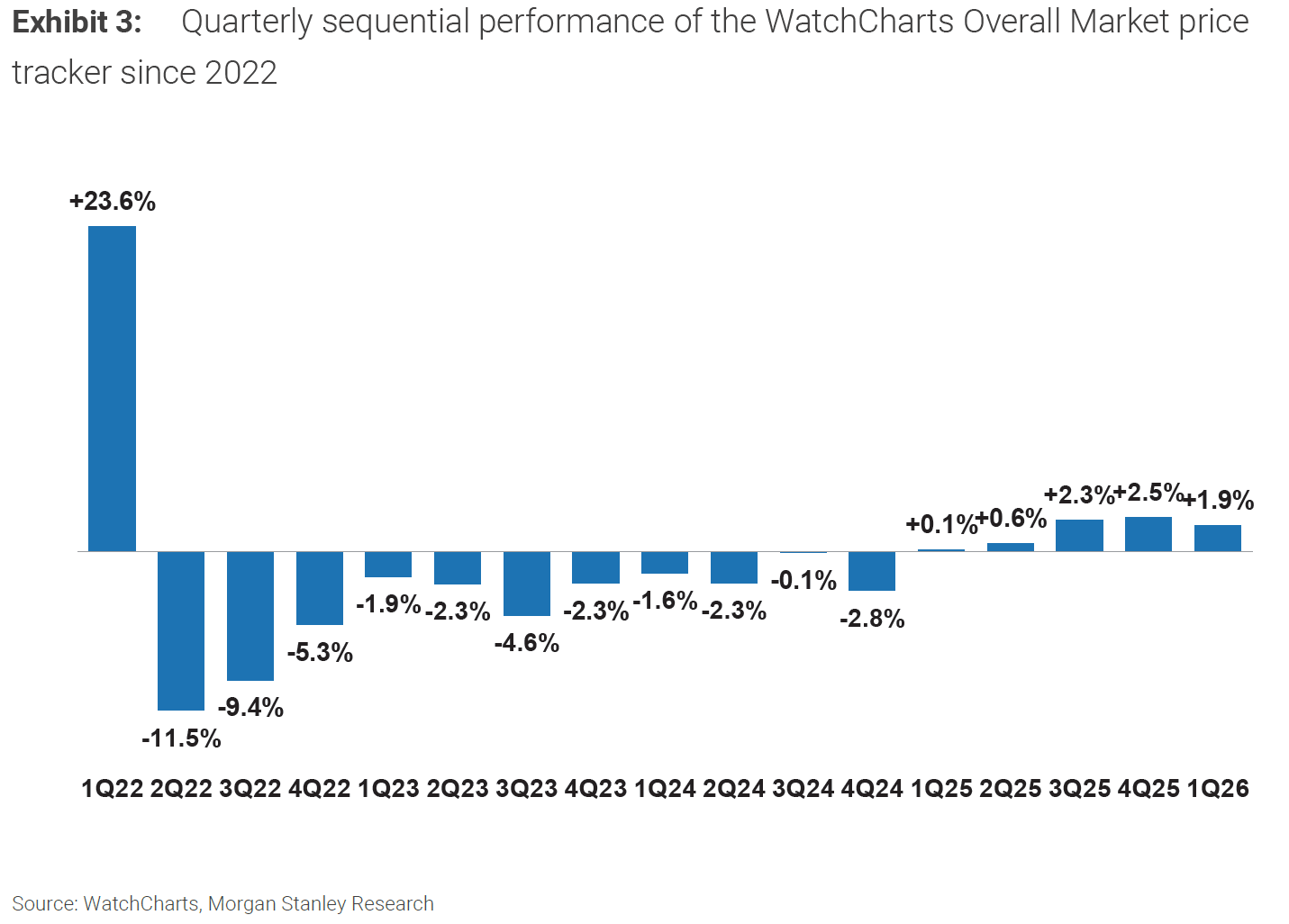
If you’ve seen the 1Q26 report which WatchCharts published with Morgan Stanley last week,1 you will see the tide has now slightly turned. The WatchCharts Overall Market tracker rose +1.9% QoQ, which marks the third consecutive quarter where secondary prices have risen by more than 1%.2
25 out of 35 brands posted positive performance, and all three listed groups (LVMH, Richemont, Swatch) were in the green together for only the second time in several years. Every brand that Morgan Stanley tracks for value retention saw an improvement, which is the first time that has happened since 2022.
So I guess it’s fair to say things like ‘the market is up’ or ‘things are fine’ or ‘the recovery is pretty broad and now even applies to listed conglomerates’. The only question, really, is what the words up, fine, and broad now mean in the current market given the last four years were spent pretty much redefining all these words.
Headlines have conditions
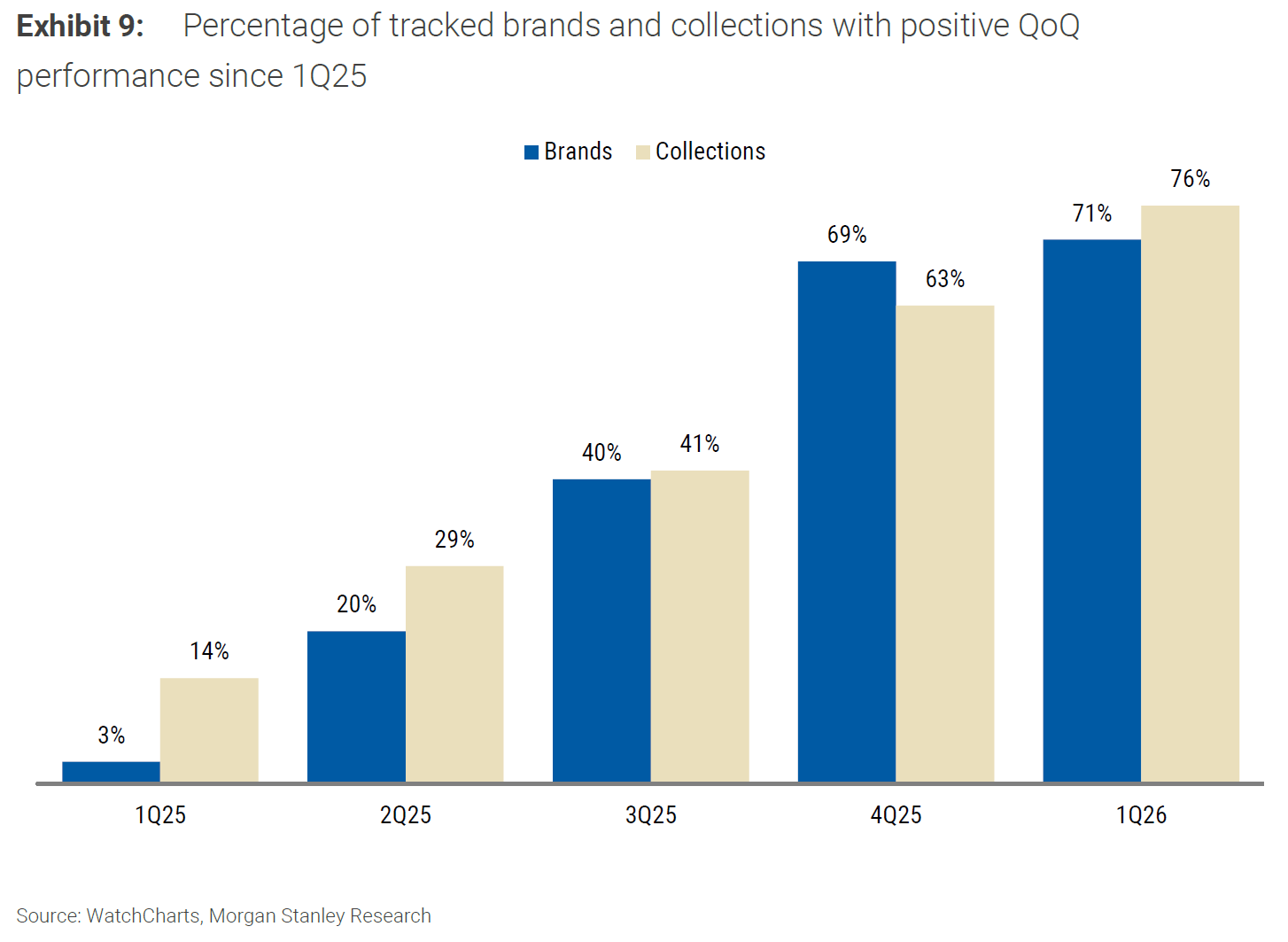
There’s no disputing the +1.9% headline number and it is also true that three consecutive quarters of growth is the longest sustained recovery this market has had since the May 2022 peak. I’d also say that the breadth stats are even more impressive than the actual level. A year ago only 3% of tracked brands and 14% of tracked collections were posting positive QoQ performance. This quarter those figures are 71% and 76% respectively. So it seems the market has gone from a single-elevator economy - Patek up, Rolex stabilising, everyone else on the way down - to something that almost qualifies as a market-wide bounceback. But is it really?
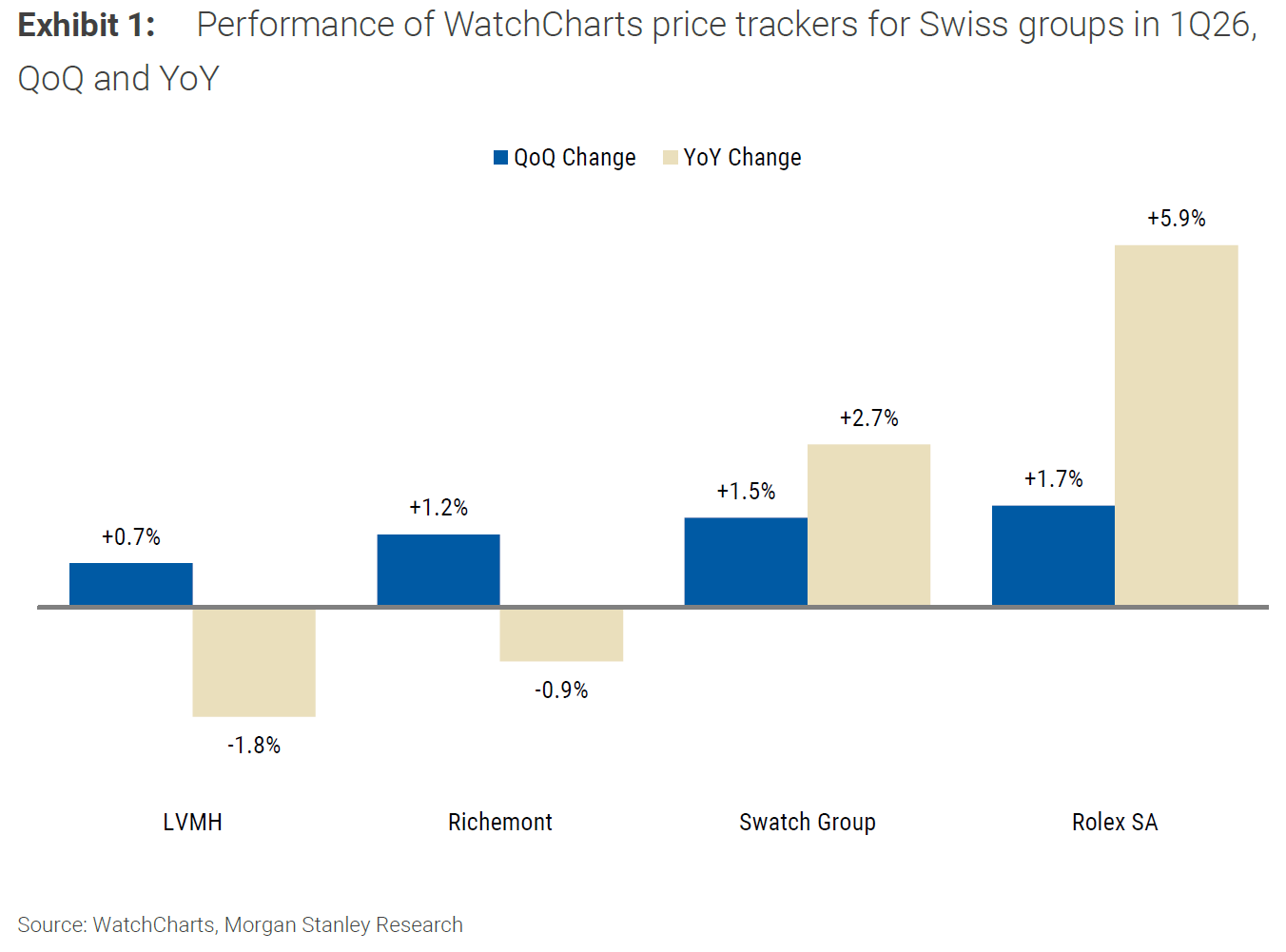
Well, the listed groups have finally caught a break as well; Richemont +1.2% QoQ, Swatch Group +1.5%, LVMH +0.7% and of course Rolex (which is technically not listed but found in the same chart) leads at +1.7%.
So far, so green; but remember, none of these are large numbers and the year-on-year performance is still a mixed bag… Richemont -0.9%, LVMH -1.8%, Swatch +2.7%, Rolex SA +5.9%.
A reasonable person reading this report (and the prior few) could easily make the case that the watch market has stabilised, and an even stronger case that 1Q26 is the first quarter in which that stabilisation has indeed been broad. They could also cobble together a very weak case that any of this represents a return to the conditions of 2021–2022 (but that would be dumb).
The report, to its credit, is explicit about the last point; they use the phrase “four years removed from the peak of the watch market bubble in 2022”, which is the most polite way I have ever seen anyone describe three years of decline.