
What 26 Years of GPHG Data Can Tell Us About the Watch Industry
Every GPHG entry since 2001 amounts to 5,957 watches. Cases have shrunk, big names left long ago, and a few things everyone assumes to be true, turn out to be illusions.

Note: SDC Weekly has been postponed to Tuesday or Wednesday… It’s ready, I just wanted to get this out first as a standalone. Have a great week!
The next time you see any prize list, just remember that an award which allows you to buy your way in is probably a bad tool for doing a ranking. But, what that list might be useful for, is data analysis. What a grand idea… and before we go any further, a quick thanks to Chris Hall for suggesting this. This story is based on data gathered directly from the GPHG’s website.
What’s good about this data set is that we know upfront brands pay to play in these awards, and this means somebody in a watch company decided that a particular watch, at a specific price, in a certain case size and material, was worth paying a fee to give it more visibility in the watch world. Now if you take that one decision about one watch, and multiply it by 5,957 watches over 26 years - that’s what we are about to analyse here; it’s essentially a time-lapsed record of what was going on in the mind of the watch industry, and perhaps, what the industry thought was worth marketing over the last couple of decades.
Estimated reading time: ~ 16 minutes
Health warning: many brands are missing from this analysis because they don’t participate in the GPHG awards. For context, out of the 20 largest brands by 2025 turnover, 13 of these did not enter the 2026 GPHG - and these account for 81% of turnover; of course, Rolex alone is more than a third of that.
So at any point if I use the word “census”, I use this term loosely and we must not lose sight of the fact that the brands who participate are, in revenue terms, a minority share of this industry.
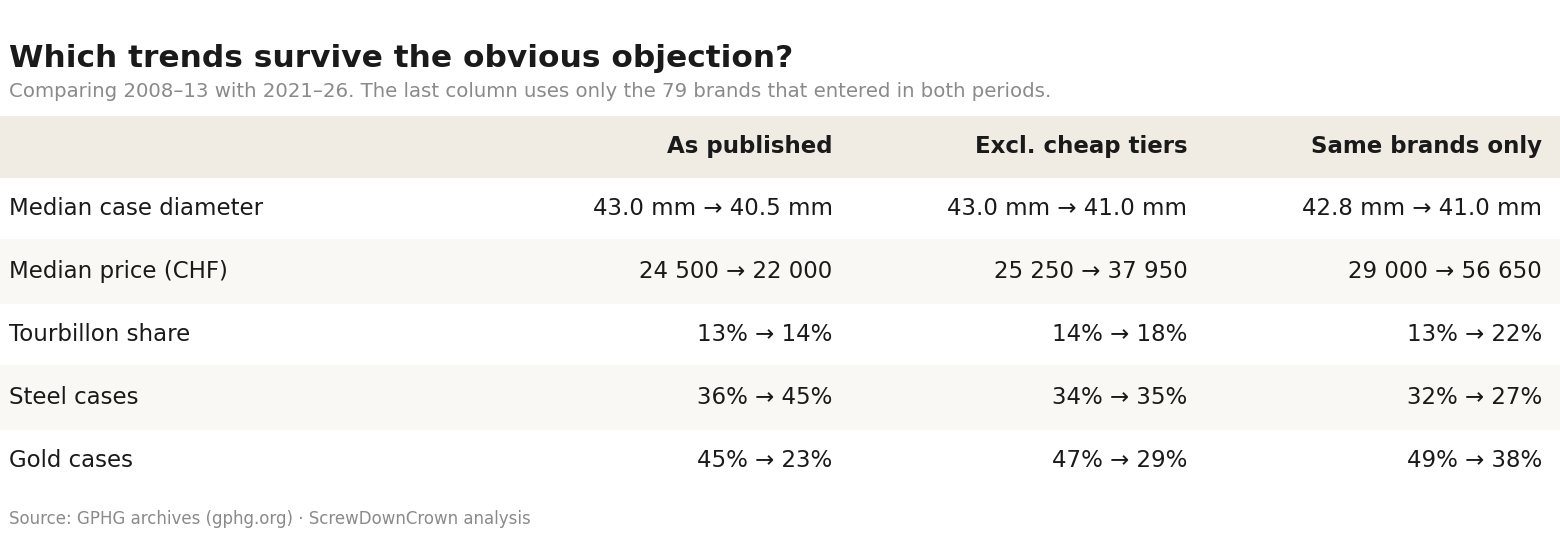
Another issue is that the total volume of entries has tripled in the last couple of decades, and it won’t surprise you to hear that most of these new arrivals are microbrands entering cheap categories which didn’t exist a decade ago. Because of this, any raw average will be skewed by the ‘new’ additions and so I have also used different cuts of the data to try and account for this (headline number across all entries; the same number but Challenge and Petite Aiguille categories stripped out; and lastly, comparing only the 79 brands that entered in both 2008–13 and 2021–26 i.e., ‘apples-to-apples’).
With that in mind, and if you don’t have time to read it all, here’s a summary:
Watches got smaller. Shocker.
GPHG basically split into two sections… the usuals, and a low-end. Overall entries, on average, are now cheaper, but the competition within has nearly doubled in (retail) price.
Complications aren’t dying. When it comes to the longstanding entrants, tourbillons went up, 13% to 22%. When you look at the data as a whole, it seems like complications have gone down, but that’s just the cheap seats filling up.
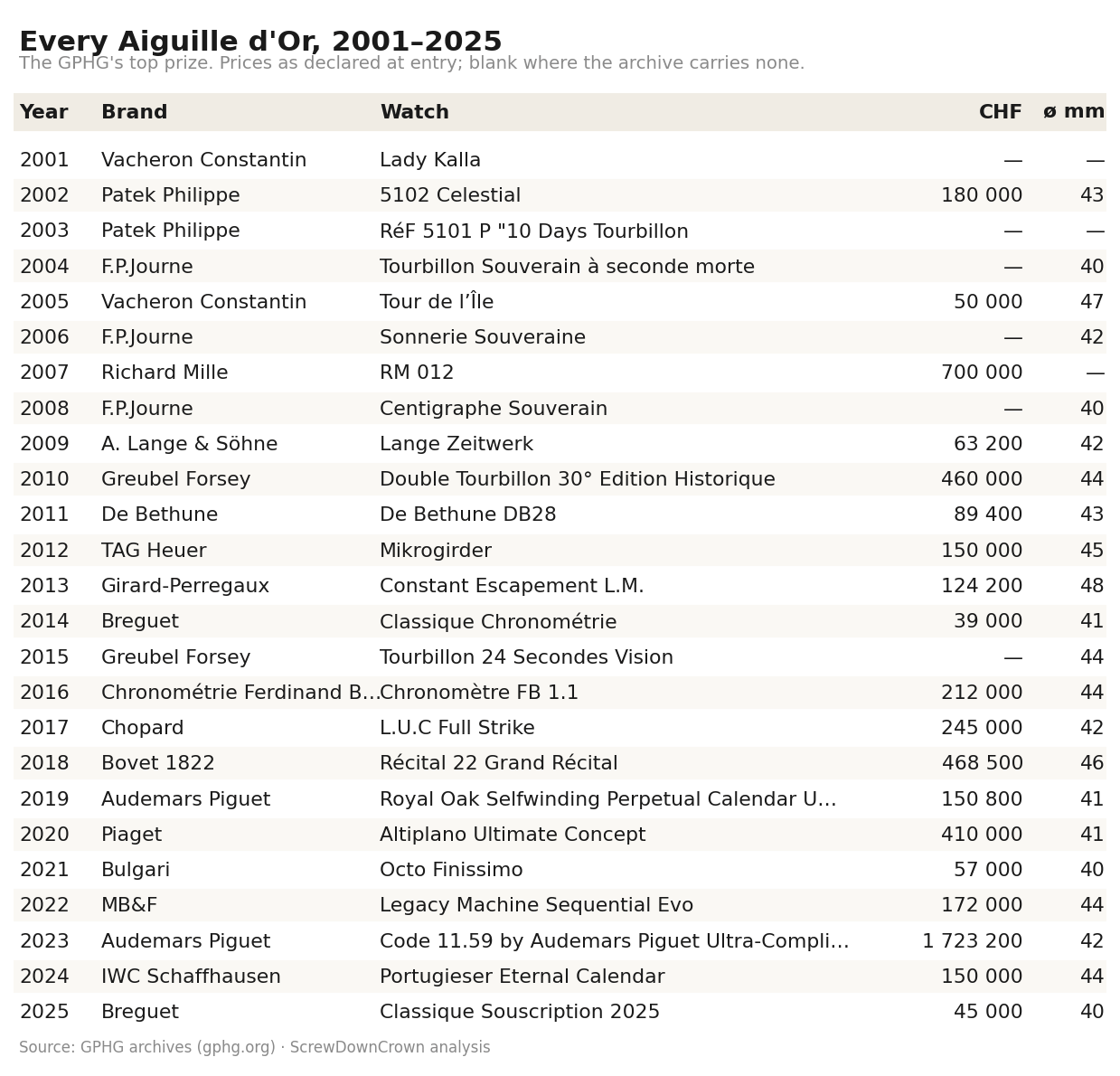
Big names left a long time ago. Rolex entered once back in 2007, and Patek won it two years running and then also fvcked off. Despite winning 5 prizes, Lange also stopped coming in 2017.
Juries reward expensive watches, by a factor of ~4.
* * Remaining charts and tables are shown to paid subscribers only
Over time, the GPHG didn’t ‘go downmarket’ - it just added one of its own.
If you’ve been reading SDC in 2026, you will have seen the term ‘premiumisation’ a number of times… that word refers to how brands charge more, make higher-end watches, and on average, sell at higher ASPs (average selling prices).
With that in mind, the median (stated) retail price of a GPHG entrant peaked at CHF 43,050 in 2016. This year, the median is only CHF 19,800 (not adjusted for inflation either). In short, a typical watch entered into the GPHG now costs less than half of what it used to cost a decade ago.
* * Chart showing GPHG Price Distribution and Segmentation
That’s kinda interesting in its own right, but it’s more interesting to compare this decline with what the industry itself seems to be pushing. Most of the export data indicates that more expensive watches are generating a larger proportion of the industry’s revenue. And as I mentioned above, retail is premiumising so much that it’s practically gentrified.
But why, you ask? I think first off, the GPHG made more cheap seats available; the Petite Aiguille (currently for watches between CHF 4,500 and 10,000 retail) and Challenge (below 4,500) categories made up by about 9% of all entries about a decade ago; these days they make up 27.5% (88 of this year’s 320 total).
So when you remove the Challenge and Petite Aiguille the median entry actually rose by half. It gets even better when you only consider brands that entered in both eras, as those nearly doubled from CHF 29,000 to 56,650 (Chopard went from a median entry of 34k to 73k, Piaget from 40k to 127k, and AP from 66k to 186k).
* * Table of brands from both eras
So yeah, you could argue that the GPHG as a whole, did get cheaper, but at the same time, the competition within, got more expensive. So it may be tempting to conclude the GPHG moved downmarket, but it’s more correct to say it kind of bolted a ‘downmarket’ onto the side and the remaining contestants premiumised just like the rest of the industry.
Dilution over time
It is well understood that many big names don’t bother with the GPHG… but what I didn’t appreciate until now is how long ago they stopped coming. Here’s a quick recollection of when last each of these brands entered a watch:
* * Table of absentees - when the big names stopped entering
I never knew this, but Rolex entered only once (two watches) in 2007, and never again. Patek had 33 entries between 2001 and 2007, and won the Aiguille d’Or for two years running… the 5102 Celestial in 2002 and the 5101P in 2003 - but have since been absent for 19 years. In fact, Lange perhaps drives this point home because they also entered 33 watches over the years, and they won five prizes including the 2009 Aiguille d’Or for the Zeitwerk. And despite having pretty good results, they also haven’t been back since 2017. The “mainstream exodus” Chris speaks about isn’t at all a recent sulk. The Oscars of the watch world apparently lost all the movie stars some time ago… some even before Instagram existed.
As for ‘establishment’ brands present each year, it’s been quite flat. They were in the low 30s in the late 2000s (33, 34, 32 from 2008-10), and between 17 and 26 in every edition since 2016. The ‘establishment’ doesn’t seem to be leaving at this point; there is a stable group of about two dozen (AP, TAG, Chopard, Piaget, the LVMH brands, a rotating selection of Richemont’s second string) who tend to show up every year. But what did change, is everything around them; all the noteworthy exits happened between 2007–2014, and since then it has really just been about subtle dilution. So now we’re left with the same ‘establishment’ names, and a growing selection of randoms.
* * Chart showing establishment brands vs other brands over time
Honourable mentions. As far as big brands go, AP is a pretty big GPHG loyalist… they entered a total of 102 watches in 22 of the 26 editions on record (they sat out 2014, 2018, 2020 and 2024) - and they’ve won the Aiguille d’Or twice in the last 7 years (RO Perpetual Ultra-Thin in 2019, Universelle in 2023). TAG Heuer is the other GPHG-lifer, with 132 entries since 2002 - more than any other brand except Chopard (who lead the loyalty rankings with 146 entries).
Peak indies
In 2025, there were 67 brands that entered the GPHG for the first time. Now in 2026, we see another 68. And for scale, consider that through the late 2010s this was a lot less (38 in 2018, 28 in 2019), and back in 2008 the entire list (new and old) was only 87 brands. This year, they have 194 brands in total, which is nearly double what it was eight years ago - of all the brands this year, more than a third (68 of 194) are brand-new to the GPHG - and that’s this year alone.
Many people will look at those stats and think it feels rather healthy for an industry that has been through some hard times of late (I kinda do as well). With the current setup, a Kudoke or Otsuka Lotec can show up on the same longlist as AP, and all it costs them is the price of a luxury dinner (Kudoke actually won the Petite Aiguille in 2019 with a CHF 9,670 watch).
Louis Vuitton forks over €150k to an indie watchmaker every couple of years via their watch prize, and this buys Jean Arnault a fair amount of goodwill and helps LV’s association with the craft… but one winner every so often doesn’t quite spread as far as the GPHG longlist does. You could be a rando launching a brand one January via a Kickstarter campaign, and for the cost of one trade-show dinner at a decent restaurant here’s what you can buy: a page on gphg.org that will feel - to any random reader on Kickstarter - like your brand has a major endorsement from a prestigious entity, you will get a backlink on every “GPHG longlist announced” article, and you of course get entered into a ‘lottery’ to win a jury prize and even more marketing. Where else in the luxury world will 800 francs get you all that?
On the other hand, this is now a competition with massive turnover at the lower end… so you could see this as a ‘competition’ which is mostly a bellwether for marketing budgets at the bottom of the market… and hardly a good signal for craft or excellence at the top of the market. I get the impression that both things are true, and that’s really the theme coming out of this whole exercise.
Shrinkage, not shrinkflation
This is again, not going to be surprising to anyone who’s followed the industry closely. Median case diameter of round entries was 43-43.5mm in 2008–09, then 42mm through the 2010-decade, and then 41.5mm in 2021, 41mm for a couple of years, and eventually 40mm for the last three editions.
But then, take a look at the distribution... in 2009, 76% of entries were 42 mm or larger; this year it’s only 29%. The share of really small watches (38 mm and under) barely moved; so what actually happened was the bigger watches declined into the 38-41mm range, but there wasn’t much change in the proportion of really small watches.
After I removed the Challenge and Petite Aiguille data, not much changes in the analysis… the median still dropped from 43mm to 41mm. Taking it further, when you only look at the brands which were present in both eras, the median still drops from 42.8mm to 41mm. There were 67 brands with useable data in both eras; of these, 49 of them had smaller case sizes over time, 7 stayed the same, and only 11 got bigger. On average, the industry changes its mind on case size at a rate of approx one mm every five-ish years.
The takeaway is that if you want to know when the big-watch era died, based on what brands chose to show off (and not what magazines said), it died over the course of 15 years and the funeral took place around COVID. That said, it seems to have stopped dropping now… the median has been stuck around 40mm for three years and it seems that the larger ones have started to creep back in (42mm and over went from 26.3% in 2024 to 27.4%, and now they are at 29.4%). Watches which are 44mm or more have moved from 6.8% to 9.6%, and now are up to 10.8%. So yeah, these are small numbers for now, hence I say it’s creeping up (see chart below). A friend of mine asked whether Panerai needs to wait another 20 years to make a comeback…. I don’t think Panerai needs to wait for 47mm to make a comeback; all it needs is to have one generation whose father didn’t wear a large watch... so that means about 7 years from now? Who knows.
* * Chart showing case size over time
Sorry, one last thing to think about here… Bulgari and Piaget have been entering ultra-thin watches into this competition for ages now, and they keep winning prizes and talking about thinness all the time… and eventually, I guess thinness eventually did turn into something which people started to appreciate more (hello Justin Hast!). This is how it plays out in fashion as well… trends start on the runway, and I guess the GPHG is the closest thing the watch industry has to a runway. So maybe it’s true, that some of the ‘trends’ in this data actually started out as a company’s marketing strategy before they defined Justin’s taste, but hey, this is pure speculation.
Complication mirage
When you first look at the GPHG data in aggregate, it will seem like complications are on the decline. Tourbillon watches peaked at about 20% of the total between 2014 and 2019, and they’re down to 11.6% now. Time-only watches (hours, minutes, maybe seconds, and nothing else) were between 1% and 9% of total entries in the late 2000s; but these are 18-19% now. In 2025, for the first time, the GPHG longlist contained more time-only watches than tourbillons, and this year the gap got wider. It’s the same with chronographs, where there were 23-30% of total entries in 2008–09, and only 11.2% now. Long story short, it appears as though everything that was ‘complicated’ has now halved, as a proportion of the total entries.
But in reality, the GPHG data taken in aggregate is extremely skewed. If you cut up the data and look at brands which have stayed present in both eras, tourbillon share actually rose from 13% to 22%. It’s the same with time-only, which, at face value, looks like it went from nothing to 18-19% now, but if you look only at the old guard this is a smaller move from 9% to 12%.
So the truth is a kind of mirage, in that complicated watches are indeed a smaller proportion of what is entered into the competition, but they are a growing proportion of what the ‘serious’ players enter into the competition.
* * Chart showing complications over time
Quick one on materials (same theme) - gold has indeed declined from 49% down to 38%, and that’s when you only consider brands present across both eras (not skewed data). Steel might seem to have gone up from 34% to 47%, but that’s skewed by microbrands; if you hold brands constant and correct for the new brands, steel actually goes down, from 32% to 27%. Titanium more than doubled from 8% to 18%, after peaking at 23% in 2024, and this is legit growth - and I believe this because I have seen it for myself (and I bought 2 titanium watches in the last 2 years!).
* * Chart showing case materials over time
When I wrote about the Morgan Stanley data, my conclusion was that design is eating watch specs on the demand side; Gen Z wants to buy shapes and dial designs instead of highly specced watches. This GPHG data is saying the same thing, but from the supply side.
In general, I think it’s safe to say brands typically enter what they’re proud of, and what they think will do well as representative of the zeitgeist. What we see from the data is back in 2014 they were clearly proud of more complicated watches. In 2026, it seems they’re mostly proud of restraint (or perhaps they just noticed how ‘restraint’ is cheaper to make and will photograph just as well).
Quick aside to end this section… Chris Hall ranted about the GPHG categories already. Truth is, they are poorly enforced. For example, there are loads of tourbillons entered this year, and not all of them are in the tourbillon category. Anyway, you try it for yourself… have a look at this year’s Complication category and decide how many legitimately fit there. I think people can read the rules in good faith and still disagree dramatically, which to me, says that the rules need to be revised. In short, this data on complications is to be taken with a sprinkle of salt!
Do juries reward expensive watches?
Yup, and it isn’t even close. In all 18 editions where the archive had all the data, the median prize-winner cost more than the median entrant (around 4x more on average). Juries are human, and an ultra-complicated, high-end, much-loved watch is always going to be tough to vote against.
* * Chart showing how juries reward expensive watches
But… it’s not exactly that simple. As a recap, let’s go through the recent Aiguilles d’Or winners; Piaget Altiplano Ultimate Concept (2020, CHF 410,000), Bulgari Octo Finissimo (2021, 57,000), MB&F LM Sequential Evo (2022, 172,000), AP RD#4 (2023, at 1,723,200 was the most expensive Grand Prix winner ever), IWC Eternal Calendar (2024, 150,000), and finally, Breguet Classique Souscription (2025). The last one was just a 40mm, one-handed watch priced at CHF 45,000. That makes the recent Breguet the least complicated Grand Prix winner of the modern era and, in GPHG history, it has only ever been undercut by another Breguet (2014 Classique Chronométrie, priced at 39,0001). So, Breguet won the two cheapest Aiguilles d’Or, which is funny because we’re talking about the inventor of the tourbillon!
It’s hard to read much into one data point in one year, but hear me out. Right now the competition is getting more expensive at the top and the most recent top prize was given to a non-complicated watch. For the 2023/24 editions, the winners’ median was closer to 7x all the entrants’ median - which is the widest that gap had been in about 15 years. Then in 2025 it fell to 3.9x, which is close to the long-run average and also the narrowest it had been since 2021. So not only did the jury pick a cheap(er) watch, the whole slate of winners actually came closer to the overall group of entrants than it had in a while.
Aside from all that, it’s worth realising that since 2018, establishment brands have made up a third of the entries and also won almost half of the prizes - a win rate of 11.7% against 6.1% for everyone else. In terms of rankings… Voutilainen won 12 prizes from 25 entries, then MB&F, then Tudor… So you can’t point to this being all about ‘corporate muscle’ only... It’s also a lot to do with familiarity. Juries are regular people, and I’m sure they all find it easier to reward a name they already admire.
Which is why the problem for all other entrants this year is we have Rexhep Rexhepi’s Chronograph Flyback in the running - it’s the right price, and also 38.8mm, complicated, and although it’s not a gold statement piece, it’s Rexhep; the darling of the whole watch world. And given Wei Koh has taken over as president of the jury this year, I struggle to see how anything else can beat the RRCHF. And if Rexhep does indeed win this year, this would tell us nothing about the jury’s appetite for restraint, and we’ll have to wait until there is no obvious superstar to see how they act.
So what is the GPHG for?
Why did the establishment leave, and why won’t most of it come back?
Think like a Chief Marketing Officer at an establishment brand for a moment. We know it costs CHF 800 to enter - which is basically free - so that isn’t the real cost. What I think feels like a major cost to establishment brands is how asymmetric the outcomes can be. If Rolex enters and then wins, the headline will be boring… “Rolex wins watch award”. Who gives a shit? Certainly not Rolex. Their brand equity is through the roof because they are already the best-known watchmaker on earth. Now, if Rolex enters and loses to some unknown 30-person atelier, that is a headline, and a bad one for Rolex.
It’s like that silly coin flip gag… heads I win, tails you lose. For an establishment brand, entering the GPHG goes something along the lines of heads you get nothing, tails a microbrand will embarrass you on stage in Geneva. Any sensible CMO would not take that bet… not for CHF 800, not for free, and I don’t even think they would take it if GPHG decided to pay them.
All the current entrants do it because it works for them and their brand equity. AP basically treats the GPHG like an R&D trophy cabinet, and TAG and Chopard enjoy a bit of ‘earned media’ which they’d probably not be able to justify paying for elsewhere. And as far as the 68 debutant microbrands are concerned, there really is no downside because nobody has any expectations for them anyway.
Now you’re probably not a CMO, so what should you take away from this?
Well, over the years I have been pretty consistent in my view that the GPHG is a waste of time and we as consumers should not care about it. Given how it is not at all representative of the overall market, there is not much to learn from 26 years of data, let alone one year’s award ceremony. We know that “award winning” is, to a first approximation anyway, a synonym for “expensive”. Great, we already knew that. We also know that established brands seem to win twice as much as others, and that tells us that prizes also measure familiarity. But really, when more than 80% of the industry’s revenue engines are not even bothering to enter the competition, and when price predicts winners and fame also helps, this is anything but a serious ‘ranking’ and more akin to a raffle.
Looking at the GPHG as a dataset, their pay-to-play ‘looseness’ (just to get on the longlist) is pretty much why it has any value at all. Whether they planned it this way or not, they seem to have created the only annual watch census in the industry.
Right now this census is telling us that watches are getting smaller, and that this whole competition has split into two separate sections. On the top, watches keep getting more expensive and more complicated - which mirrors the industry in general. The bottom section now makes up most of the entries, but also, not much of the industry’s revenue.
So what I take away from all this data is that the GPHG’s problem, is lack of representativeness. They have 194 brands on the longlist this year, but of those, the establishment is maybe one or two great maisons, a couple of loyal majors, and a rotating cast of group second-stringers - as Chris said, this is the Oscars where someone forgot to nominate the movies people actually watch!
Anyway… the full dataset (5,957 watches, every entrant page the GPHG has ever published, 2001–2026) is now in my research folder, and it’s pretty easy to refresh for future editions. If there’s some cut of this you want to see (ladies’ categories over time? water resistance? whatever happened to bronze?), just let me know in the comments and I’ll consider posting it inside a future SDC Weekly post.
Footnotes
This may be incorrect… a few early winners like Journe etc have no price in the archives. YMMV, and I didn’t think it was worth hunting down the price because this stat is not that big of a deal anyway
Really enjoyed this. The GPHG archive in my view is a remarkable public record in an industry where structured data is often lacking.
It's not quite an industry census, but serves as a record of what brands considered worth putting forward, and therefore I guess of marketing intent and changing tastes.
I’m not convinced the fee-paying model is inherently a flaw in the way that people say it is. It creates a bias in who enters, yes, and it means it can never truly capture the best of the whole industry. But funding the awards through a handful of major industry sponsors, for instance, could create a bias that is way worse. I can't immediately think of a clearly better way for an institution like this to sustain itself while maintaining some credibility and independence. So it is a competition for those who enter. That doesn't seem that bad to me – the entry price is not prohibitive for most.
And what it has given us is an archive that the more closely you look at it, the more I believe it has to say.