

SDC Weekly 153; Dynamic Pricing; Breguet's Tourbillons & Daniel Roth; Anoma A1 Prehistoric Reveal
A pre-release review, why a group chat is the wrong place to ask, Steve Harvey on what fathers want, the first ticking nuclear clocks, a 'fast' swimming pool, M.C. Escher at Somerset House, and more!

🚨 Welcome back to SDC Weekly!
Lange fans rejoice… their next and final Lumen watch will be launched in 2028; it will be a Zeitwerk Minute Repeater! I’m also told we can expect a platinum Triple Split in September.
Admin note: The Unofficial Editor refused to proofread this draft because he’s busy landscaping his backyard. He told us to figure it out ourselves while he spends the afternoon playing with a hoe. Please tap the title of this post or click here to ensure you read the most recent edition, which may include corrections made after publishing..
If you’re new to SDC, welcome! When you have some time, check out prior editions of SDC Weekly here, or peruse the archive here.
Estimated reading time: ~34 mins
In case you missed it last week:

📊 Dynamic Pricing Revisited
If you have tried to buy a World Cup ticket this year, you already understand most of what I want to say about watch pricing, and let’s face it, you probably have the trauma to prove it.
FIFA took their ticketing platform in-house for 2026 and turned it into an Uber-for-football, in the sense that the price rises with demand. Reporting suggests 95 of the 104 matches saw a price increase, at an average of roughly 34%, with the cheapest ticket for the final starting north of two grand.1 Surge pricing, basically, is the same thing that makes Uber cost double when the train drivers are on strike. Shocker. I do get it, by the way; demand is there, the number of seats is finite, and so somebody was always going to collect that premium - usually it’s scalpers, and this time FIFA decided it might as well be… FIFA!
But it turns out, FIFA was too greedy. Demand for the less hyped group games was soft, and prices were too high to sell seats. But FIFA, being a body with around $3bn of ticket revenue riding on the idea that these things are ‘precious’, could not be seen to be cutting prices. A public price cut would have every fan who paid full whack demanding the difference back… with chargebacks and consumer-protection lawyers following close behind.2 So, allegedly, the unsold inventory started turning up in large blocks on StubHub and SeatGeek, below FIFA’s own published price, while the official site kept the original (higher) prices.3
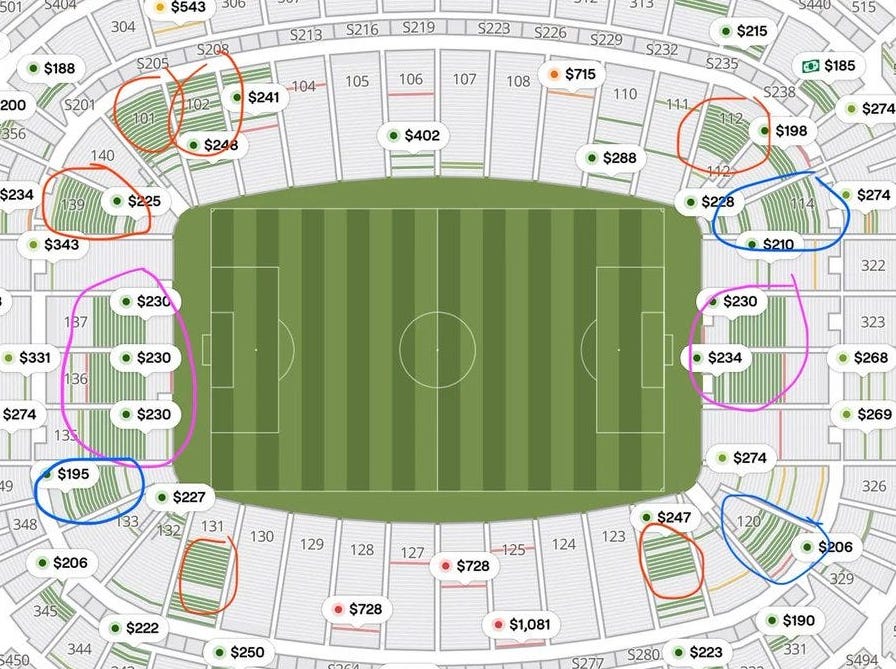
Prices that only move up in public
With dynamic pricing in ‘prestige’ markets, the up-move and the down-move do not get equal treatment. In theory the price should float both ways but in reality, the rise happens openly and the fall happens in a hushed way - because dropping prices openly is an admission that the thing is worth less than you initially said it was, and the prestige probably won’t survive such an admission.
Airlines live with this happily, since nobody’s ego is bound up in a Tuesday fare to Faro. But luxury? They seemingly can’t afford to do this. The price itself is part of the product, so marking it down will not only cost you margin, it will inform everyone the magic has gone (as you know, economists call this a Veblen good). FIFA wanted to price like Uber and then realised it was more akin to Hermès… i.e. you can nudge prices up, but you get stuck there the moment you want to bring them back down.
What about watches?
You probably realise now, that the watch industry has been doing the same thing as FIFA for ages. It just happens slower, and perhaps with better manners for the most part.
First, there’s the annual price increases; every year the industry raises list prices a few percent, and the reason is almost always input-costs rising, Swiss franc strength, gold price rising, the tariff of the month, and so forth. To me, that is a special case of dynamic pricing; the price moves with inputs, which is the same thing a surge algorithm does, but this one only moves once or twice per year by committee - instead of once-per-minute decided by software. And of course, it only ever moves up not down. Other than a few exceptions like the Patek tariff adjustment and JLC, I cannot remember the last time a major brand sent a cheerful email announcing its watches would now cost X% less because demand had dropped.
When demand does decline, as it has done in the squeezed middle of this market for a couple years now, the brand still won’t cut prices. Instead, it lets the grey market do the cutting (and we covered examples of this via Wristcheck in a prior SDC Weekly). So your watch trades below retail on the secondary, the grey dealer sells with a markdown, and the brand keeps its list price high (and its hands clean). So just like with FIFA, the price dropped, but you were simply not allowed to watch it happen - and the loss landed on you and the grey dealer, but not the brand or watchmaker.
So when we ask whether watch brands ‘should’ adopt dynamic pricing, one could argue we are in fact asking a silly question… because they already have! More worthwhile questions might be “who pockets the difference?”, and “are consumers able to see it?”
This brings me to an interesting disagreement I had with someone who knows considerably more about this than I do; and he also has 20+ years of experience.
Max and I part ways
Max Büsser read my HM12 essay and during the course of a discussion that ensued we got onto this subject of pricing. His position, which he holds as more of a personal ethic, is that you should ‘treat people the way you would want to be treated’. He does not want fluctuating prices for two main reasons. First, if you were the customer, a moving price means you might buy at ‘the wrong moment’ and feel like you made a mistake. Second, he thinks it nudges watchmaking further toward a speculative, asset-mindset model, which is arguably bad for everyone.
I suppose this is at least an admirable perspective, and for what it’s worth I think it is half right. A stable retail price is undoubtedly a powerful anchor. It is the number you (as a consumer) measure ‘I did well’ or ‘I overpaid’ against, and taking it away does leave you slightly adrift at sea with every purchase. The behavioural economists would file Max’s worry under anticipated regret, and they would be right to do that. I respect the whole instinct… I am just not sure it is doing what Max thinks it does.
I mean, notice how fixed pricing does not actually delete one’s regret. If anything, the regret is just moved somewhere else. With a fixed price you still get to feel terrible, as the person who paid retail for a watch now worth half, or as the person who could not get allocated and paid triple to buy it off a flipper. The bad feeling was always somewhere. A moving price just changes who you are pissed off with… and the ironic part is we probably forgive the faceless flipper for charging the market price more quickly than we forgive the brand for charging the identical number - that’s likely because we have decided ‘the brand is supposed to be on our side.’ Max is, in effect, refusing to break that, and I respect the position - I just think the regret it saves is mostly being moved, NOT removed.