

SDC Weekly 155; Walt Odets; Watch Signalling; Crowd Drifting
Remembering Walt Odets, the man who measured 'the gap'; how watches learned to talk and who taught the crowd to listen; why we all drift anticlockwise; ten seconds on the demagnetiser, and more.

🚨 Welcome back to SDC Weekly!
Quick word of thanks to SuperlativeCommenter (sick name btw!):

Posting this on Hodinkee - organically - is such a kind gesture. Thank you!
Admin note: The Unofficial Editor declined to review this edition - he’s busy explaining to his wife why “just admiring the finishing” took four hours in another man’s workshop. Please tap the title of this post or click here to ensure you read the most recent edition, which may include corrections made after publishing.
If you’re new to SDC, welcome! When you have some time, check out prior editions of SDC Weekly here, or peruse the archive here.
In case you missed it last week:

Estimated reading time: ~31 mins
🧐 Walt Odets
This was a man who once took a factory-fresh Rolex Explorer apart on his bench, photographed everything he found under magnification, and concluded that a fair retail price would be $600 to $800. At the time, this watch retailed for around $2,500, and this man published the photographs he took along with some highly controversial opinions.
“The anomalies of the Rolex Explorer make it difficult to neatly summarize a personal opinion. For me, the only intriguing aspect of this watch is that a movement so lacking is [sic] basic workmanship is capable of being so accurately timed. This is, no doubt, a product of the thickness (and thus permissible loose tolerances) of the movement, and the use of computer-timed balance/spring assemblies. For the person for whom accuracy of rate in a mechanical watch is the only criterion in buying a watch, and for whom value-for-the-dollar is of little concern, the Explorer might be a choice. In the current watch market, the poor quality of the movement–and relatively good quality of the case and dial–suggests that this watch should retail in the $600 to $800 range.”
Walt Odets passed away just over a week ago. He was 79, and if you have ever read a movement review that seemed to not skip over the shortcomings of any particular watch, that style of reviewing effectively descended from Odets. William Massena said in the New York Times profile of him last summer: “He set the template on how to review a watch and how to talk about watches on the internet” and “basically, we still live in Walt’s world.”1
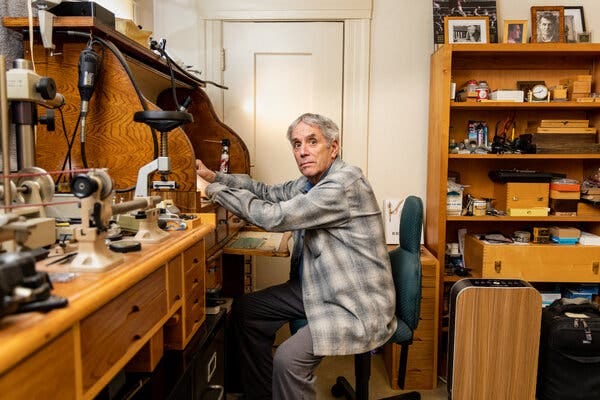
Some background for newer readers… before Instagram, before Hodinkee, and long before this very newsletter, the watch internet was one site, TimeZone. This was a rudimentary forum that watchmaker Richard Paige bought in 1995. Walt bought 10% of it, because, he explained to the Times three decades later: “We’ve got to have content on here, otherwise we just have a group here, people blabbering back and forth.” So he wrote the content, at the leisurely pace of about 20 reviews a year, until Paige sold the site in late 1999. The best of Odets can still be found in a corner called the Horologium2 (”I was the mayor,” Paige said, “and he was the movie star of the site.”). He was not a journalist and he was not in the trade. He was actually a clinical psychologist in Berkeley who happened to own a watchmaker’s bench, a lathe, a microscope and a macro lens, and who would disassemble a watch (his own, Paige’s, or a willing collector’s; JLC was his favourite maker) the way the rest of us open a bag of crisps. Then he would tell everyone exactly what he found, in prose that sounded like a very entertaining autopsy report.
The Explorer review is the one that made him famous, or infamous, depending on which forum you grew up on. Paige bought the watch specifically for the review; he later admitted he saw a chance to “play P.T. Barnum.” It was split into two parts (one, two) in the late 1990s3, and if you’ve been reading SDC for a while, you might remember I linked to both parts way back in SDC Weekly 79. Even if you read it now, it’s surprising to see how he approached things, regardless of what the prose implied. He measured timekeeping and reported “excellent figures,” which from him probably meant a lot more than, say, a random YouTuber parroting such a phrase. The external parts got mixed marks… decent case, dial “cramped and busy,” lugs with “an unpleasant feel,” a bracelet he described as “an afterthought”… and then he opened the back and found unchamfered jewel holes with machining debris, a bridge screw so roughly finished that it gouged the plate the first time the factory installed it, brass shavings scattered through the movement, and perlage applied on top of surfaces nobody had bothered to finish. His verdict was: “the most crudely finished watch movement that I have ever personally examined.” A watch, he said, “of no horological interest whatsoever.”
That already sounds bleak, but what probably ground everyone’s gears the hardest at the time was this sentence:
“I cannot think of another consumer product in which the gulf between the publicly perceived quality and the reality I saw is as broad as with the Explorer.”
A guy who just wants to complain about a watch wouldn’t write that sentence. This sounded more like a psychologist measuring the distance between a brand and its product, and he used data to back up his claims. What followed was, in Paige’s words, “like a war.” Odets told the NYT he received about 100 emails and some even stooped to mocking his sexuality. Rolex called Paige and asked for Walt’s number, but Paige refused (”I’m not going to have them yell at him”). Entire rebuttal sites were created, honour was defended, the pile-on became its own piece of forum history.
The coda took years to arrive, but it did. One evening, long after, a Rolex employee smuggled him into a company facility in Los Angeles to look at the updated Explorer movements, with one condition: “Don’t say Walt, and don’t say Odets.” He examined them for about a quarter of an hour and concluded they “really were actually very good watches.” Eric Wind reckons Rolex moved to a faster upgrade schedule than planned because of Odets’ article, though as he says, “they probably would never admit that.” (The Times asked Rolex to comment on the review but Rolex declined.) Interviewed at 78, Odets was still cheerfully unrepentant about the original: “I mean, that was really a piece of junk.”
It would be easy to label him a Rolex hater, and plenty did just that. The record is funnier, though; asked in a 1999 forum debate whether Rolex used a Breguet overcoil (a hairspring with its outer end raised and curved inward, which keeps the spring breathing evenly and the rate consistent between positions), he conceded they did, in the calibre 3135, then added: “I don’t think of it as a watch.” Later in the same debate, a poster asked how the Rolex escapement stacked up against Patek’s and Lange’s; Odets accepted the design was sound and explained how Rolex could afford it: “They aren’t spending it on ANYTHING else.” You can call this snobbery if you like, but he owned the charge cheerfully; his beat was the top of the market, and he seems to have judged everything by whether the money you paid was actually in the object.4
That’s also why I think the whole Lange drama is more interesting than the Rolex story, though I think nobody outside the old forums remembers it. In November 1999, Peter Chong published the world’s first review of the Datograph, and Walt, who owned a few Langes himself, spent ten days on TimeZone arguing that the money spent on the watch only went as far as you could see through the caseback, and no further. He thought that behind the lavishly engraved top plate they used an under-engineered escapement and keyless works that, in his words, “could come from a mediocre watch.” The inconsistencies, he wrote, “divide the line between ‘show’ and ‘go.’” His summary: “They’re great watches, but they’re not completely honest.” And when a poster tried to summarise that into “Lange is dishonest,” he actually corrected them. He’d said there was an element of dishonesty about the watches… quite clearly a psychologist’s distinction if ever there was one. He essentially reviewed watches the way he’d assess a patient. What does this thing present itself as, what is it under the hood, and how big is the gap between the two?
Walt Whitman Odets was the son of the playwright Clifford Odets, orphaned by sixteen, raised partly in the household of Lee and Paula Strasberg, which means the family business was very literally the study of performance. He trained as a clinical psychologist and spent the late 1980s and 1990s doing serious, controversial work on the psychology of HIV-negative gay men during the AIDS epidemic. His 1995 book In the Shadow of the Epidemic made the New York Times’ notable books list; his Harper’s essay that same year argued that prevention campaigns were failing because they addressed how people ought to behave rather than what people truly felt. Do you see the connection? That essay was about public message versus the private reality which, if you think about it, is another type of gap. He spent most of his adult life, in both career and hobby, pointing out gaps.5
And if you want to know why watches, specifically, there’s some interesting data in this NYT article. On 30 November 1992, at precisely 10:22 pm, undertakers carried the body of his partner out of their Berkeley home. A week later his therapist asked how he knew the exact time, and he said: “because I looked at my watch.”
In the book, Mr. Odets wrote that he had looked at his watch because he “wanted to see something that was reliable, something that — unlike the human lives you loved and needed — could be trusted.”
That’s what a watch movement meant to him. Now if you go back and reread the Explorer review, when he talks about the gap between perceived quality and reality, you will notice it isn’t really about Rolex per se. To me, all he was doing there was checking whether the one thing that’s supposed to be trustworthy, was, in fact, trustworthy.
And the man could love, too. If the Explorer review is his infamous essay, his three days with a Lange Saxonia essay is probably his best. He begins lukewarm, at dinner with a retired-watchmaker friend, and falls for the thing in real time on the page. His Lange was “an anvil, a solid lump of a super-dense new element that ran right off the end of the periodic tables,” a watch with no charm and a “Wagnerian soul,” “a baby only an engineer-mother could love.” By day three he’s beaming back at the number 30 in the date window and closing with Oscar Wilde’s deathbed line about the wallpaper. That review was truly a psychologist’s self-report of desire overruling judgement, written by a man who knew precisely what was happening to him and was allowing it to happen anyway. Every essay about why we buy watches, including most of what I write here, also descended from that essay.
The trade knew what he was, even when the forums were burning him in effigy. Jeff Kingston, in a WatchTime interview, tells the story of meeting Jean-Claude Biver, then running Blancpain, who demanded: “Who is this Walt Odets? He is the only person who understood our 1185 chronograph movement, the only person. Who is this man?!?” Biver was still telling the story to the Times last summer: “He’s one of the rare people who spent some time to understand it.” Odets heard that Biver was “absolutely astonished that an American could understand a watch that well,” and found this hilarious; the 1185’s cleverness, he’d explain, was a vertical clutch (the chronograph engages by friction from above, like pressing two records together, instead of meshing a side-mounted gear that makes the seconds hand stutter). Then, for the rest of us: “They’re not the kind of movements you’d run over with a bus and they’d be fine, let me put it that way.”
He was, Lord knows, not always right, and not always kind. He could be imperious in debate; he read innocent questions as ambushes; in the Lange debate you will find the sentence “Your approach is rhetorical and sounds aggressive,” aimed at Peter Chong, who was asking about hairsprings. But then again, he definitely paid for every opinion with hard work. Before he told you the Explorer’s fourth wheel had cheap straight-cut teeth, he would have taken the wheel out and photographed it himself. Most modern reviews are powered by superlative adjectives; Odets powered his with disassembly and a camera. Nowadays we have more watch writing than ever before, yet almost none of it involves a screwdriver.
He also wrote one of my favourite autobiographical sentences in all of watch writing. Opening Tweaking the Mark XII, his account of swapping a fancier calibre into his IWC: “In the 1970’s, I was a pilot flying printing plates, bags of canceled checks, and the occasional dead body, also in a bag.” He earned $12 an hour doing it, wearing an Omega Seamaster his aunt gave him for graduating. No other hobbyist was writing like that, because no other hobbyist had lived like that.
Anyway, raise whatever you’re wearing on the wrist today. If it’s an Explorer, he’d have approved of the case, admired the rate, and told you to send him the movement. The gap between what a thing claims to be and what it is, will not close just because the man who measured it is gone. But hey, at least he handed us some callipers to measure it ourselves.
🚦 Watch Signalling
The comments under SDC Weekly 154 were spectacular. You must read those if you missed them. They’ve given me plenty of food for thought, and today I wanted to pull on just one of the many threads exposed there. While everyone else argued about status, Captain of the good ship Curmudgeon (Hi, Rip Roach) shared an observation that I thought deserved a section of its own. Rip came of age as a watch lover in the 1970s, and back then, he wrote: