

SDC Weekly 156; Swatch sells gold below spot; Watch Industry Omertà and the GPHG
Citadel's Scott Rubner on Equities, Rolex's real-life 'Rollie', $50m T. rex, Walt Odets on bidirectional winding, Watches of Switzerland takeover talks, Descartes on doubting your collection, and more

🚨 Welcome back to SDC Weekly!
Admin note: The Unofficial Editor declined to check this edition. He said he only has three brain cells left, and he absolutely refuses to let SDC murder the survivors. Please tap the title of this post or click here to ensure you read the most recent edition, which may include corrections made after publishing.
If you’re new to SDC, welcome! When you have some time, check out prior editions of SDC Weekly here, or peruse the archive here.
Estimated reading time: ~35 mins
In case you missed these last week:


🥇 Swatch selling gold below spot
Any business that generates more want than product has to pick a way to ration their stuff. The obvious method is to ration by price; raise it until enough people p1ss off. You can just make more, which of course nobody in luxury likes to do. The third option is to ration by something that isn’t money; this could be a queue, a list, purchase history, whatever.
Price is the most straightforward because price says whoever wants it most and can afford it, will get it. Making more doesn’t work out well, as we already know from examples like Omega and IWC and many others. But how about something that isn’t money? This one is interesting because when you ration by queue or by list, the gap between what the thing costs and what it’s worth doesn’t magically go away. In fact, the whole secondary market is basically a spotlight on who captures the value.
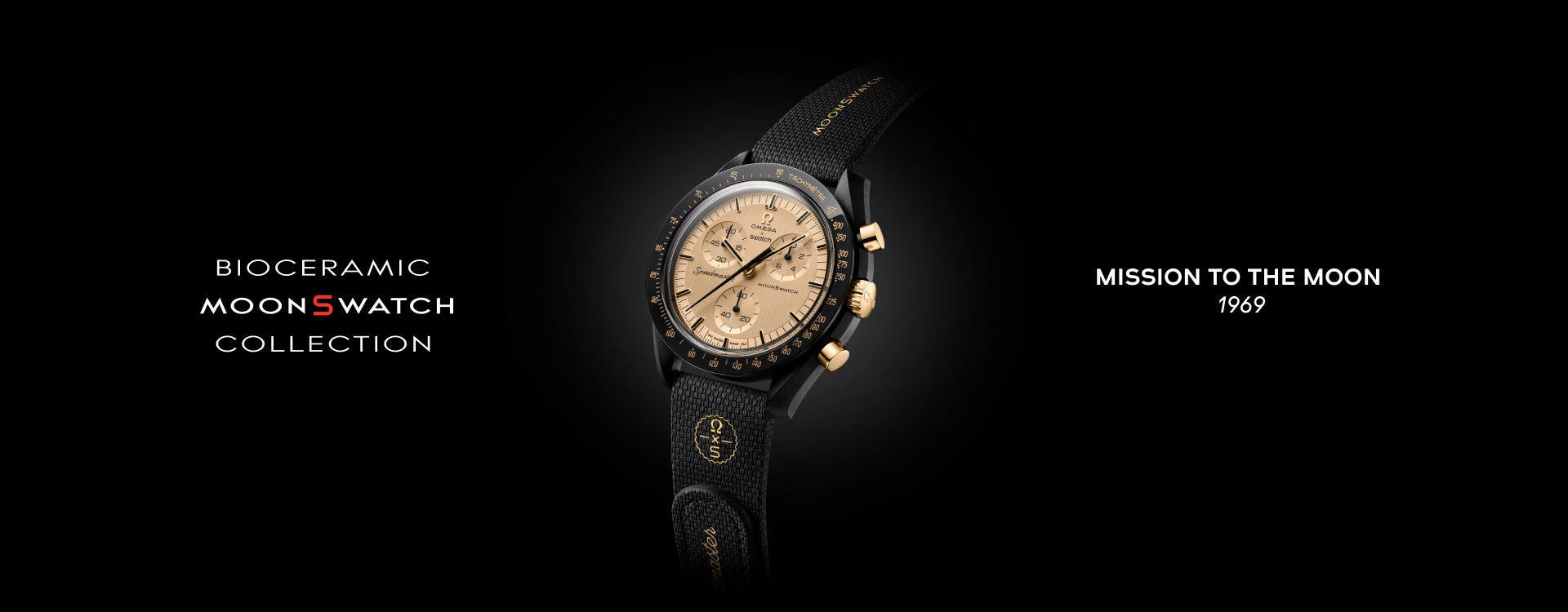
That brings us to Swatch. On 16 July, at 15:32 CEST (which is 13:32 UTC - the moment Apollo 11 left the pad in 1969 - apparently they did that on purpose!), Swatch opened applications for the MoonSwatch Mission to the Moon 1969. The watch is limited to 1,969 individually numbered pieces. The dial, hour and minute hands, crown, and chronograph pushers are all in Omega’s 18K Moonshine Gold. They use a total of 11 grams of gold, the dial is stamped Au750 and also marked “OM” for or massif (i.e., solid gold, which is a designation Omega has used on and off since the 1950s). The watch costs €600, £520, CHF 500, or US$570 excluding tax.
Gold is at €112.94 per gram as I type this. Basic maths tells us that the metal alone is worth more than the watch at retail. Has the team at Swatch forgotten how to do basic maths?
Not so basic maths
Firstly, “11 grams of 18K gold” is not 11 grams of gold. 18-karat is 750 parts per thousand pure, which just means three-quarters gold and one-quarter other metals for hardness and colour. So 11 g of 18K alloy contains maybe 8.25 g of fine gold.
At €112.94/g that’s €932 of gold in a €600 watch which is roughly 1.5x the sticker price. Across the full batch they will use 1,969 × 8.25 g = 16.24 kg of fine gold, or 522 troy ounces, or about 1.3 London Good Delivery bars - melted down and used for gold parts. The metal value at spot is therefore around €1.8m. To add some whimsy to the story, Swatch is said to have priced the gold at its 1969 value… their claim is that 11 g of 18K gold cost $11 in 1969.
Is that right? Well, sort of. There were two gold prices in 1969. The official one, propped up by central banks, was $35/oz. The free market one, after the London Gold Pool collapsed in March 1968, was around $41.76/oz that July. Looking at all four combinations:
11 g fine at the official price: $12.38.
8.25 g fine at the official price: $9.28.
11 g fine at the free-market price: $14.77.
8.25 g fine at the free-market price: $11.08.
As you can see, only one of them is $11 - which links the story nicely to Apollo 11. Swatch needed the free-market fix and the alloy conversion to get to this number. It seems that somewhere in Biel there was a person whose job was to find a gold price that produced the number 11, and they found one.
Nominative determinism for commodity markets... Sure!
Money you can’t have
“Fine,” you say, “so I buy it for €600 and I’ve got €932 of gold. Free money.” Not so fast!
You do not have €932 of gold. What you have is a gold dial with black-lacquered bevelled indices, two pushers, a crown, and two hands, all of which have to be extracted from a bioceramic case, weighed, assayed, and then refined. A refiner pays 90-something percent of spot on clean scrap, minus a lot fee; and by the way, this is not clean scrap at all. So okay, call it €800 ‘recoverable’ if you’re organised and lucky, but you will have destroyed a numbered limited edition that the market will happily pay four figures for, intact. My point is, the melt value is technically a real thing, but I’d argue it’s also just theoretical; how’s that for a sentence you could carve above the door of the whole watch industry?
That €332 value gap does write headlines, though. So many press releases talked about this gold value gap because that is the story - and if you think about it, it’s the only part of the product that a person who has never even heard of a Speedmaster can immediately understand. Gold is expensive. The watch is cheaper than gold. Weird!
Buy it now.
Two P&Ls
A standard MoonSwatch retails at €230 and Morgan Stanley pegged the gross margin at roughly 90% - this implies a bill of materials somewhere near €23 (quartz chrono, bioceramic case, garbage strap, box). If you add in some gold fabrication (casting the recycled alloy, stamping and brushing a dial, machining a crown and two pushers, hallmarking, individual numbering, certificate, etc) let’s call it €85 all-in per watch before you count any metal. That number is indeed made up, so bear with me (or scale everything to your beliefs).
Scenario A. Assume the gold is free. Well, it kind of is. The metal came from Omega spare parts dating to the 1960s and 70s; this stuff was sitting in Biel, and got recast in Swatch’s own foundry. It’s basically inventory so old that it has almost certainly been depreciated down to zero many years ago. Under that treatment, €600 minus 21% VAT is €496 of net revenue, minus €85 of cost, times 1,969 pieces. That gives them €809,000 of profit on paper, for a watch that supposedly “loses money on the metal.”
Scenario B. Gold is worth what gold is worth. Logically, this tracks more sensibly; Swatch Group could have just sold those ounces on Thursday. It’s clearly an opportunity cost of €1.83m, and now they’re facing a loss of ~€1m.
Which is the real number? I guess it’s both! The accountants get Scenario A and the CFO gets Scenario B… and if you have ever wondered how “profitable” and “value-destroying” can refer to the same activity, I present to you Exhibit A: a bioceramic example which you can strap to your wrist.
Why though?
“But this is a daft move,” you object. “They could just make 1,969 gold-dial MoonSwatches, charge €1,200, sell out in nine seconds, bank the money. There are plenty of idiots who would pay that.”
I would agree… there are! At €1,200 the maths tells us it’s nearly €1m more than they will make as it stands. That difference is the more appropriate measure of the marketing spend i.e., ~€1m of profit that Swatch seems to have thrown in the bin.
But what’s a million bucks anyway? Swatch Group did over CHF 6bn of net sales in 2025 with CHF 135m of operating profit, a 2.1% margin, down from CHF 304m the year before. Net profit was CHF 25m, down 89%. So the forgone contribution here is under 1% of group operating profit and 0.015% of revenue. It is, for our purposes, nothing. Frankly, it’s a rounding error with a great story.
And for that rounding error they got… the attention of the entire watch press inside 24 hours and even a new database. I just think that at €1,200 nobody would write excited headlines… then they’d just be another brand doing a limited edition and be accused of cash-grabbing. Having the appearance of ‘free money’ is the press release. You can’t have the money and the exciting story. Swatch chose the story, and given that the story is the only thing that’s worked for them since the first MoonSwatch, I’d have taken it too.
Underlying story
I think this goes beyond even the gold itself. Swatch has a distribution problem it has failed to solve since the first MoonSwatch. In March 2022 there were queues from Ginza to Times Square, one-per-person rules, and flippers making $2,400 against $260 retail. Fast forward to May this year and we saw with the Royal Pop, police were using tear gas in Paris, pepper spray at Roosevelt Field, and stores got shuttered in Mumbai and Singapore, with at least one arrest in Manhattan. A full set of these pops was clearing north of $25,000 on StockX before most buyers had packed up their tents on the pavements. And this was followed by a 72% resale collapse within about 48 hours. Great pictures. Terrible pictures.
So for this 1969 edition they launched this new ESTA thing (Electronic Swatch Timepiece Application). You create a Swatch account, nominate the boutique you’d collect from, and answer 32 questions (!) in two hours and fifteen minutes. The questions are a mix of Swatch history, spaceflight trivia, and some that are just… odd1. Then apparently an internal jury selects 1,969 from the pool of people who answered everything correctly. Selected applicants get 48 hours to pay online and must collect in person with ID and a printed approval.
Will this stop flippers? Obviously not. A professional reseller with a VPN, a spreadsheet of different accounts, and a large language model could get through the 32 questions faster than you could clear your inbox. The 135-minute limit is a gag anyway, it doesn’t take that long.
What this ESTA does stop is casual buyers. And what it also does is move the rationing from price, to something that isn’t price. Swatch is now trying to stop selling to whoever turns up first, and instead, they are picking.
This is like an authorised dealer’s internal list. Rolex spent the better part of a century building a global dealer network to do exactly this, and the collector world has spent the last decade furious about it. Swatch built one in a web form, over five days, and got everyone’s email address, store preference, and short-answer essays thrown in for bants.
Bourdieu would have enjoyed this. The barrier to entry moved off money, where it hadn’t worked (‘everybody can find €600 to double’), and leaned into cultural capital - do you know what Beat Time is, and would you spend your valuable time proving it? It’s basically an audition. Looks to me like a company that has spent four years being unable to tell its customers apart from its arbitrageurs has now found a filter that costs very little to implement.
I have no idea how many people applied, but we could look at this from a customer-acquisition cost perspective… 100,000 applicants, Scenario B’s €1m loss works out at €10 per completed, timed, 32-question, store-selected first-party record. At 250,000 it’s €4. Either of those are numbers a performance marketer would faint at. (Whether Swatch can lawfully do much with the data is a separate question with a GDPR-linked answer, and I’m not a lawyer; not legal advice, obviously.)
Anyway…
Nobody who wins the ballot will be melting this watch. Not one of the 1,969 will be melted for the money - in my opinion it will remain more valuable as an intact watch anyway.
Which of course means the 8.25 grams isn’t a store of value at all. It’s simply collateral for the story. Swatch used real Bloomberg-checkable metal so that you’ll believe the romance about 1969. The bottom line is that this is the most transparent hype product Swatch has ever made, because for once the gap between what you pay and what you get is literally printed on the dial and quoted on a Bloomberg screen. Swatch spent about a million euros of ‘forgone profit’ and for that money, they got a customer list, a slot in the global news cycle, and a new allocation system. Access turns out to have better margins than watches…
Cheap, at 8.25 grams a head, don’t you think?
We’ve just covered how a company can spend about a million bucks buying itself a story, and get a bargain on it. To me, this raised the obvious next question: if a story can be bought cheaply in this industry, who exactly is paid to check the stories?